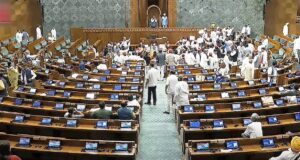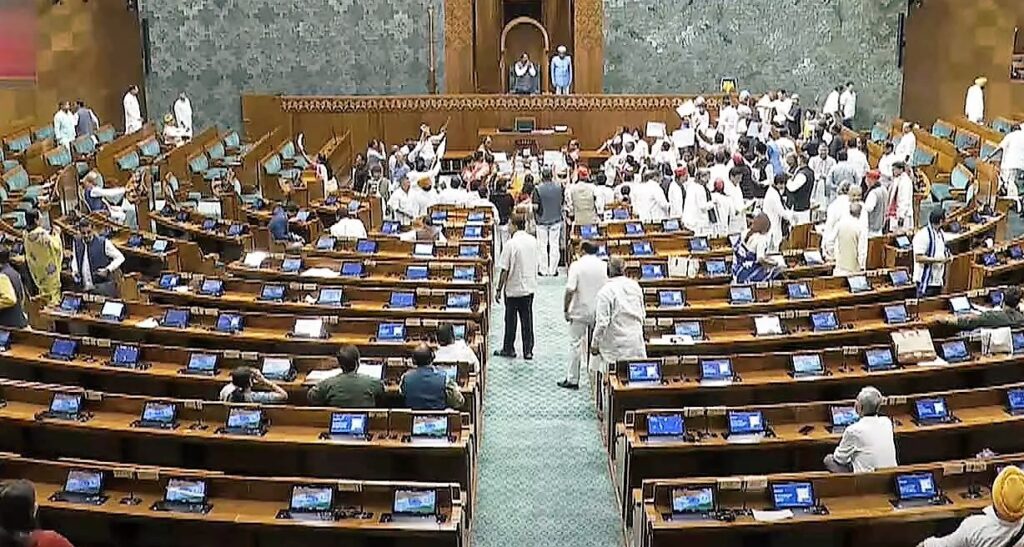
Representitive Pic. Courtesy: Sansad TV
For a few decades now, the Parliament in India has come to be seen as a “place for protest.” Political parties that have achieved moral high ground on this matter are nowhere to be seen. No matter what the issue is, the tactic of drawing attention by disrupting proceedings has become unremitting.
There is always some “controversial” issue around, or one can easily be created and imagined. Our political sphere has reached a point where creating a ruckus over it is considered a true democratic right.
This situation has become normal for both the people and the media. News items like “Massive uproar in the house, session adjourned” have become routine. This is an era where the expectation—“Let’s see over which issue there will be chaos this time”—has become normalized every time a parliamentary session begins.
Universal elections were held in 1951–52, and a new, full-fledged Parliament came into existence in May 1952. The first session of the new Parliament commenced on May 13. In the 1950s, the house sat for an average of 127 days a year; now it has dropped to fewer than 70 days.
In the 1950s, the atmosphere inside the Indian Parliament was different. Back then, there was no notion of “washing out” the entire duration of a session. Most members came prepared to speak having studied the subjects. Looking at the records of old parliamentary proceedings shows what the quality of discussions used to be. Today, it is uncertain how many members use the parliamentary library.
Long ago, a “walkout” used to be major news. Even though proceedings could continue if someone walked out of the house, it lacked grace. It carried the shadow of something lost that could not be preserved. That much was enough to register a protest and dissent.
Gradually, politicians grew thicker skins. No matter who walked out, the sessions continued “unfazed.” During the Emergency, a situation even arose where there were no opposition parties at all. After the Emergency, new tactics and new “tricks” gradually came to the fore. Slowly, the feeling grew that mere walkouts were not enough. Walkouts served no purpose; discussions on topics unpalatable to them continued, and bills were passed in their absence. Therefore, the opinion intensified that the right tactic was to scream, scratch, and obstruct the house from functioning altogether.
The Historical Parallel: Liberum Veto
The origin of such an opinion and where it came from is a subject of curious study. Many types of experiments have taken place and are still taking place in the history of world parliaments:
- Filibuster: A strange legal disarray that halts the lawmaking process through ridiculous tactics like endless unnecessary discussions and slow-paced proceedings.
- Liberum Veto: A special power exercised arbitrarily under which any member could immediately and abruptly halt the proceedings of the house.
Various such experiments have been carried out in the name of democracy. It is a necessity of the hour to thoroughly study all systems and disarray, and learn lessons suited to our current times and circumstances.
There was once a disorder in Europe that closely resembles our country’s current parliamentary behavior. Its name was “Liberum Veto.” Let us pay some attention to it.
During the 16th to 18th centuries, the Liberum Veto was in force in the Polish–Lithuanian Commonwealth government. Back then, those who became members of the legislature (the Sejm) were influential and wealthy (a similar situation has now arisen in our country and many others, where the notion that “there is no politics without funding” has taken deep roots everywhere). The Sejm of that time was shaped around the notion: “Since everyone is a wealthy and influential member, there should be no discrimination among them; the house must treat everyone equally and respectfully; no one’s opinion should be dismissed even slightly; every single person’s word must carry weight in the house, and the house must appease everyone.”
The Liberum Veto disorder was shaped precisely according to that concept.
How the Veto Destroyed a Legislature
Superficially, this concept looks like a lofty ideal. It is true that the house should respect everyone equally. But how can everyone’s word prevail? That is where the trouble began. The stance that no one’s opinion could be sidelined turned out to be a major obstacle to the lawmaking process. No law could be passed without the “unanimous consent” of all members. Many new bills fell through without being passed. Serious discussions in the house became rare.
Among most influential members, an egoistic arrogance grew: “Why should I listen to what they say? Let them accept my opinion instead.” Sessions turned into brawls. Under the name of Liberum Veto, members were given the power to veto everything. Taking advantage of this, many began vetoing and overturning bills that had already received the approval of the house. Under this disorder, even bills that had already been passed could be rescinded.
All it took was for a single member to make up his mind, and he could easily obstruct the legislative process. Even if just one member stood up and simply shouted, “I oppose this; I will not allow it,” that bill would fall through!
Gradually, under that disorder, many Sejm members became deeply corrupt. It became a habit for members to obstruct house proceedings and overturn bills, inspired by foreign powers. Over the commonwealth’s roughly two-century history, more bills were rejected and proceedings halted through the Liberum Veto than laws actually passed by the Sejm. The entire parliamentary process became paralyzed and inactive, eventually leading to the partition of the commonwealth. Today in Europe, “Polish parliament” is a negative term, much like “balkanization.”
The Present Danger in India
Worry haunts us as to whether India, knowingly or unknowingly, is sliding toward such a bizarre situation. Our thinking is changing to the extent that we believe actions like shouting, screaming, roaring, barging in, pulling, rolling on the floor, and fighting inside the house constitute “democracy.”
There is no consensus between the government and the opposition regarding what the subject of discussion in proceedings should be. They do not listen to what each other says. Whatever the issue may be, looking at the ways our public representatives express their opposition makes one anxious about the political future of the country. If children and students understand it this way—“This is what the parliamentary system is. This is how it is, and how it is supposed to be. This is the correct form of democracy”—what will be the course of the country’s future?
Does it make any scene if the Speaker pleading, “Please go back to your respective seats and grace your august designated place,” to members who rush past their seats? Why do Speakers not take immediate disciplinary action against members displaying brute force?
It is true that presiding officers should manage the house skillfully, impartially, and treat everyone equally. There is nothing wrong with governments respecting the opinions of the opposition and discussing subjects of their choice. But what if the preconceived notion that “This time the house must not be allowed to run” is too strong in someone?
Time for Reform
In recent decades, the number of wealthy members has increased. Ticket distribution based on caste has intensified. The entry of individuals facing criminal charges into Parliament has gone up. The camaraderie between politicians and criminals, and individuals facing criminal charges engaging in politics—all of this has been deeply rooted in our country for a long time.
The quality of our parliamentary sessions is not satisfactory. Discussions are not taking place freely. Ruckus has become a common sight, and disturbances have increased since the live television broadcasting of proceedings began. It is as if they are trying to make someone believe that raising slogans and creating ruckus inside the house is what “democratic struggle” means.
Informative speeches, honest analysis of issues, fair criticism, alternative policy suggestions and the patience to listen to what others have to say have decreased considerably among both the ruling and opposition parties.
One can observe that the mindset of most parties and members has grown identical in many respects. The question arises: does perhaps no one want a strict system devoid of chaos? No one shows enthusiasm for subjecting the current system to reforms to create a stricter, more decent system. The suspicion arises whether a “foresight” has taken root in the ruling parties: “If governments of other parties come to power in the future, we should also have the opportunity to create a ruckus then.” Whether a mindset akin to Sejm membership and the Liberum Veto is unknowingly growing is a question that needs pondering.
It is a worrying development that the Parliament has reached a point of destroying proceedings (washout) instead of walking out (walkout). There are numerous instances where the BJP and others obstructed proceedings when a Congress-led government was in power, and the Congress and others are doing the same when a BJP government is in power. How long must this vicious cycle continue?
Is a situation where the house can be run peacefully for 120–130 days a year going to remain merely a dream from now on?
Our houses must not become like the Liberum Veto of the Polish-Lithuanian Commonwealth, should they?
If we do not give a sacred priority to our parliamentary proceedings and establish proper order through sound reforms, there is a fear that India’s parliamentary bodies will slip into permanent inactivity.
Author