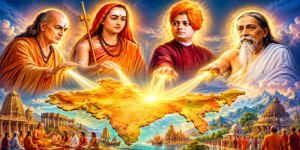
Bharat, and through it the world, attained an understanding of this world and the hereafter, becoming civilized and enlightened due to the hard work of many Sanatan sages. At a certain phase along this path, the notion that “causes and effects operate by themselves, and there is no need for a dispenser of fruits, the Supreme Lord,” took root in the minds of some. Similarly, the idea that “the Supreme Lord is a supreme ‘person’; His form with attributes and a visible form is His ultimate state” also took root. Amidst these, the doctrine of ‘Shunyatva’ (Voidness/Nihilism) was also propounded.
None of the proponents of Shunyavada have ever provided a reasonable answer as to how a voidness devoid of any causative energy became the cause of creation. Why did that driving force exist in an unmanifest seed-form? Shunyavadis do not ask whether its manifestation was merely accidental or if another causative energy was necessary that planned a pre-determination for it to manifest. If any Shunyavadi is unwilling to honestly find answers to such crucial questions, Shunyavada must be regarded as a concept with limitations.
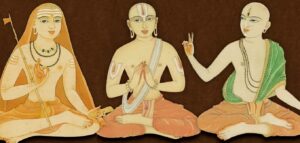
Sri Adi Shankaracharya strongly rejected Shunyatva and called out, “Bhaja Govindam Moodha Mate” (Worship the Lord Govind, O foolish-minded one). The commentary he wrote on the Bhagavad Gita is the most ancient commentary available to date. In it, he propounded that “Vasudeva Narayana is the Supreme Lord” and provided a firm foundation for Bhakti. Consequently, in the post-Shankara era, Bhakti Yoga shone brilliantly.
Even for those who have realized the Ultimate Truth (Paratattva), it is impossible to explain it to another through language. If someone asks, “What does sweet taste like?”, no matter how much one describes it through language, the experience of sweetness is not conveyed to the listener. Therefore, most disputes arose over the very subject of the Ultimate Truth. Over time, errors occurred in reflecting the views of the ancients.
Sri Krishna has explained both the Unmanifest principle (Avyakta Tattva) and the even greater Imperishable principle (Akshara Tattva) in the Bhagavad Gita. After explaining everything, He states that He is the Supreme Lord, superior to both the unmanifest and the imperishable principles. Most spiritual aspirants have been unable to grasp this fundamental principle of the Lord, which is superior even to the Shunya, because His personal grace (anugraha) is indispensable for it.
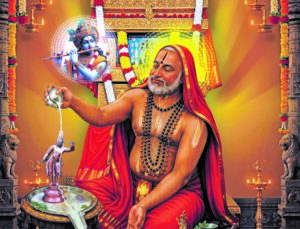
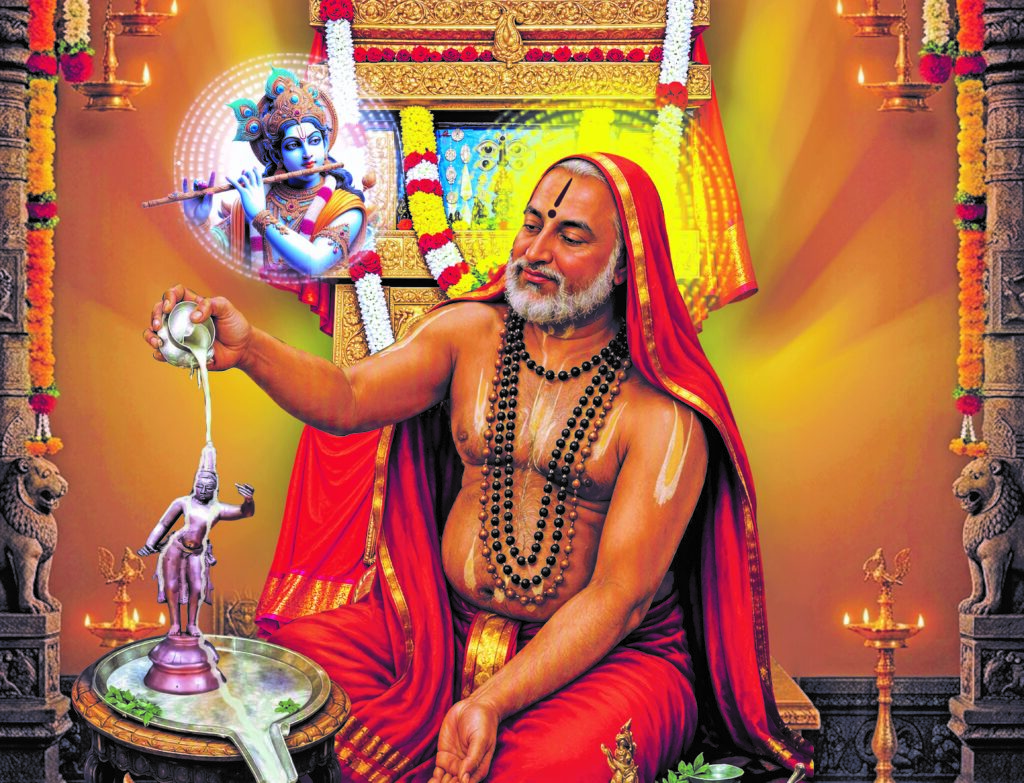
The easily graspable philosophy came to the fore that leaving the Ultimate Truth to the highest Jnanayogis, the rest should take refuge in the ‘Saguna‘ truth (the Lord with attributes) that is easily accessible to them, and through it progress toward the Ultimate Truth—and that at all these stages, the grace of the Lord is an absolute necessity. The core of Sri Madhvacharya’s Bhakti Yoga is that no matter how much knowledge is attained, liberation (moksha) cannot be achieved without the ultimate grace of the Lord. Rejecting Shunyavada, bringing back the clarity that Bhakti Yoga is Jnana Yoga and Jnana Yoga is Bhakti Yoga into the main stream was his greatest contribution. Walking steadfastly on this path, Sri Guru Raghavendra Teertha Mahaswami is a great historical practitioner of Bhakti Yoga.
Bhakti Yoga saved Bharat. Through the tradition of devotees, the Sanatana glory came to the forefront. Festivals and celebrations acquired a new luster. Life gained a lively vibrancy. In the dimension where Sri Shankara’s “Bhaja Govindam…” and Sri Raghavendra’s “Indu Enage Govinda…” converged, a brilliant radiance of Bhakti Yoga emerged.
Although the Tapasvi whom people affectionately and respectfully call ‘Rayaru’—Sri Raghavendra Teertha—had expounded upon philosophical distinctions (such as Taratamya Jnana) at a doctrinal level, there is no discrimination in his compassion for living beings. He is a Guru to people of all faiths. He is a tapasvi who bestows grace upon all. His compassion for living beings is akin to Sri Krishna’s ideal of “Sarvabhootha Hita” (the welfare of all beings).
No child loves its mother by considering her philosophical theories and ideologies. Similarly, devotees regard the Guru—who occupies a position analogous to maternal compassion and maternal love—just like a mother. Just as a mother does not love her child by analyzing its train of thoughts, Gurus with a mother’s heart do not differentiate among his devotees and bless everyone equally. Rayaru is one who attained such a supreme state. He is not merely revered within the tradition of a single matha, but is revered in the hearts of the entire Sanatana populace. He is adored by people of all jatis and communities. Just as those who foster dogmatism and engage in arguments need Rayaru, innocent devotees who have no desire to understand the basis or value of philosophies also need him. Wise devotees who know everything need him, too. There is no one who does not remember him with devotion. That is his greatness.
Author