After the lineage of the rishis faded away, the concept of moksha (liberation) in the Kali Yuga was reduced to the confines of theoretical texts. Amid the grand spectacle of condemnation, denunciation, and triumphal conquests (digvijaya), true spirituality has been lost. Adherence to a doctrine has come to be viewed as more important than personal penance (tapas). The ancient wisdom that “spirituality is not a collective, communal exercise or an external battle; rather, it is an internal process of the individual, a path of renunciation where all attachments are abandoned” has vanished. In the name of philosophy, organizational factionalism, marketing, and intense emotional polarization of likes and dislikes stand out prominently. The path of retirement and renunciation is transforming into an overly intense path of worldly engagement.
In the Sanatana tradition, the guru holds an exalted position. Only those who have attained liberation can show others the path to attain it (and only show it); you must experience liberation yourself. How? Through good deeds, knowledge, awareness, experience, the guru’s guidance, and the grace of the Supreme—this is the ancient stance of the rishi tradition.
That was the age of the rishis. Back then, conflicts, quarrels, and battles among the disciples and followers of various rishis were rare. Even though diverse opinions existed, there was no factionalism or religious fanaticism. The era of the “triumphal tours” of refutation and establishment had not yet begun. Most of the rishis attained knowledge through their own internal penance. Even when they received guidance from deities or senior rishis, they forged their own path to knowledge in solitude.
During the Kali Yuga, the lineage of the rishis came to an end. Non-Vedic traditions such as Buddhism and Jainism came to the fore. Within Vedanta itself, countless sectarian differences sprouted—Advaita, Vishishtadvaita, Dvaita, Shuddhadvaita, and Dvaitadvaita. Among the people, the personal dedication to seeking the truth independently diminished. The notion began to grow that simply following pre-packaged doctrines was the essence of the “spiritual process.” Permanent labels like “our doctrine” and “their doctrine” took root. Debate, conflict, and logic became paramount, and an era began where defeating others took precedence over attaining one’s own liberation. What moksha actually meant became a matter of fierce debate.
The ancient wisdom that “spirituality is not a collective, communal exercise or an external battle; rather, it is an internal process of the individual, a path of renunciation where all attachments are abandoned” has vanished. In the name of philosophy, organizational factionalism, marketing, and intense emotional polarization of likes and dislikes stand out prominently.
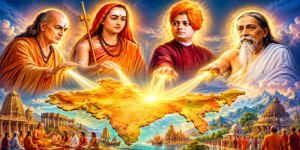
During the era of Buddhist thought, the ancient knowledge of the rishis—that national dharma, raja dharma, social dharma, and community dharma are universal, whereas spirituality is a personal dimension—was lost. The contrasting concept that “dharma is personal, while spirituality is universal” began to grow. Diplomatic and strategic thoughts failed to receive the importance they deserved. From the time of Acharya Chanakya until the time of Swami Vivekananda, this deficiency plagued India, and it continues to do so today.
While verbal battles over moksha were taking place in India, foreign religions that engaged in real wars and mass slaughters were born abroad. Demonic ideologies came to the fore where the obsessive fanaticism of forcibly dragging others onto their path superseded the pursuit of one’s own liberation.
The influence of foreign religious aggressors eventually impacted Indian thought as well, though not in the way it should have. The strategic realization that the only way to escape the onslaught of foreign conversions was to engage in counter-conversions did not emerge (such thoughts arose for the first time during the era of Swami Dayananda Saraswati). The militant zeal that should have been directed toward the religious and societal sphere was instead directed inward into the spiritual sphere. Abandoning foreigners, the enthusiasm to outdo one another on the subject of liberation grew among the Sanatanis themselves. The realization that there is no liberation without righteous conduct (dharma) faded into the background. At a time when people had become extroverted, the advocacy for inward-looking visions intensified.
Driven by the belief that dharma is purely a personal matter, individual rituals aimed at attaining heaven—such as yajnas, homas, and ritual feasts—increased. Social consciousness and the concept of the nation faded away. During this time, Adi Shankaracharya attempted to solve the problem by accomplishing two things. First, he composed texts teaching methods to attain spiritual elevation at an individual level rather than focusing on the allure of heaven. Simultaneously, he established numerous temples and mutts (mathas), giving a systematic form to study, teaching, practice, and philosophical inquiry. He traveled across the country, ensuring the preservation of the Vedas, Vedanta, and all sacred treatises. This helped foster a collective awakening. In that era lacking mass media, contemporary documentation of all his works is scarce, but the sheer scale of his monumental efforts can be deduced from traditional records and his works’ subsequent impacts.
Then, another problem arose. Shankaracharya’s massive contributions were forgotten, and people continued to raise disputes centered solely around his texts on liberation. Later scholars began to misrepresent Shankara’s stances. The immense work Shankara had done in the religious and national defense spheres was not properly understood until the time of Swami Vivekananda. The narrative went off track. Romanticized stories of whom Shankara defeated in debates were invented. Later, as a counter to the “Vijayas” of Shankara, texts like “Madhva Vijaya” and other sectarian triumphs came to the fore.
A pure and accurate presentation of what Shankara’s actual spiritual stance was, did not happen until very recent times. Swami Sachchidanandendra Saraswati of the Adhyatma Prakasha Karyalaya shed considerable light on this matter. On the religious and social realities of those times, S.L. Bharappa’s novel Sartha has brought some perspective to the forefront.
In short, the post-Shankara era turned moksha once again into the primary domain. Replacing the gentle, serene disposition of the rishis’ era, a passionate, aggressive zeal (rajasic enthusiasm) emerged in the spiritual domain, surpassing even the political arena. Ashrams and mutts became entirely centered around the charisma of gurus and swamijis. People developed the sentiment that devotion to the guru is greater than devotion to God. Exactly the same thing happened in organized religions: the core rule of all organized religions is the belief that their founder alone is supreme and forever unquestionable. Both serene righteousness (satvik dharma) and true spirituality are absent in them. Their lifeblood consists of worldly rules, political dimensions, and dogmas that are easy to follow rather than profound philosophical contemplation.
A similar simplified sentiment took root in India as well. This was the background from which the new notion—“Mukti cannot be attained until you become a slave to the guru”—emerged. The assertion grew strong that what was once an internal process in ancient times now indispensably required the institutional backing of an external system. Interpretations evolved: “Becoming a slave to the guru means becoming a slave to the guru of ‘our own tradition,’ not a slave to every guru!” The ancient Indian tradition where all rishis were respected was forgotten, and the “regimentation” of respective gurus began.
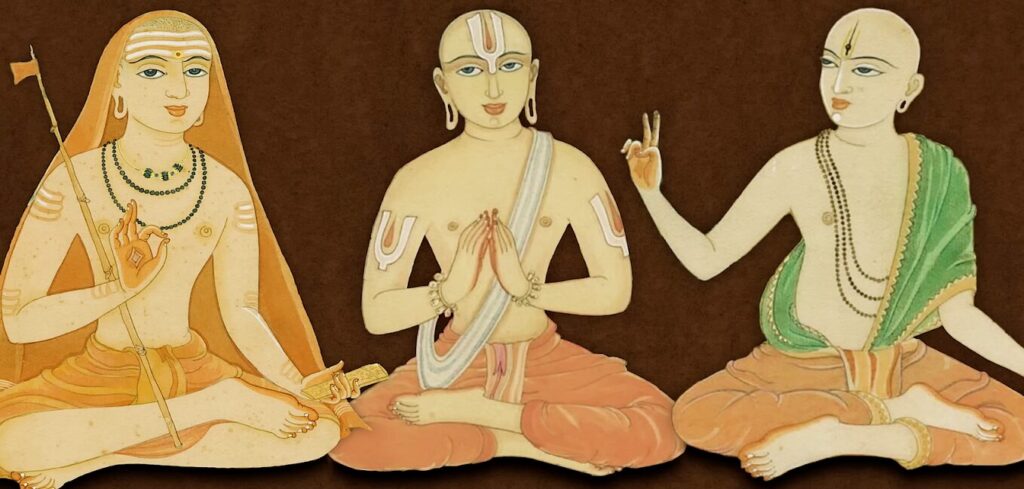
Although there are numerous lineages of acharyas, Shankaracharya, Ramanujacharya, and Madhvacharya are prominently recognized as the foundational trio (Acharyatraya). There are both similarities and differences in the teachings of these three. All three are equally worthy of respect. The Indian worldview is not that a single idea must rule the world.
During this period spanning several centuries, the disciples and followers of various gurus and acharyas even resorted to street brawls! Ridiculous squabbles broke out, with each side claiming, “The path to liberation taught by our guru is the only correct one, not what your guru taught.” Honest, sincere inquiry was pushed into the background.
Countless wars have been fought in the world over concepts like liberation, the afterlife, heaven, and hell. Abrahamic religions have rivers of blood. Once their era began, a flood of mutual insults began to flow even within India’s Sanatana tradition. The street brawls among the disciples of various acharyas reached the heavens.
Although there are numerous lineages of acharyas, Shankaracharya, Ramanujacharya, and Madhvacharya are prominently recognized as the foundational trio (Acharyatraya). There are both similarities and differences in the teachings of these three. All three are equally worthy of respect. The Indian worldview is not that a single idea must rule the world. Three scientists in a scientific institution can research the same subject from three different perspectives; we should view all acharyas in the same light. If we start viewing or proclaiming any one of them as the absolute and final word, fundamentalist problems and riots are created. That has happened in India, and it still happens in places today.
Many of those who fight in this manner do not actually want liberation! They are not willing to sacrifice anything for liberation, nor any of the comforts of their lives. They simply want their guru to win, period. In other words, the foolishness typically seen in political party activists who are willing to give their lives to elevate a politician has infiltrated the spiritual arena. The wisdom of the rishis’ knowledge tradition has been forgotten.
Until the influence of Islamic and Christian thought took root in India, the notion of “becoming a slave to the guru” did not receive prominence. A strong current currently exists among us that the associated monastery, the philosophy of its founding acharya, and the grace of the current pontiff are not merely aids to liberation, but are the very definition of true liberation. Stories of the triumphal conquests (digvijaya) of their respective acharyas and examples of how they “put others in their place” bring joy to “fundamentalist devotees.” The sentiment arises: “We are blessed to be utterly loyal to such an acharya.” A fierce determination builds up to stand rock-solid for their philosophy. The regimentation mindset—“Our organization must grow stronger”—sprouts. In historical terms, the exact same psychological mindset, psychological dependence, and organizational attitude found in Islamic and Christian thought have infiltrated the Sanatana tradition as well.
Intellectual conviction is not wrong. However, history shows us examples of how, at a collective level, it frequently reaches dangerous stages. Even today, people’s fundamentalist convictions are the root cause of religious conflicts. At an individual level, all sincere convictions are fine. But at a collective level, the division between a group of believers and a group of others creates “organized hatred.” Society and the country split into two: “those who believe” and “those who don’t.” People who have no personal understanding of what liberation actually is begin to fight on the streets in the name of various liberation doctrines. The sentiment hardens: “We must defeat the liberation doctrines of others.” This is the danger brought by blind faith. Much like Semitic religions, India has witnessed the “organizational” presentation, condemnation, and “triumph” of liberation concepts, creating deep internal fractures.
The followers of all acharyas have stopped thinking independently and have been reduced solely to propagating their own guru’s doctrine. The argument has deeply rooted itself: “Everything that needed to be said has already been said. ‘Our guru’ has explained everything. Now, all that remains is the literal adherence to the guru’s word. Nothing new remains to be understood.”
Social media warriors have now acquired the kind of “absolute certainty” that even the rishis of the Nasadiya Sukta in the Rigveda did not possess! Even when the Lord Himself says, “Do as you wish,” we refuse to do so. We refuse to let go of the mentality: “Do not ruin yourselves by believing false doctrines.”
Author