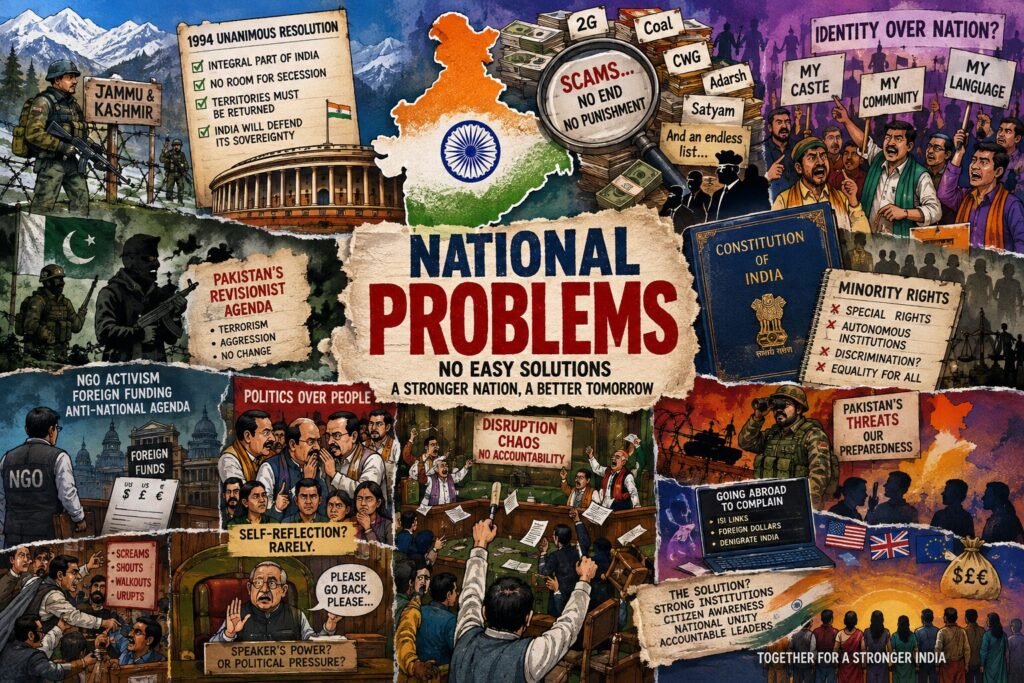
In 1993–94, the BJP was keen to table a resolution in Parliament officially declaring the integral nature of Jammu and Kashmir and explicitly stating that there is no room for secessionist sentiments. However, the then Prime Minister (of the Congress government), P. V. Narasimha Rao, suggested: “A resolution on a matter of such national importance should not come from any single party. It must emerge as the official resolution of the entire country.” Accordingly, the resolution was moved through the then Speaker of the Lok Sabha. On February 22, 1994, the entire Lok Sabha unanimously—yes, unanimously, cutting across party lines—passed this resolution. It was an official resolution, and a unanimous one. It was not a resolution adopted merely in the name of the people of Kashmir. The resolution explicitly stated: “This is a resolution adopted on behalf of all the people of India (including Jammu and Kashmir).” It strongly condemned Pakistan’s acts of terrorism. The resolution clarified the following three main points:
- The entirety of Jammu and Kashmir was, is, and shall forever remain an integral part of India. All possible measures will be taken to prevent any attempts to separate this state from the country.
- India has the willpower and capability to counter and crush all viewpoints and activities directed against India’s sovereignty, territorial integrity, and unity.
- Pakistan must return to India the territories of Jammu and Kashmir that it has occupied through aggression.
This was the unanimous opinion of all the people of the country and of Parliament, which is their representative assembly. It simply means: “Undivided Jammu and Kashmir is a territory that equally belongs to every citizen of the entire country.” However, Pakistan-occupied territories have not yet come under India’s control.
Leaders of the current government often bring up the scams of previous governments. But how many wrongdoers have been punished? Consider a few samples: Bihar flood relief scam, Oil-for-Food scam, IPO scam, Taj Housing Scheme scam, Scorpene deal scam, Naval war room spy ring scam, Uttar Pradesh Ayurveda scam, Punjab City Centre project scam, Kerala ice cream parlor scam, Paaza forex scam, Haryana teachers recruitment scam, Jharkhand medical equipment procurement scam, Army ration scam, State Bank of Saurashtra scam, Satyam Computers scam, Hasan Ali black money scam, Cash-for-votes scam, Gujarat sugarcane scam, Astral Coke scam, Vasundhara Raje land scam, Sukhna land scam, Odisha paddy scam, Odisha mining scam, Rice export scam, Goa SEZ scam, Madhu Koda mining scam, 2G spectrum scam, Adarsh Housing Society scam, Commonwealth Games scam, Uttar Pradesh food grain scam, Assam North Cachar Hills scam, Arunachal Pradesh PDS scam, LIC housing loan scam, Karnataka land scam, Karnataka Housing Board scam, Karnataka mining scam, Goa mining scam, MGNREGA scams in various states, PDS scams in various states, Tatra truck scam, Mumbai sales tax scam, Kerala investment scam, Pune housing scam, BBMP fund scam, Ballari mining scam, Himachal Pradesh housing scam, ISRO S-band scam, Uttar Pradesh NRHM scam, Aadhaar scam, Coal block allocation scam, Karnataka Waqf property scam, Andhra land scam, Service tax scam — and so on. In most of these scams, the guilty have not yet been punished.
It has been a long time since people facing criminal charges started participating in politics in our country. Political sympathies began to be shown even toward terrorist forces. It reached a point where state legislative assemblies passed resolutions supporting terrorists—such as in favor of secessionist militants in Jammu and Kashmir, the LTTE in Tamil Nadu, and jihadists like Abdul Nasser Madani in Kerala. We also have people among us for whom regional, religious, and linguistic sentiments override the country and the nation’s interests. A major reason behind this is politicians inciting the public. It is a stark reality that politicians have ‘groomed’ sections of the public to suit their needs by portraying themselves as champions for whom language, caste, and region are everything and who are fighting solely for those causes. For politicians’ identity politics to stop, people’s ‘identity voting’ must stop. As long as people harbor blind partisan affections such as “he belongs to my caste,” “he speaks my language,” or “he is from my community,” identity politics will not end; instead, it may intensify further and further. Politicians do not let such sentiments fade among the people. If the entire political class sets its mind to it, it is not impossible for all citizens to live in unity. Regardless of how severe the problem of religious fundamentalism is, ordinary people in communities are not hard to win over in support of good political resolve. However, the politics of caste and religion does not allow this. This is a vicious circle, and no one has offered a solution to it.
In democratic nations, all religions are given space to exist. People have the opportunity to follow any religion in their private lives, or follow none at all and live simply by obeying the law of the land. They also have the freedom to convert from one religion to another. Given this, how did the concept of a “religious minority” come about, and where did it originate? Even though it is a Western thought, its application in the West is not the same as in India. In India, “minority rights” mean special rights possessed by religious minorities that are not available to others! There are two strange concepts here: one is the idea of “religious minorities,” and the other is that religious minorities “alone” must have special rights, while those rights “must not be available to the majority.” For example, under the concept of “minority rights” in India, autonomous educational institutions can be run without government regulation—an opportunity not available to the “majority.” In India, many legal rights (special privileges) are enjoyed by other communities that Hindus do not possess. This is official, constitutional discrimination. No political party has come forward to amend Article 30 (and other related articles) of the Constitution in this regard, nor have Hindus strongly demanded that they too be granted autonomous educational rights.
Constantly and repeatedly, the Pakistani military engages in anti-India activities and aggression. Despite failing in four direct wars—including suffering a humiliating defeat in one of them (1971) and losing its territory (East Pakistan)—the mischief of the Pakistani military has not stopped. Even though terrorism has failed to subdue India, its malicious plots continue. Strategic experts term this mindset “revisionism” or “revisionist tendency” (an obsessive compulsion to repeat actions incessantly). We require an extraordinary and comprehensive policy to manage and defeat revisionist-style forces, along with a detailed action plan. The country needs the mental fortitude and resolve to consistently pursue a unique policy, and that policy must maintain continuity even if governments change.
Many of our NGOs have still not broken out of the “Privy Council” mentality. Even Marxist NGO activists who decry the US and Britain as “imperialists” rely on those very countries when they need to go and air their grievances. They want Western dollars, pounds, and euros. Lobbying in Pakistan, filing complaints in the United States, spreading venom against the country under ISI and CIA sponsorship, denigrating our intelligence agencies and security forces, and lobbying with the backing of the brand value of notorious foreign intellectuals/pundits—all of this continues.
Do we have examples in our country where any political party, influenced by election results, engaged in self-reflection and underwent comprehensive reform? Regardless of the election, it is routine for losing parties to say: “We will sit down at leisure to discuss the reasons for our defeat. We will rectify our flaws and weaknesses and face future elections with renewed enthusiasm and unity. We are confident that the people will make us win.” What else is possible to say upon losing? Is there any instance where any party or political leader directly stated, “Yes, our conduct and ideas were bad, and the people have taught us a fitting lesson for it”?
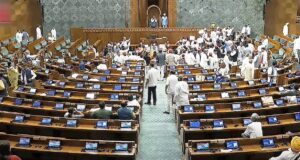
A fundamental question is whether our MLAs and MPs need the “authority” or “right” to shout, scream, roar, rush, pull, tumble, and scuffle inside the assembly hall. Every time the sessions begin, it has become routine for everyone to wonder, “On what issue will disruption break out this time?” Proceedings are perceived as if watching an exciting movie. The younger generation has yet to experience the sight of a civil assembly. Regardless of the issue, seeing the manner in which members of our legislative assemblies express their opposition causes both disgust and anxiety among the public. In the past, incidents such as pulling sarees have occurred inside assemblies. Pepper spray was even brought into the Lok Sabha and sprayed on other members. There were rumors that knives were brought in as well. Yet we did not wake up then, nor are we waking up now. All parties share the blame for the disruption of legislative proceedings.
What is the point of the Speaker pleading with members who rush out of their seats, saying, “Please go back to your respective seats and grace your esteemed podiums”? Why have no Speakers taken immediate disciplinary action against members displaying hooliganism thus far? The traditional duty of Speakers is to manage the assembly well, with skill and patience, ensuring that no member suffers injustice or disrespect. However, this does not mean allowing chaos and anarchy to thrive. If Speakers used their power to suspend members properly, impartially, and efficiently, much of the uproar would subside. Yet, since most Speakers are also members of political parties, the question arises as to how independent they truly are. It is difficult to take disciplinary action against members of one’s own party, and for fear of being labeled partisan, disciplinary action cannot be taken against members of other parties either! Consequently, pleading has become the norm. Must all of this continue this way?
Author