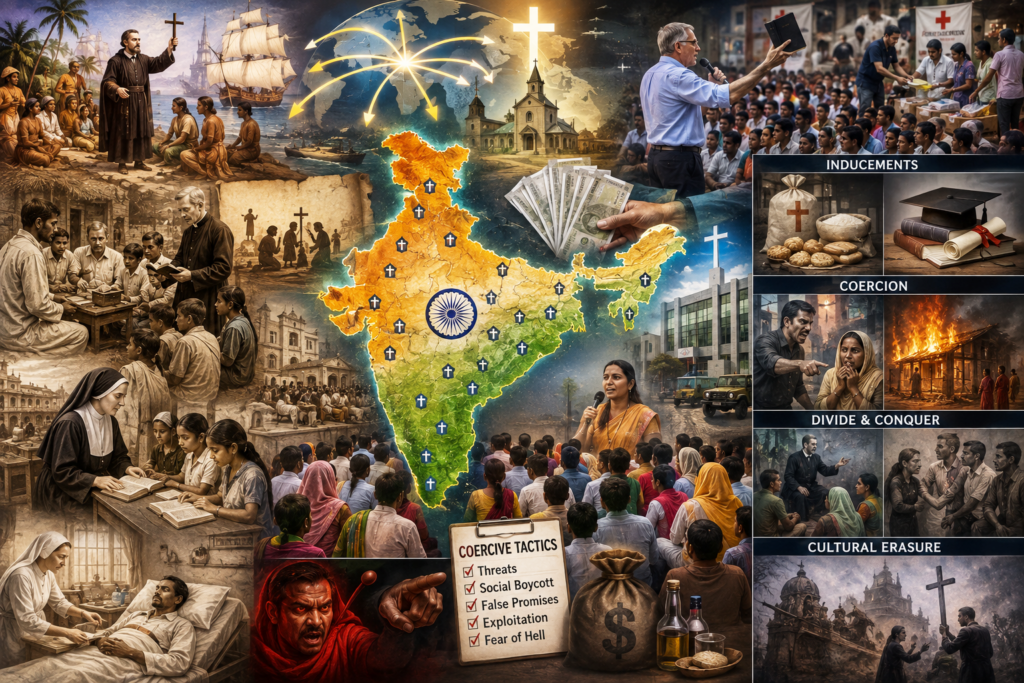
Conversion is not a problem of yesterday or today. It is not merely the problem of North Eastern States, Tamil Nadu, Punjab or Kerala. Nor is it just India’s problem; it is a global issue. No one across the entire world has ever taken conversion lightly; it has always remained a burning issue in all societies.
Without “conversion,” missionaries have no occupation; without “jihad,” there are no mujahideen who believe that “jihad” is a religious duty. Similarly missionaries believe that conversion is a biblical command and therefore their duty, which they call the “Great Commission” (Matthew 28:19).
Let this be known to you: in missionary literature, it is customary to refer to non-believers who need to be converted, as well as members under the church’s control, as “sheep”! Bringing newcomers into their “flock” is their language!
There is a difference between fundamentalist missionaries and jihadis. There are thousands of mujahideen who believe they can bring Sharia worldwide tomorrow. However, the missionaries have a systematic, long-term plan. That is why in 1999, the then Pope John Paul II issued a call that “in this coming millennium,” the cross should be planted completely across Asia and Asia brought under our embrace.
From the sword of Emperor Constantine to the Crusades waged by Popes for centuries, from the massacres carried out in various countries in the name of the Inquisition to the Second Vatican Council of the 1960s, conversion has remained a burning topic of discussion. World wars have been fought over it. It has a long, dark history, along with an “official code” such as the Vatican’s “Canon Law.”
Today, if someone who is a Brahmin were to say tomorrow, “We are Harijans,” our government itself would not accept it. According to our current “secular” governmental system, a person’s caste is permanent forever; no matter what you do, it cannot change. But their religion is not permanent—you can keep converting every single day!
Prohibition of Illegal Conversions
Christian conversion has been legally prohibited by Muslim countries such as Saudi Arabia, Pakistan, and Iran. There is also a ban on conversion in China. Do you know? Greece, a majority-Christian country, also restricts conversion! Likewise, Christian countries do not accept Muslims converting Christians. Barack Obama’s religion was a hot topic of discussion in America, and in the end, he had to get his church leaders to state that he was a Christian. In France and Spain, the conversion conflict between Islam and Christianity is still intense.
In India, too, the call against conversion is not new. Although there was no anti-conversion act in British-ruled India, kings of certain provinces had banned illegal conversions. The Raigarh State Conversion Act 1936, Patna Freedom of Religion Act 1942, Sarguja State Apostasy Act 1945, and Udaipur State Anti-Conversion Act 1946 are a few examples. Similarly, illegal conversions to Christianity were also prohibited in Bikaner, Jodhpur, Kalahandi, and Kota.
In the 1950s, when foreign missionary activities intensified to the point of threatening inter-religious harmony, the then-Congress government of Madhya Pradesh appointed an inquiry committee headed by Bhawani Shankar Niyogi, a retired Chief Justice of the Nagpur High Court. The Niyogi Committee visited more than 700 villages, interviewed 11,360 people, and conducted a very thorough investigation. It prepared a detailed questionnaire with 99 questions and obtained answers from everyone; 375 written statements were submitted to the committee. Opposing the committee, the Roman Catholic Church knocked on the doors of the High Court, but the court dismissed its petition.
The committee’s investigation confirmed that conversion attempts by foreign missionaries and the denigration of Hindu gods were taking place intensely. The activities, literature, and speeches of the missionaries were documented in detail in the committee’s report. Confirming that “hospitals and schools are being misused with the ulterior motive of conversion,” the Niyogi Committee recommended that conversions should be legally banned.
In 1954, Parliament considered the Conversion Prevention Bill and the Backward Communities Protection Act, but due to insufficient support, these bills were not passed. Although these enactments did not come into force in Parliament, laws to prevent illegal conversions came into effect in Orissa in 1967 and Madhya Pradesh in 1968. In 1978, this act also came into force in Arunachal Pradesh. Gradually, anti-conversion laws were implemented in over a dozen states across the country, out of which Congress party governments had implemented these acts in some states. However, our “secularism” still does not let these acts be properly enforced.
Proponents of conversion repeatedly ask: “If illegal conversions have taken place, why has legal action not been taken?” Their argument is that complaints have not been registered. Do they have the statistics on how many complaints have been registered in many states? If one looks for a few general details, they can be found. According to our version of secularism, missionaries are gods of this earth, whereas only the Kanchi Acharya was arrested without hesitation.
Now let us come to the matter of the Supreme Court. In 1977, the Supreme Court of India clearly declared that “no one has the right to convert any other person to their own religion.” In 2006, the Supreme Court also ordered that with regard to criminal cases related to conversion, High Courts cannot quash proceedings until the investigation is completed. This was in connection with the allegation that a pastor named Raju from Bengaluru tried to convert Hindus. The Karnataka High Court had quashed the proceedings, stating that the case was registered without prior permission from the government, but the Supreme Court ordered that the proceedings continue.
It is well known that Mahatma Gandhi explicitly stated that conversions should be banned. It is also well known that some missionaries cajoled Gandhi, saying, “You should become a Christian.” Swami Vivekananda stated that conversion is also a shift in nationalism. Dr. Ambedkar also condemned the foreign allegiance of the churches, which was one of the reasons why he refused to convert to Christianity. Wanting to send a clear political message through conversion, he explained why he did not convert to Christianity. Our “secular” intellectuals who support systematic conversions conceal all this and display willful blindness.
This is Not Just India’s Problem
A former Prime Minister had pronounced that “as long as the caste system exists among Hindus, conversions will continue.” Are we supposed to believe that missionaries are mahatmas who have come to eradicate the caste system? As long as these politicians who practice caste politics exist, when will casteism ever become irrelevant? Along with politics, ignorance is also hidden in the former Prime Minister’s statement. It is the arrogance of our politicians to speak clamorously about subjects they have not studied.
It is notable how the missionary church crushed and obliterated the world-famous Greek civilization. Were there “flaws” like the “caste system” there? Missionaries give different reasons in different countries to justify the expansion of their religion, and the foolish and home-breaking people of those respective countries support them. It is also notable how Christian churches are attacking Buddhism in South Korea. The number of Christians in that country is already very high, and foreign church administration has been established to a large extent.
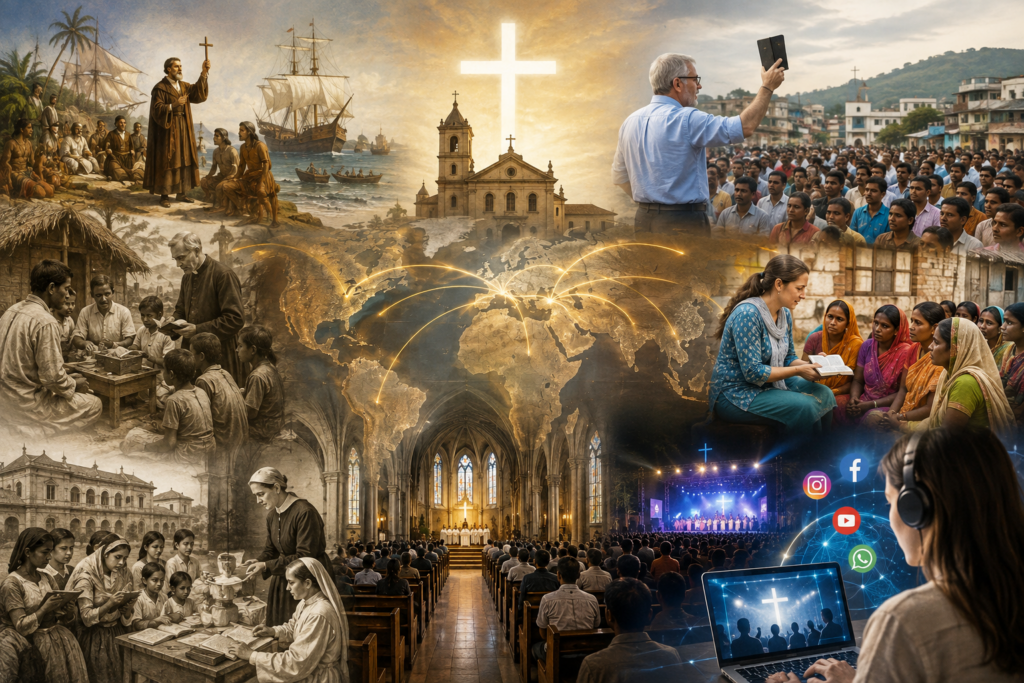
You may remember that in 1999, standing on Indian soil, the Pope said, “Just as the cross was planted in Europe in the first millennium, and the American continents came into our embrace in the second millennium, so Asia should become completely ours in the third millennium.” What is the meaning of this? Is this the voice of a champion of service, or a call for religious aggression?
By issuing such calls for aggression, churches gain numerical strength, political benefits, and economic benefits. Exactly one year after Mother Teresa’s death, Germany’s prominent news magazine Stern published a long investigative article (issue of September 10, 1998). At that time Stern was the highest-circulating magazine in Europe and was certainly not considered prejudiced against the Catholic Church. The title of the article it published was: “Where is Mother Teresa’s Multi-Billion Fortune?” Throughout the article, there are details on how Teresa raised money in the name of service and how it was deposited and secured in the Vatican Bank, with documents provided to support these allegations. Thus, Indian money and world money have gone to the Vatican. This is just one example of the economic benefits for churches. In many countries, churches collect separate taxes, which can be compared to Islam’s “Zakat” and “Jizya” taxes.
Coming to the matter of political benefits, plenty of examples can be drawn from history. Let us look at an example from our own country: the Kerala government had ordered an investigation on sedition charges against 13 bishops of the Syro-Malabar Church. The allegation was that their church is defying the Constitution of India and enforcing the religious laws of the foreign Vatican government in the name of religion. An organization of Christian laypeople called the Catholic Laymen’s Association (CLA) had formally filed a complaint against these bishops, accusing the church of tax theft as well.
There are “Castes” Among Christians
Now let us come to the subject of casteism. It is a habit for many to speak as though casteism does not exist among Christians at all—that it is a single-layered, equality-achieving, monolithic block. There are as many Christian castes in India as there are Hindu castes. There are churches with separate entrances for Dalit Christians, as well as entirely separate churches. Other Christians do not establish marital relations with the families of Dalit Christians. All of these are well known.
However, when it comes to global matters, the situation is even more horrendous. According to Encyclopædia Britannica, there were not one or two, but 22,000 sub-sects (now it is 40,000+) among Christians! There are various differences and mutual intolerance between one sect and another, including problems similar to the Shia-Sunni conflict among Muslims, along with the competition of converting one another.
In Western countries like Europe and America, when people write down their “religion,” no one writes “Christianity.” Instead, they state the name of their church and sub-sect: Catholic, Lutheran, Unitarian, Pentecostal, Beach Church, Baptist, Methodist, New Life, Evangelical. That is what they call their religion. The singular, monolithic religion of “Christianity” does not exist by name anywhere there.
In Britain, the Anglican Church is politically significant; its followers are the majority, and it is the church of the royal family. Historically, the British monarchy, rebelling against papal bureaucracy, established an independent national church called the Church of England. Therefore, when a political leader and former Prime Minister like Tony Blair announced that he was going back into the Pope’s embrace by converting to Catholicism, it became a hot topic of discussion in Britain, and the Anglican people panicked. The media wrote that “Blair fell under the influence of his wife”!
Here, we alone speak naively about a single Christian religion. But where does a single Christian religion exist? From the perspective of Indian Hindus, Tony Blair was a Christian when he was an Anglican, and he is a Christian as a Roman Catholic. But from the perspective of the Anglican Church, his conversion is the loss of one of its prominent and influential “members.” To the Catholics, however, it is a prize catch!
When converting, Blair did not announce that he was becoming a follower of Christ—he was already a follower of Christ before. What he announced was: “I have adopted all the beliefs held by the Roman Catholic Church!” This statement naturally angered the Anglicans.
People who do not understand the organizational structure of the Christian religion may be surprised by this. But in reality, if you convert to the Christian religion, it is not just that you have accepted the teachings and beliefs in the name of Christ; you are required to accept the beliefs of the church that converted you. The fact to be understood here is this: conversion does not happen to the Christian religion. The procedure of admitting someone into the Christian religion simply does not exist anywhere. Conversion happens to a church. In reality, “conversion” is the procedure of officially joining as a member of a specific church. If another church converts you away, that original church looks upon it with anger. That church grieves, lamenting, “This church easily snatched away our prey.”
When the “conversion” of Catholics into Protestant Christians became too frequent, the same Pope John Paul II—who had told Asia to plant the cross—condemned Protestant missionaries and church leaders in very harsh terms as “rapacious wolves” (wolves licking their lips and yearning for prey and attacks). This holy figure could not tolerate the members of his own church being converted by other churches belonging to the same Christ!
If this is the case, why should the non-Christian, spiritual religions of the world endure unjust “conversions”? To use the Pope’s own words, aren’t all proselytizing missionaries also “rapacious wolves”?
Be that as it may, let us come to the main point. To speak the truth, outside of the churches, the Christian religion has no existence, because the religion we see today was created by the churches themselves. Jesus Christ (if he was a historical figure) never established any church. The New Testament Bible that we read today is not a text created by Jesus Christ; it was created by the churches. It contains four Gospels (John, Matthew, Mark, Luke). But at that time, many other gospels were also in circulation (for example, the Gnostic Gospels). There were Christian traditions that gave respect and honor to women as well. However, the Roman Catholic Church recognized only four gospels, crushed the remaining Christian gospels, banned other forms of worship of Christ, and decreed that only what it recognized was the true Bible. That is a long history. Yet, those who do not know these things—or who wish that we should not know them—keep blowing the false trumpet that “there is equality in the Christian religion; there is casteism in the Hindu religion; those who convert to Christianity become uplifted.”
Not all missionaries agree with members of their sect changing churches—that is, “inter-denominational conversion.” But Hindus are expected to abandon their thousands-of-years-old foundational, civilizational Dharma and convert to churches!
“Sheep Hunting” for Religious Expansion
Just as jihad is to Islam, conversion is to Christianity; both are methods of religious expansion. Some Muslim sects believe they are the true followers of the prophets, arguing that other sects like the Ahmadis are not Muslims at all, and thus declare jihad against them as well. Similarly, there are radical Christian sects that do not accept papal supremacy, believing that the Bible alone is final and that every single sentence of it must be implemented literally. There is also a call to bring back the “Sacred Feminine.” There are some radical sects holding the Bible in hand that carry out aggressive conversions through any means possible. These sects are identified as “Born Again” sects. Born Again sects are hated by other churches too, and they are more aggressive in conversion activities than the rest.
Just as the Sunni Wahhabi Muslim sect berates Shia and Ahmadi sects, saying “I am a purer Muslim than you,” so too do Born Again Christian sects berate other churches and those churches berate these churches.
“Ethical Conversion”?
Non-Christian communities are not the only ones facing problems from conversion. When new “sheep” are not available for conversion, greater emphasis is placed on inter-church conversion. How to prevent their own members from becoming members of another church is the problem haunting the leaders of all churches now.
Along with this problem, there is yet another issue. That is the competition going on between churches for the hunting of new “sheep.” It happens that two or three different denominational churches rush forward to convert the same community and fight among themselves—just like wolves fighting over prey. This is not an exaggeration; this problem is troubling churches at a global level. The Vatican itself is dismayed by the aggression of American Evangelical churches and it had attempted to establish an accommodation between churches, trying to formulate an “Ethical Conversion Code.”
A few years ago, under the joint auspices of the Vatican and the World Council of Churches, a massive religious conference took place in Toulouse, France, attended by representatives of all major churches. It was decided at this meeting to adopt a conversion. The plan was for various churches to divide up non-Christians among themselves and convert them.
There are many among us who speak without knowing any of this, or who conceal all of it. It is argued as though there is no plan and no budget behind conversions and that people of the world are voluntarily abandoning their foundational religions to become Christians. It is asked, “What is wrong if someone voluntarily becomes a Christian?” This is innocence, or else foolishness, dishonesty, or plain outright support.
The “Joshua Project” is a grand conversion project created by several missionary networks. Under this project, strategies have been devised on how to target and convert “unreached” communities in India and Asia. After the Second Vatican Council, the Catholic Church devised new strategies using its old tactics. The Vatican’s secret intelligence agency, “Opus Dei,” has become more active. American churches have formulated a new conversion program targeting the 21st century under the name “10/40 Window”, working aggressively according to it. Their goal is to completely convert the people of countries lying between 10 degrees and 40 degrees north latitude. West Asian Islamic countries, India, China, North African Muslim nations, and Japan all fall within the scope of this 10/40 window. It would be no surprise if missionaries cause a new global conflict through this.
No one questions conversion at the level of some individual; everyone has that freedom. But trying to prepare the world itself for the “Second Coming of Christ” through conversion is wrong. Not only is this outwardly wrong, but it is also a dangerous belief.
Author