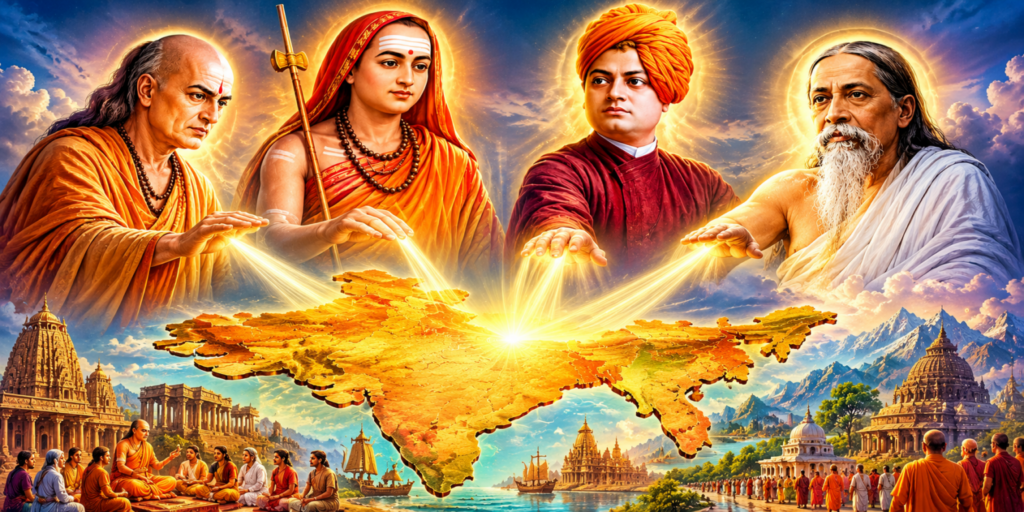
Many people’s hard work has contributed to Bharat (India), and through it the world, gaining an understanding of this world and the beyond, becoming civilized, and attaining enlightenment. This process has taken place over several millennia and continues to run uninterrupted to this day. Our lineage of sages has made a wonderful contribution in this direction.
Because spiritual wise men—the sages—upheld and guided ancient India’s knowledge, conduct, and practical life, the country was able to survive without total destruction and remain peaceful. Against this backdrop, during the past two millennia (the period for which recorded history can be written), who made the most unique contributions to the Indian traditions of knowledge and valor?
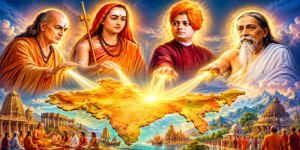
When I pondered this question, many names came to mind. However, I will attempt to name only four main pillars here. The first criterion I followed in choosing these individuals was that they must have upheld the Indian spiritual knowledge tradition passed down from antiquity, serving as crucial links in it themselves. Subsequent criteria: alongside wishing for the welfare of all humanity, they must have established their influence across all regions from the Himalayas to the Southern Ocean. They must have possessed the concept of the unity of the entire Bharatavarsha, considering the whole nation as their field of activity and contributing to its well-being. Viewed from this perspective, after Sri Krishna and Vedavyasa, I recognize four great Jnana Yogis.
1. Acharya Chanakya
First is Arya Chanakya. He was ancient India’s great economist and statesman, proficient in statecraft and military strategy. He was a great visionary who revived Indian martial and intellectual thought, which had gradually disintegrated after the Mahabharata era. He was the preceptor, guide, and prime minister of Emperor Chandragupta Maurya (approx. 340-293 BCE).
It is believed that Chanakya was born around 350 BCE and passed away around 275 BCE (scholars do not agree on the exactness of these years). Chanakya brought an end to the rule of the wicked king Dhanananda of Magadha and enabled Chandragupta to attain royal authority. He himself was the founder of the Maurya Empire. He was a far-sighted patriot who forced the Greek king Alexander—who had set out to conquer the world—to retreat from India. He was the first great thinker who strived for the security of India’s borders and the protection of its culture. In his time, he was renowned everywhere as extremely intelligent.
Based on the story of Chanakya establishing the Maurya dynasty, an ancient writer named Vishakhadatta composed a Sanskrit play titled Mudrarakshasa.
Chanakya had other names such as Kautilya and Vishnugupta. He was a professor at the world-famous Takshashila University. The two great treatises he authored are considered unique in the world: one is Arthashastra, and the other is Nitishastra, also known as Chanakya Niti. Some researchers claim that Vishnusharma, who wrote the Panchatantra stories, was also this same person, but there is not enough evidence for that.
2. Sri Sankaracharya
Sri Sankaracharya is one of the greatest ascetics India has ever seen. In my view, he is a epoch-making figure who played a most significant role (with influence lasting for centuries) in the country’s cultural history after Sri Krishna and Chanakya.
The name following Chanakya (in terms of chronology, not significance) is Sri Sankaracharya, also known as Adi Shankara and Sri Shankara Bhagavatpadacharya. He holds the glory of having traveled on foot multiple times across all directions of the country, including its current border regions, to propagate knowledge. He laid a firm foundation for the country’s cultural unity and integrity.
He was born in the village of Kalady in Kerala. His birth year is believed to be 788 CE. He lived for 32 years, yet accomplished immense achievements in that span.
Shankara was an supreme Vedantin. Through his writings and discourses, he gave a new scope to the Advaita Vedanta thoughts that were already prevalent before his time. He wrote numerous treatises and devotional hymns to Bhagavan. When he did all of this, he was merely a teenage boy! The doctrines he propounded as a boy remain a formidable challenge even to aged scholars of knowledge across all times!
Sri Sankaracharya established four major mathas in the four directions of the country to proclaim its cultural unity. He also established many more mathas and temples. Many of the land’s famous scholars became his disciples.
Shankara gave importance to devotion, but he gave even greater priority to Jnana Yoga over blind devotion, writing commentaries on the Bhagavad Gita, the Upanishads, and the Brahma Sutras. Based on these commentaries, all future Indian spiritual thought (including pro and con stances regarding his doctrine) was shaped. Thus, he ushered in a tradition of thought and a significant era of knowledge in the country’s history once again.
3. Swami Vivekananda
Following Adi Shankara, the person who influenced the whole of India and showed a new direction to the nation’s history was Swami Vivekananda. He alone influenced the entire country and infused a new spirit into its personality. He was the one who generated a fresh curiosity and respect for India in the Western world. Without him, the country’s freedom struggle and aspiration for Swarajya would not have acquired a precise goal and direction. Spirituality would not have taken root as strongly as it does today among the peoples of the world. From this perspective, it is no exaggeration to say he also gave a new turn to world history.
He was the total embodiment of a magnet-like personality, blazing intellect, prodigious memory, and the meditative power that perceived the soul of the nation and the world. Born in Bengal on January 12, 1863, as Narendranath Datta, it is history that he later earned the grace of the wonderful spiritual master Sri Ramakrishna Paramahamsa and became a great yogi. As a seeker who even examined his own guru, he was the one who introduced his guru to the world.
As a Mahayogi who displayed India’s greatness across the length and breadth of the world, Swami Vivekananda reawakened the dormant self-awareness and self-confidence among Indians. He provided a new perspective of “Daridra Narayana” service, viewing the welfare of the poor as another form of spirituality.
In his 39 years of mortal life (passed away: 1902, Belur Math), his historical achievement was causing nationalism, a religion transcending caste and sect, a spiritual way of life, and the well-being of all people to re-establish themselves nationwide. To this day, his complete works in 8-9 volumes are recognized globally as guiding literature.
4. Sri Aurobindo Ghosh
Following Vivekananda, the one who continued the same self-knowledge sacrifice was Sri Aurobindo Ghosh. Describing him is very difficult. He was a great yogi, an unparalleled patriot, a seeker of truth, a visionary, an expert in spiritual lore, a freedom-struggle revolutionary, a great scholar in secular learning, a scholarly writer, a poet, an exponent of Indian nationalism, and a guru with a vast multitude of disciples. It is very rare for one person to possess all of this!
Aurobindo was born on August 15, 1872, in Kolkata. His education took place in England. In 1890, he passed the ICS (similar to today’s IAS). However, his mind did not agree to becoming an official under the British government, so he purposefully disqualified himself in the practical exam. Returning to India, he became an official in Baroda, a professor, and then the vice-principal of Baroda College. In 1905, he plunged into India’s freedom struggle. The Gandhian era had not yet begun; Aurobindo began revolutionary struggles, writing essays, plays, poetry, and articles espousing Indian nationalism. He became the editor of the Bande Mataram newspaper. In 1908, the British arrested him and put him in Alipore Jail.
The silent environment of the prison proved favorable to Aurobindo’s meditation and yoga practice. One day while meditating, he experienced a spiritual realization. From that day, the pattern of his life changed.
After his release in 1909, he went and settled in Pondicherry, which was under French control, and established an ashram. He began strengthening Sanatana Dharma, which had been battered by foreign invasions, and set about preparing a patriotic generation. He began teaching people the inclination for independent study and research, bringing spirituality back into the mainstream. It can be said that Aurobindo continued forward from where Swami Vivekananda left off his work of building religion, culture, and the country.
Aurobindo wrote marvelous articles and treatises. Wonderful books poured from his pen, such as The Life Divine, The Foundations of Indian Culture, The Secret of the Veda, Essays on the Gita, The Mother, The Synthesis of Yoga, Love and Death, and others. As a crowning jewel to all these, channeling the entire spiritual realm, he wrote a supreme English epic of 24,000 lines titled Savitri: A Legend and a Symbol. He did not accept the partition of India. He dreamed many dreams about a new India and proclaimed and hoped that India has a bright future.
Author