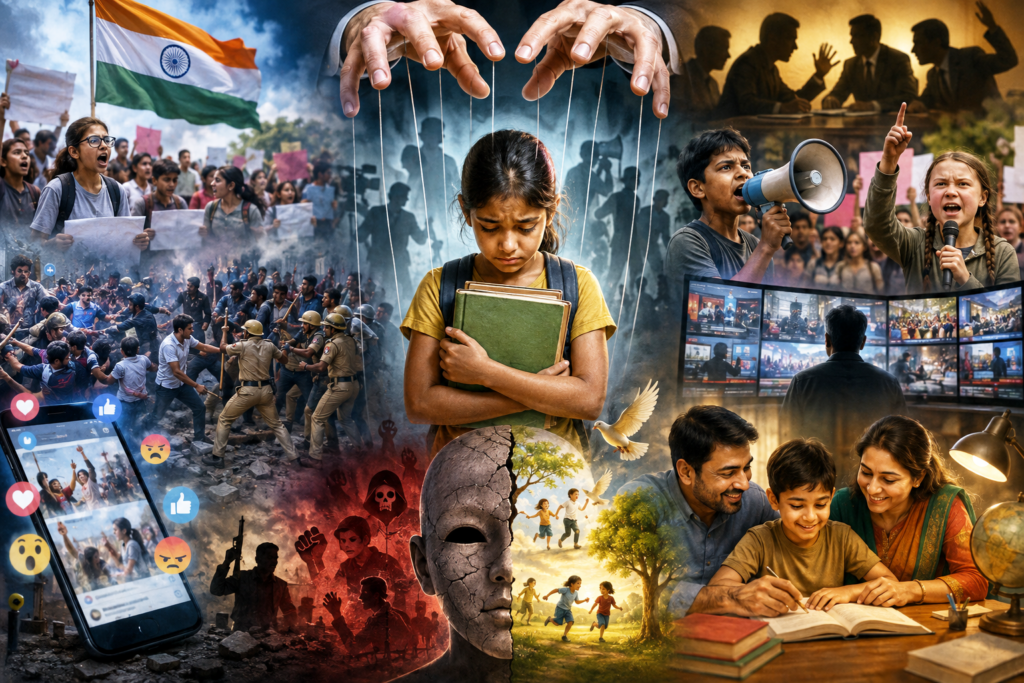
An obsession with ideology and an obsession with publicity are powerful psychological traps. Once children become trapped by them, returning to an ordinary, balanced life can be extraordinarily difficult.
The controversy surrounding the protest conducted under the banner of “Cockroach” tarnished the credibility of many. It did not reflect well on the Central Government that it failed to initiate legal reforms before the unrest erupted. Likewise, before demanding the resignation of the Union Education Minister, the opposition could have set a moral example by acknowledging that question-paper leaks had also occurred in the states they governed and by calling for the resignation of their own education ministers.
The movement imported from America under the name “Cockroach” failed to uphold any moral ideals. Instead, it surrendered its moral authority by descending into obscenity and criminal violence. Thousands of criminals infiltrated the protest. Some shouted slogans such as, “We will turn India into Nepal,” while others cried, “We want Azadi for Kashmir.” The exploitation of underage children was also plainly visible.
In the process, the genuine educational issues at the heart of the controversy—and the reforms needed to address them—were pushed into the background. The entire episode increasingly appeared to be less about students and more about various political interests using a “student movement” to advance their own agendas.
Many sections of the media also abandoned impartial reporting and instead behaved according to their respective ideological leanings. A wave of sensational propaganda followed: “This is the great Gen-Z revolution… A kind of Arab Spring is unfolding in India… The government is facing its gravest crisis… ‘Crores’ of young people have risen in revolt… The government is shaking.” The same emotional excess and ideological fanaticism that frequently characterizes sections of the American media found a striking echo in India. Foreign media organizations entered the fray as though they themselves were participants in the protest.
While some leading television channels focused almost exclusively on claims that “The real, hidden reason is FCRA amendment. America’s Deep State is behind this,” several major newspapers neglected balanced reporting altogether and became absorbed in promoting the narrative that India had entered an Arab Spring-like uprising. Some repeatedly highlighted visuals of protesters assaulting police personnel, while others sensationalized incidents of police attacking protesters. Very few attempted to report the violence in a balanced and impartial manner.
The question the public should ask every politician, journalist and commentator promoting one ideology or another is a simple one: “Where were your own children that day?”
Who are encouraging young people—at an age when they should be studying, building careers, and securing their futures—to immerse themselves in ideological causes, following examples such as Greta Thunberg? Who bears responsibility for robbing them of the natural innocence of childhood? Was it the parents who allowed such involvement? Was it the ideologues who created such an atmosphere? Why did the leaders of various political parties who rushed to Jantar Mantar not send their own children and grandchildren to participate in the protest?
The situation is reminiscent of the old Kannada saying: “Pushing someone else’s child into a ditch to see how deep it is.”
This is how such movements usually unfold. The children of political leaders and ideological campaigners remain comfortably out of harm’s way, while the “responsibility” of protesting falls almost entirely upon the children of ordinary families. The same pattern is visible in America, and the same pattern is visible in India.
Across the world, there exists a vast enterprise devoted to manufacturing child and teenage “activists.” Yet the children of those who run this enterprise are rarely found among the protesters themselves.
Ideological intoxication is profoundly dangerous. Once it takes hold, escaping its grip becomes exceedingly difficult. When adults applaud and celebrate the words and actions of children, the children naturally become even more encouraged. This basic psychological principle is deliberately exploited to transform children into activists for controversial causes.
Young children are made to speak on complex issues they scarcely understand, and global media organizations elevate their statements into banner headlines. Such attention only encourages them to continue down the same path.
The very term “Gen-Z” is itself a curious label born out of a targeted conceptual framework. It is yet another of America’s controversial creations.
Long before they are mature enough to understand the realities involved, they begin to believe: “We are doing something extraordinary. We are changing the world. We are the pioneers of a new age. We are not ordinary people. We were born to bring about change. We have a historic role to play. We are part of a great global mission. The world’s media stands behind us.” If such illusions take hold of a child’s mind, the child is not to blame. The real culprits are the cynical forces that cultivate such “activist” children in order to advance their own interests.
The very term “Gen-Z” is itself a curious label born out of a targeted conceptual framework. It is yet another of America’s controversial creations.
Across the world, there exists an active political enterprise that singles out children of a particular age group, assigns them exaggerated labels, shapes their thinking through social networking platforms, and ultimately uses them to serve its own objectives.
What meaningful activism can adolescents possibly undertake on issues so complex that even scholars struggle to understand them?
Do media organizations that lavish excessive attention on such young activists possess any sense of social responsibility? Do they not implant in children’s minds the illusion that “We are extraordinary individuals… We were born to set the world right”?
And what lies behind the persistent strategy of placing teenage activists—especially young girls—at the forefront of virtually every public controversy?
Inviting children to comment on the world’s most complex issues, presenting their opinions as though they were matters of global significance, and encouraging them to deliver carefully framed statements—all of this contributes to the erosion of their individuality and the distortion of their natural psychological development.
One of the defining problems of our age is the cultivation of separatist tendencies rooted in particular political ideologies and the aggressive marketing of those ideologies. One belief system seeks to erase another, giving rise to an endless cycle of ideological conflict. In this strange environment, the deliberate use of children as instruments of ideological campaigns has become increasingly conspicuous.
Children are introduced to controversial “woke” subjects such as multiple genders, gender assignment and reassignment long before they possess the maturity to understand them. They are encouraged to use vulgar language. Political ideologies are packaged and promoted under the banner of “climate change,” a subject that even scientists continue to debate in many respects.
Topics such as race, class, caste, liberalism, marijuana, transgenderism, homosexuality, dissent, and human rights are taught to children in ways designed to serve particular ideological interests. The objective is not education but indoctrination—shaping young minds through systematic ideological conditioning in order to manufacture angry child activists and “child icons.” An extensive global media ecosystem then elevates such children into symbols and celebrities.
Just as organizations such as Naxal groups, Pakistani jihadist organizations, and the LTTE have recruited and trained teenagers for violent causes, these ideological movements similarly recruit children for political activism, albeit through different methods.
The slogan “Catch them young” has long served as the guiding principle of countless organizations, whether social movements or extremist groups. Though their goals may differ, many share a common strategy: influence children while they are still impressionable, shape their thinking, and recruit them into lifelong service.
Just as the manufacture of teenage terrorists is unacceptable, the manufacture of teenage activists should also be viewed with equal concern. There is little moral distinction between exploiting children for violent extremism and exploiting them for ideological activism. Just as society rejects child labour and child marriage, it should also reject the deliberate creation of child activists and the encouragement of child-led protests. All, in different ways, amount to forms of child exploitation.
The exploitation of children extends beyond politics. Destroying childhood innocence through so-called reality shows, exposing children to ideas and themes far beyond their emotional maturity, making them perform merely for adult entertainment, drawing them prematurely into commercial television and cinema, and producing films that portray high-school students as romantic couples—all of these are different manifestations of the same problem. Each, in its own way, places adult expectations upon children before they are ready to bear them.
The world’s most influential ideological campaigners have generally ensured that their own children pursue education, build careers, and enjoy stable, comfortable lives instead of plunging into protests. The same holds true for many of those who publicly encourage such activism. It is noteworthy that the children of The New York Times journalists are not allowed to abandon school to travel the world campaigning on climate change in the manner of Greta Thunberg. That those who urge other people’s children to take up such causes carefully protect their own children should serve as a lesson to society.
Those who project these young activists onto the global stage rarely make similar sacrifices within their own families.
The public should recognize that there are always people who advance their own careers, influence, and reputations through the sacrifices of others. Parents from ordinary families, therefore, must remain vigilant when it comes to activists, ideological leaders, billionaires, NGOs, ideological professors, partisan writers, and political or social campaigners who shape and promote these “activist” children. No parent brings a child into the world with the intention of turning them into a “child activist.”
Yet those who push other people’s children into danger are seldom willing to listen to such concerns. Nor do they stop to consider that other parents cherish the same hopes and dreams for their children’s futures that they cherish for their own.
Such people become so consumed by ideology that it shapes the way they think, speak, and see the world. Such people breathe ideology, live by it, and interpret everything through its lens. Under their influence, ordinary children are especially vulnerable. Without even realizing it, they may begin to regard such figures as role models and adopt activism at an age when they should instead be developing culturally, intellectually and emotionally.
This is not an issue confined to the political Left or the political Right. The danger lies in ideological extremism itself, regardless of its source. Children should be raised in an environment where they are free to think, learn, and mature without being drawn into any form of ideological fanaticism.
Instead, they should be given ideas that bring peace and stability to their lives. They should receive a sound and cultured education that nurtures both character and judgment. They should grow up with confidence in life and hope for the future. They should be shaped into decent individuals who respect their parents, teachers, and elders, and who, in turn, earn the respect of others.
Above all, children should never be encouraged to believe that they were born to reform society, lead ideological movements, or see themselves as extraordinary figures destined to change the world. Such illusions, however flattering they may appear, can become deeply damaging.
An obsession with ideology and an obsession with publicity are powerful psychological traps. Once children become trapped by them, returning to an ordinary, balanced life can be extraordinarily difficult. Parents must recognize this danger early and remain constantly alert to the influences shaping their children’s minds.
Author