In his Independence Day speech last year, Prime Minister Narendra Modi made a call, “Let us resolve to completely liberate India from Macaulay education and colonial mindset within the next decade.” Ever since then, foreign powers have begun paying closer attention to the Indian education sector.
The organization of protests favoring American left-wing “wokeism” under the guise of “Gen-Z” has increased. India’s two major ambitions—”Viksit Bharat 2047″ (Developed India 2047) and “Freedom from Colonial Mindset”—have drawn intense global attention.
These are the most ambitious dreams the country has seen over the past thousand years. If these dreams come true, India’s thousand years of slavery will be completely erased. Many foreign institutions are also admitting that “India now has the internal capacity to reach its goals,” and this calculation is bringing forth new problems.
Would colonial powers quietly tolerate a massive country like India slipping out of their hands? Therefore, brand-new ploys are being rolled out to ensure India fails to lift its head.
What are the massive existential challenges India has faced over the past 100 years? Colonial rule, communism, jihadi terrorism, church conversions, internal divisions, Marxism-Maoism, security anxieties, wars, illegal migrations, riots, famine, drug menace, global pandemic—there is a huge list. The question now is: What if all the problems of the past 100 years recur combined within the next 10 years? To what extent can India withstand that?
If one observes current developments keenly and correctly, clear indications show that the next 10 years will bring heavy challenges. Security, economic, political, and cultural challenges can be expected to increase. America’s eyes are fixed on India’s agricultural and educational sectors. There are signs of attempts being made to establish control over these two fields.
The West’s usual “divide and rule policy” is being intensively deployed once again; politicians, media, and technology are being used to make India’s political parties fight among themselves, say security experts. As former Foreign Secretary Kanwal Sibal points out (in his Substack artcle), America, China, and Pakistan are working together to put roadblocks in India’s path.
The sudden surge of casteism in everything, the flood of internal protests, calls for the destruction of Sanatan Dharma, calls for religious conversions, unleashing Pakistan, various kinds of economic blows, and disrupting supply chains—none of these are accidental. The more the attempts at “decolonization”—a decolonized mindset—increase within India, the more it is expected that the nuisance to prevent its success will also increase.
What are the massive existential challenges India has faced over the past 100 years? Colonial rule, communism, jihadi terrorism, church conversions, internal divisions, Marxism-Maoism, security anxieties, wars, illegal migrations, riots, famine, drug menace, global pandemic—there is a huge list. The question now is: What if all the problems of the past 100 years recur combined within the next 10 years? To what extent can India withstand that?
Read on
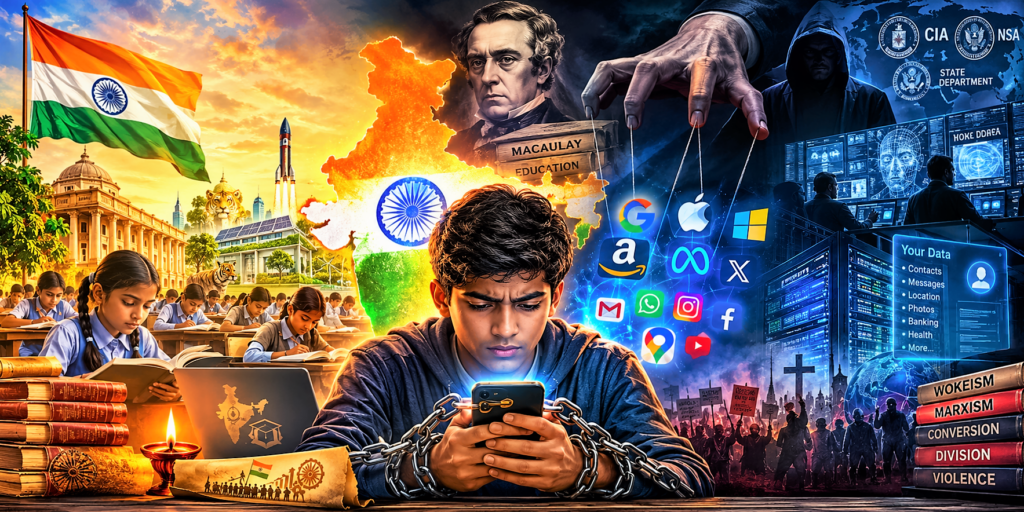
In this regard, the use of digital technology and anti-India algorithms has intensified. Google, Microsoft, Amazon, Apple, Meta, X, and Chinese companies—all of these keep constant watch on the Indian people. All data of the people and details of all daily activities are being collected. “Big Tech” companies predict your next move even before you do. Through appropriate nudges, they try to lead you down the path they desire. How much they can influence and haunt the collective psyche of our people through their vast wealth and technology is a matter that needs serious investigation.
The accusation that American social media and tech companies operate like lobby groups for the American CIA, NSA, and State Department has existed from the beginning. There are allegations that they are misusing AI for their political objectives.
Even so, India did not learn a lesson like China. These companies were embraced and welcomed, and dependence on them became excessive. Indians are using Gmail, WhatsApp, Instagram, and Facebook much more than Americans do (even in terms of population percentage).
It is impossible to use an iPhone, iPad, or Apple Watch without depending on Apple. Yet, the fascination for them is extreme. The computers of our banks, institutions, media, and companies rely on Microsoft Windows. Now, through its AI called “Co-pilot,” Microsoft is setting out to collect even more data than Google.
Today, the voice demanding that “American tech companies must be curbed and we must preserve our ‘tech-sovereignty’ and ‘data-sovereignty'” is being heard louder in Europe than in India. In such dire times, Indians are completely at the mercy and whim of American tech companies.
Although some precautions have been taken in certain central government operations and alternative technologies have been adopted, dependence on America continues at its maximum level.
Those born in the 1980s and earlier are the ones who witnessed and experienced the slow pace and corruption of the pre-digital era firsthand. They happily welcomed digital life upon noticing that all of those issues have significantly reduced under the systems of the new information age. Those born since the 1990s are digital creatures who know nothing apart from digital, information technology, and smartphone systems. For them, an era without a smartphone is merely history to be read about and heard. Their “empirical” understanding is that “life is just like this.” Just as no one now has direct personal experience of what an era without media was like, they have no personal experience of an era without smartphones or social media. Foreign powers are targeting such individuals.
Both those who blindly embraced the digital world and those born into the digital world are unaware of the dangers that a “life of foreign espionage” can bring.
This is not just a story about an individual’s personal data. It is a serious scenario of what happens if the aggregate data of an entire country’s people becomes accessible to another country. Gmail, WhatsApp, Google Maps, and Google Earth hold everyone’s contact details, everyone’s home addresses, the names of people living there, and phone numbers. In addition to the data directly collected by these “services,” the information available from indirect sources (big data) is immense. There are suspicions that all of this may be available to agencies like the CIA and NSA. Google also makes money by selling people’s data to paying data brokers. Imagine what happens if Pakistan’s ISI acquires sensitive details of Indian citizens through the CIA.
Among those who are aware of such dangers, some are themselves the creators of the digital revolution. Regret and worry engulf them, such as: “We thought of one thing, but the path technology is taking is entirely different.” For example, scientist Tim Berners-Lee, who himself designed the World Wide Web and handed it to the people, and scientist Geoffrey Hinton, famously known as the “Godfather of Artificial Intelligence” and a 2024 Nobel laureate, are both anxiously criticizing the current “digital revolution” as a “digital dystopia.”
Despite this, Google dependence remains intense in many of the Indian government’s projects. The government and Indian companies have failed in making people “Google-free” and “America-free.” Except for Sridhar Vembu’s Zoho Corporation, all other Indian digital companies (including Jio) are yearning for foreign investment and foreign partnerships. Many startups are dying for foreign valuations.
Our smartphone empire is completely under the subjugation of Google and Apple companies. Nothing operates without the grace of these companies. Every single app requires the permission of these companies.
With the dream of autonomy and with the encouragement of the central government, the company PhonePe launched an Android app store named “Indus App Store.” (However, the PhonePe company itself is not fully autonomous; behind it lies the shadow of American Walmart ownership!) For any app store to work properly, and for many apps downloaded from it to function, “Google Play Services” must be active on your Android phone. (There is no room for other app stores on an iPhone.) The explanation given is: “Since Google owns the Android operating system, ‘Google Play Services’ is required for app security.” But Google has not approved the Indus Play Store itself! One has to change certain settings and download it like a separate APK file in a sneaky manner (“sideloading”). A warning message comes from Google saying, “APK file is not safe, beware!” For this store to work itself, “Google Play Services” must be active on the phone! Indus’s store cannot work without Google’s favor; when this is the case, how independent and Google-free are the apps inside it?
However, Google approval is not required for an app store called “F-Droid,” created by a single British programmer, nor for any of the apps inside it. They all work on Android phones. They function comfortably even on phones without a Google account or Play Services. This is a point we must note (Google is moving to curb F-Droid app creators starting this September).
But the official app store created by the Indian government does not possess such autonomous operational convenience. None of our government apps work without Google and Apple approval (in the name of security). Even government apps downloaded directly from the government, as well as our banking and UPI apps, must have Google and Apple approval! When government apps themselves lack native digital sovereignty, what kind of digital sovereignty can be provided to the people?
To reduce Android-Google dependence, there is a mobile operating system (custom ROM) in Europe called “GrapheneOS.” In India too, news about a custom ROM called “BharatsOS” created with the cooperation of IIT Chennai made some noise. Now there is no trace of it!
The government could easily create an app store like F-Droid that has no dependence on Google. But why is it not doing that work? If it is impossible to completely eliminate foreign dependence, why do you need a separate “Government App Store”? What grand sovereignty are you achieving by distributing government apps through it? Why is the self-reliance that was possible for a single British programmer not possible for our government? Is it the fear that “Google company will get upset, and joint-venture projects and foreign investment will face trouble”? If so, do the Prime Minister’s speeches on “decolonization” have any meaning at all?
Without first eradicating American dependence and digital slavery rooted in the fields of digital services and social media, nothing else that is attempted will make it possible to banish the Macaulay and Marxist mindset from within India.
Author