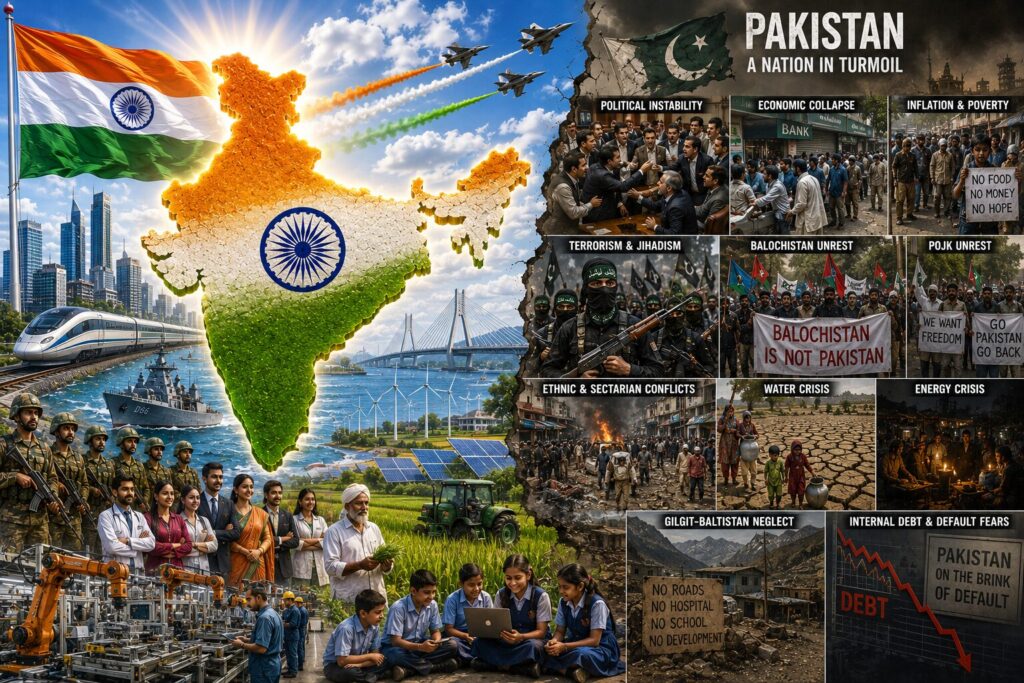
Recently, the confusion that arose regarding “talks” with Pakistan is an undesirable development. After Operation Sindoor’s brilliant execution, after placing the Indus Waters Treaty in abeyance, when parts of Pakistan-Occupied Jammu-Kashmir are rising up against Pakistan’s administration, and when Balochistan is moving toward separation — the emergence of opinions in India that “talks must be held with Pakistan” gave people the sudden experience of a jarring, discordant note amidst a delightful musical concert.
It became a development that brings to mind the proverb: “Prepared payasam, then dipped footwear into it.”
Following Operation Sindoor, the United States was more red-eyed than Pakistan. Don’t know where and which strings it pulled, the discordant note that “the Indian government must step forward for talks with Pakistan” began to be heard again inside India.
Alongside the usual voices of Farooq Abdullah, Mehbooba Mufti, and the remnants of the “Hurriyat,” this time even RSS leaders—who are capable of influencing the government—causing surprise, made statements such as: “The Pak military has made a mistake. We must take all necessary steps for national security. Alongside, we must maintain people-to-people contact through talks.” Although they later clarified their true intent, it is true that the anxiety of the old discordant note recurring arose in the minds of Indians who are currently in a “Dhurandhar” mood.
Meanwhile, media reports began to surface that “the Central government has already secretly conducted ‘Track-2’ talks through unofficial persons in Thailand and Sri Lanka.” The heat rose intensely over reports that certain controversial retired officials of India, active intellectuals, and operating officials of Pakistan engaged in secret pleasantries in Bangkok and Colombo. Promptly leaping into the fray, prominent spokespersons of the Congress and other opposition parties began criticizing the government. The very words that the BJP had previously used to criticize the Congress government came back toward the BJP. A bizarre scenario was created where they represented each other’s stances.
In this too, the name of the RSS was brought to the fore. RSS media clarified that this was not their idea; Pakistan and international think-tanks are behind it; foreign forces have joined hands to weaken India’s strategic milestone, and some Indian media outlets have fallen into their trap.
Amidst the intense heat, swiftly regaining his composure, India’s Foreign Secretary Vikram Misri came out of the embarrassing situation by issuing a statement: “Unofficial seminars and talks by retired persons are not official actions of the government. Someone or the other may have discussed something privately. That has nothing to do with the government. The government remains ever committed to its official stance of no talks with Pakistan.”
After all, was there a need to experience such embarrassment? “Terrorism and talks do not go together. What is there for the victims of terrorism to speak with the architects of terrorism?” — this is the policy officially declared by the Central government until now. The same has been repeated time and again on all international platforms. The unanimous consent of the people has also been obtained for it. All Indians are against Pakistan and in favor of the Central government’s stance on this issue. Many Indians harbor the hope that “sooner or later, due to Pakistan’s internal challenges, Pakistan-Occupied Jammu-Kashmir and Gilgit-Baltistan will once again come under India’s possession.” Current global scenarios and the setbacks being experienced by Pakistan and the big powers behind it are all fully supportive of Indian sentiments. When such a rare, supreme moment exists, how would people feel if the discordant note of “talks” arises again with the feeling that we are going to achieve something else miraculous?
Several arguments are floating around on this matter. One argument is that “to gauge the deep-seated opinion and ‘mood’ of the people, the government itself conducted a test experiment by floating the subject of talks unofficially like this. As soon as it understood the public sentiment, it stepped back.” Another circulating opinion: “No, for the government this was an undesirable and internally embarrassing scenario. There is a lack of unity within the BJP family.” In short, problems within the BJP family currently appear to be at a very complex level.
Twelve years ago, right at the beginning of the Narendra Modi government coming to power, it became a controversy when Congress’s Mani Shankar Aiyar led a large delegation to Pakistan, and a member of his delegation met and discussed with Hafiz Muhammad Saeed, the founder of the Lashkar-e-Taiba terrorist organization. The name of that person who met Hafiz Saeed was Ved Pratap Vaidic. He was someone who long ago moved in BJP circles and Baba Ramdev’s ashram circles, and later slipped into Mani Shankar Aiyar’s camp. That delegation had strutted about as if going to the place of Hafiz Saeed and speaking with him and drinking tea with him was a great achievement. Vaidic’s statement—”I went to ask and get an assurance: If Modi comes to Pakistan, will you accept and welcome him?”—had also stirred up controversy. Demands to arrest Vaidic erupted.
Later, the BJP joined hands with the PDP—which had continuously abetted pro-Pakistani separatism—to form a government in Jammu and Kashmir. To state it another way, allowing the PDP an opportunity to form a government was a misstep by the BJP. Likewise, sending Minister General V. K. Singh to the celebration of “Pakistan National Day” was another confusing scenario. The Pakistan Embassy in India purposely and grandly celebrates it. For mischief, it invites pro-Pakistani extremists from within India like the Hurriyat Conference, treats them to a biryani meal, and makes news. Certain influential people, intellectuals, and journalists waiting for Pakistan’s hospitality go and eat. General V. K. Singh, who was a minister, was sent to such a mischievous party. The question arose: What benefit did India actually gain from that “symbolic behavior”?
Gradually, the Modi government learned its lesson. Clarity emerged in its foreign policy. It corrected its blunders either by keeping away those responsible for its two missteps or by moving forward with a new clarity. In 2019, it successfully made people forget the old missteps by showing the historical boldness of revoking the Temporary Article 370 of the Constitution.
Now, historically, India’s strategy is turning toward a favorable scenario. At this time, anti-India forces may have calculated that India could be dealt a setback through the drama of “Track-2 diplomacy.” The BJP family, knowingly or unknowingly, seems to have been caught in this trap and rescued itself by waking up at the final stage.
From the beginning, America and China-backed pro-Pakistani lobby has been at work in our country. A few years ago, a Pakistani ISI figure named Ghulam Nabi Fai was in the news in America. His job was to frequently organize seminars, invite Indian intellectuals to them, and provide them with luxury facilities funded by ISI money. It was reported that many “great intellectuals” of our country availed the “benefits” of his hospitality. All these are usually portrayed as “friendly people-to-people contact.” But there are also suspicions that actual ground reality might be entirely different.
The concept of “Track-2 diplomacy” is nothing new. It always exists between all nations. Even between countries waging war against each other, an unofficial door is kept open for the discussion of certain matters. That is also inevitable in international affairs. Since India does not permit third-country mediation on the matter of Pakistan, some argue that it is necessary to maintain a window of contact with Pakistan directly. But it is noteworthy that this is not the time for talks. Even if the window remains as it is, there is no need to open it now. At a time when the opinion of carving up Pakistan like in 1971 is solidifying, unofficial windows end up dipping footwear into painstakingly prepared payasam.
The world is now turning toward a decisive juncture. With whom in Pakistan should we talk? With the Pak military plotting to swallow India? With the titular Prime Minister there? With the ISI? With people suffering from jihadist fever? About what matter should we talk? Will our words receive respect and value from that side? What benefit can India get from anyone in Pakistan? What does the experience of the past 80 years tell us?
Even if one “simply” appears alongside current or former Pakistani officials in any genuine international seminar, escaping blame is impossible. Because in Pakistan, former officials also have links to the ISI. The ISI uses many former officials like its lobbyists and brokers. The army keeps an eye on all officials.
When dealing with foreign countries, especially with leaders of countries like Pakistan and China, our country’s retired officials or members of any party must provide prior information. This is not merely etiquette, but also a national necessity.Former officials, retired military generals, political party leaders, social leaders, and holders of prominent national positions, public intellectuals always have to act with caution and supreme responsibility. Even though officials are retired, they must act as if they are still in office.
The international movements of all such public leaders should become the matter of national security and national concern. The national interest is above all.
Author