Ours is a land of festivals. More exceptional than daily dharmic rituals, festivals are unique celebrations. No other country in the world has as many festivals as India. It is true that festivals exist in every nation and culture; even tribal communities have their distinct celebrations. However, in India, festivals carry a special brilliance and meaning that sets them apart from the rest of the world.
There are four primary reasons why festivals, celebrations, and congregations (melas) are more abundant in India than in other countries. Let us explore them briefly.
The first reason is that ‘spirituality’ forms the core foundation of Indian civilization (Sanatana-Vedic / broad Hindu framework) and its communities. Here, all faiths and schools of thought were born out of spiritual inquiry. In spiritual communities, ‘life’ (jiva) and ‘living’ (jivana) are viewed as blessings. Here, the birth of life is not the result of an ‘original or eternal sin.’ Therefore, ‘life’ is a principle meant to be celebrated and rejoiced. Religious rituals were formed to perceive and validate the expression of biological consciousness from the unmanifest to the manifest, and to honor the divine causal forces responsible for this expression. This is the path of engagement (pravritti marga). (The path of renunciation or nivritti marga, pursued by those who believe the cycle of creation is a continuous wheel best avoided, is a different matter altogether). In other words, it is a path that embraces the natural inclination of the universe. This can also be called the ‘theistic consciousness’ (astikate). In India, this theistic consciousness runs deeper and spans wider than anywhere else.
Looking at it closely, the entire world is, in a way, a theistic one. You can see theistic communities all over the globe. While ‘atheism’ can be found on an individual level, atheistic communities are nowhere to be seen. What is the reason behind this? Along with cultural and historical reasons, there is a scientific dimension to this as well. Research has shown that theistic inclination is established in a child’s brain even before birth. ‘Theism’ simply means the awareness that there are causal forces behind one’s material existence. In human beings where the horizon of this awareness is expanded, the ‘theistic emotion’ acts as a ‘pre-installed’ genetic trait. Therefore, theistic communities are natural. Since atheism is an attribute that develops later, it remains confined to an individual level. Civilizations based on collective atheism are non-existent.
The second reason for our abundance of auspicious festivals is India’s polytheism (the worship of many deities). Even within theistic consciousness, there are various levels. While Indian mystics and sages recognize a single source, a single power, and a single ultimate reality, they also recognize that at the lower, worldly levels, numerous distinct energies manage the affairs of the universe. They have extended due reverence, respect, and devotion to all these distinct energies. Hence, polytheism here is neither a problem nor a complexity; it is a natural validation given to cosmic reality. Civilizations that practice polytheism naturally have special festivals dedicated to different deities.
The third reason is our understanding of time—the concept of the calendar. Ancient India possessed a scientific and complex system of time-reckoning unmatched by any other country, which led to the establishment of special festivals. For instance, the worship of the Sun (the core pillar of the solar system), the celebration of Uttarayana, the commemoration of historical-mythological events (e.g., Naraka Chaturdashi, Utthana Dwadashi), special time-based congregations like the Kumbh Mela, collective community celebrations, and local village fairs—our profound knowledge of time has enriched our cultural wealth.
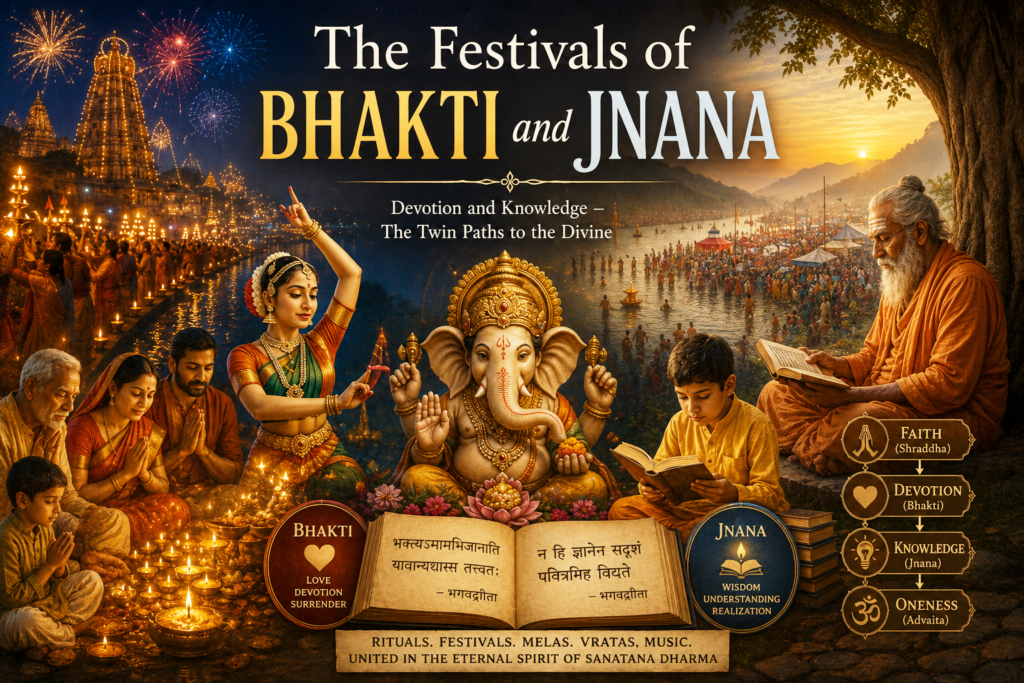
The fourth reason is devotion (bhakti). While faith or dedication (shraddha) can be found everywhere in the world, bhakti is unique. It is only in India that the various forms and stages of bhakti have been deeply analyzed; such a complex presentation cannot be found anywhere else. Bhakti is distinct from mere faith (shraddha). Faith is the positive sentiment you hold toward the principles you admire and accept. Bhakti, however, is the intense state of spiritual practice (sadhanabhava) where you realize that principle through absolute dedication, a sense of oneness, and your own temperament. Bhakti is the act of tuning your internal ‘frequency’ to the ‘frequency’ of cosmic energies that lie beyond sensory perception, thereby creating absolute oneness. Possessing the awareness of such elevated devotion at the level of consciousness is knowledge (jnana). Therefore, devotion and knowledge are complementary to each other. They are both indispensable in spiritual practice. Devotion without knowledge is merely blind faith. Similarly, knowledge without devotion is nothing more than dry intellectual thought.
For highly advanced seekers, knowledge and devotion merge into one. For the common person, pursuing devotion directly through the path of knowledge is difficult. For them, a step-by-step approach makes spiritual practice easier: entering the primary stage of devotion through faith, achieving the primary stage of knowledge through that devotion, ascending to a higher level of devotion through that knowledge, and finally reaching the highest peak of knowledge.
Ours is a civilization of devotees. At the primary level of devotion, external rituals play a massive role. Even in our classical music, devotion is the primary emotion (rasa) and the core foundation. The perspective of our traditional saint-composers is that “of what use are rhythm and melody for a song devoid of love?” and “there is no musical knowledge without devotion.” Bhakti encompasses love, loyalty, attachment, respect, meditation, communication, bonding, and ultimate merging. At the initial level, devotion follows the path of duality (dvaita). As devotion transforms into intense love, it culminates in a sense of absolute oneness, reaching the highest realm of knowledge to become the experience of non-duality (advaita).
However, it is impossible to establish a society or civilization purely based on inward meditation without any external rituals. Therefore, in our culture, daily duties (nityanushthana), daily practices of devotion, special festivals, vowed observances (vratas), and rigorous austerities are all richly present and complementary to one another.
This very synchronization of devotion (bhakti) and knowledge (jnana) is what we worship as Siddhi (attainment/fulfillment) and Buddhi (intellect/wisdom) during the adoration of Lord Ganesha.
Author