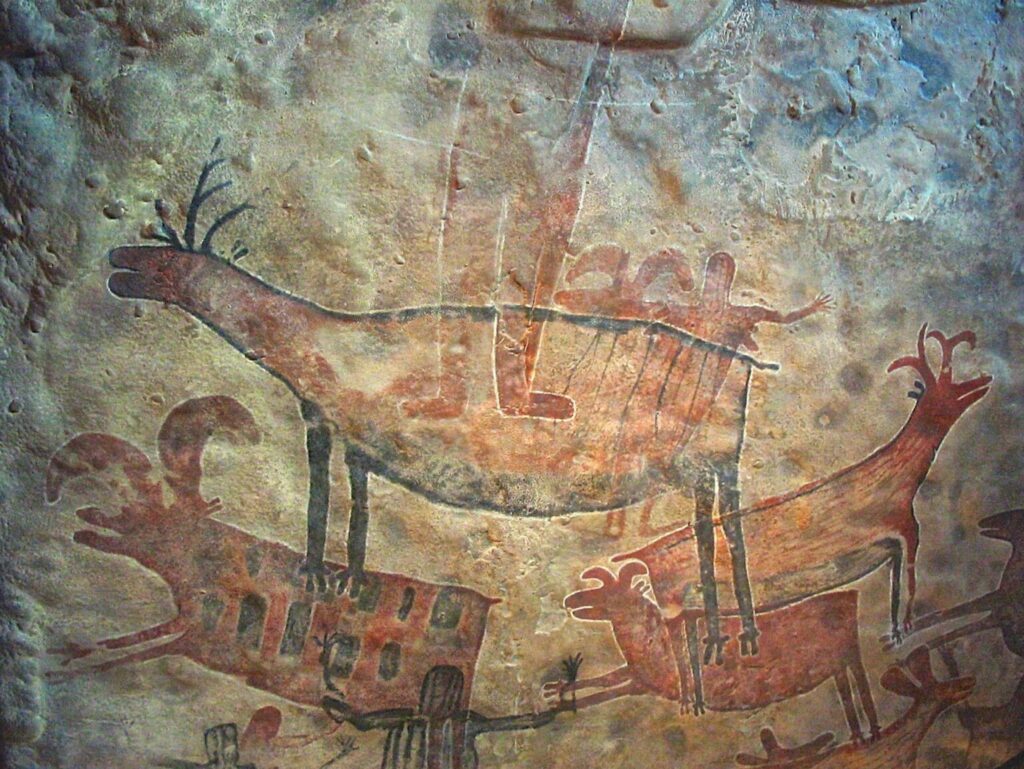
Many people have the misconception that long ago, humans lived like animals. That is wrong. There is ample evidence to suggest that people lived long ago in the same simple manner found in our villages today. For instance, there is evidence that humans around 100,000 years ago had learned to make colors by mixing various ingredients.
Similarly, scientists previously believed that the modern human species (Homo sapiens) developed the ability for complex, abstract thinking around 70,000 to 80,000 years ago. However, it was later discovered that humans possessed this capability 20,000 to 30,000 years earlier than that. A team of researchers led by Christopher Henshilwood, working at the University of Bergen in Norway and the University of the Witwatersrand in South Africa, uncovered this fact.
One-hundred-thousand-year-old remnants were found in South Africa’s Blombos Cave. Among these was leftover red paint! It had been stored inside a shell. This paint was made by mixing several materials. This implies that humans back then possessed the knowledge of which materials to mix and in what quantities to produce colors.
Two shells were found in different locations. Both contained paint, and both were identical in chemical composition. This means it was not an accidentally created color; the paint was prepared by following a specific formula. This implies that chemistry (knowledge regarding chemicals) existed a hundred thousand years ago!
Now let us focus on another matter. It has been proven that people were using mattresses (beds) to sleep on not 5,000 or 10,000 years ago, but 77,000 (yes, seventy-seven thousand!) years ago! A petrified fossil of a mat-like bed from 77,000 years ago was found in South Africa a few years ago. An international excavation team led by Lyn Wadley of Johannesburg discovered these petrified fossils. This bed, spanning an area of 22 square feet, had an estimated thickness of about 1 foot!
The people of South Africa at that time prepared beds using plant-based materials, much like today’s mats. Not only that, but the fossils revealed that they used a bedsheet made of a specific type of leaf (insecticide) on top of the bed to ward off insects! This implies that the medicinal importance of plants was known to humans as early as 77,000 years ago!
Look at another interesting example. Excavation work had been carried out for several years in the Hohle Fels caves in the Swabia region of southwestern Germany. In September 2008, an excavation conducted by a research team led by Dr. Nicholas Conard of the University of Tübingen unearthed some ancient flutes! Nicholas published his study report in the scientific journal Nature. Many other objects were found, one of which was an ancient female figurine.
Anyway, some of the flutes found during the excavation were made from mammoth ivory! One of these flutes was completely intact and was crafted from the wing bone of a griffon vulture. One end of the flute was split into a ‘V’ shape, and five finger holes (musical note placements) were drilled into it. The flute was 21.8 cm long and 8 mm in diameter. It was sent for Carbon-14 dating. The result stunned the scientists. According to the Carbon-14 test, the flute is over 35,000 years old! This is the oldest musical instrument discovered in the world so far.
Although it is in good enough condition to be played even today, experts have not allowed anyone to play this flute. However, experts newly crafted an identical flute from a vulture’s wing bone and tested it by playing it. The melody that emerged from it was wonderful!
Some experts say that humans left Africa and reached different parts of the world about 50,000 years ago. The discovery of this flute clarifies the following points:
- Advanced Civilization: Human civilization was quite advanced 35,000 years ago.
- Musical Knowledge: Humans back then possessed knowledge of music and musical notes!
- Daily Integration: Music was a part of their daily life.
- Diverse Skills: Aside from just hunting, they also had the skill to craft musical instruments and figurines.
- Craftsmanship: Processing and carving ivory, in particular, is a very difficult task. Knowing this skill signifies that the civilization of that time was advanced.
- Social Structure: Since music existed, it implies that social relationships and a collective way of living were also present.
The moment we hear that people back then lived in forests, the notion that “there is not much difference between animals and humans, ancient humans were like gorillas or chimpanzees” crops up in our minds. The reality is not so. Human civilization dawned in the forest itself, through forest-knowledge. Nature was the first guru that taught spirituality. The section containing the oldest hymns of the Vedas is called the Aranyakas (those understood/revealed in the forest).
The moment we think of the ancient world, we cannot draw boundaries in our minds like India, Pakistan, Iran, Arabia, or Africa. Everyone knows that in the world of more than 10,000 years ago, there were no political boundaries like today, right? Until very recently, all the forests of India were as if they were one. Even if state borders were conceived, no such differences were felt inside the forest. The experience of borderless unity was universal.
Similarly, it is no surprise if entire continents were knit together by forests and natural culture thousands of years ago. It is also not surprising if cities existed where forests stand today. The massive Angkor Wat temple and the entire metropolis of ancient Cambodia were covered by forest; its discovery happened just two centuries ago. We must keep in mind that today’s borders do not match the ancient world, and we cannot assume that the ancient natural and geographical features were identical to those of today. Even if we assume there were conflicts among the communities of that time, there is no denying that geographically, forests were as vast as oceans. Imagining the Earth of that time from today’s global perspective will not provide a realistic picture. It is no surprise if what we now call the Amazon Rainforest previously spanned the entire South American continent (even now, it is the world’s largest and lushest forest). Likewise, we cannot rule out the existence of a metropolis where a forest stands today. Our job is simply to explore wherever a doubt arises.
The exciting thing we must note now is the discovery of strange geoglyphs (line designs) in the Amazon River region. It is now believed that an advanced ancient civilization existed there. Ironically, deforestation was the cause behind this discovery! As the forests of the Amazon basin began to vanish, the secrets within the forest started coming to light. Some time ago, in a deforested area, massive circles, squares, and other geometric patterns carved into the ground were discovered! The dense forest had concealed those designs.
According to available material evidence, Indian civilization is over 10,000 years old. However, if we consider the rock paintings in the Bhimbetka region, the history of Indian civilization must be pushed back to 50,000 years ago. If proper studies are conducted on the Ram Setu in the Rameswaram sea, information hitherto unknown might surface. But is our mind mature and open enough to accept all of it? Why are we faltering by not conducting proper studies even on the pyramids of Egypt? Due to some religious, ideological, or political prejudice, we are dragging the history of civilized life as close as possible to the present era.
Returning to the Amazon forest, satellite photographs of the Amazon River basin were taken in 1999. They were analyzed 8–10 years later. At that time, more than 200 massive man-made geoglyphs were found across a vast area of about 250 km! The patterns were immediately subjected to scientific study. Their antiquity was estimated to stretch from the 3rd century AD to the 13th century AD. Denise Schaan, an anthropologist at the Federal University of Brazil, authored the study report on these shapes.
The ‘history’ written by Europeans has long claimed that until European Christians invaded in the 15th and 16th centuries, those living in the Amazon region were merely rough, wild forest dwellers. However, the new discovery created an inevitability to rewrite history. Because those who carved such massive designs must truly have been highly advanced in technology and understanding!
Remember, these are shapes from thousands of years ago. What about their size? When we say ‘massive’, they are truly colossal. To create these shapes, lines were formed by digging trenches that were 36 feet wide and several feet deep. This means every single line was 36 feet wide and several feet deep! Standing next to those lines, you cannot see the whole figure; it only looks like a long trench. Their true forms become visible only when viewed from above (i.e., from airplanes or satellites).
Why such massive figures were carved remains a mystery. What is even more peculiar is that footpaths and unpaved dirt roads were also constructed to move from one figure to another! What does this mean? In that era, there was no forest in that location! If so, what else was there? What was the purpose of these massive figures? Nobody knows.
The Essence:
The essence of all this is: we possess very little information about the ancient world. Spinning various theories based on just that is common practice. However, every time researchers learn something new, a new challenge arises. Our preconceptions about old times turn out to be false. The knowledge and technology of the ancients go much further back than our imagination. Hence, it is difficult to pinpoint the starting point of civilization. Trying to explain everything solely based on newly manufactured hypothetical theories is an unscientific approach. Perceiving time on a religious basis in a backward order—as BC and AD—to understand and write the long history of the Earth is sheer foolishness.
Author