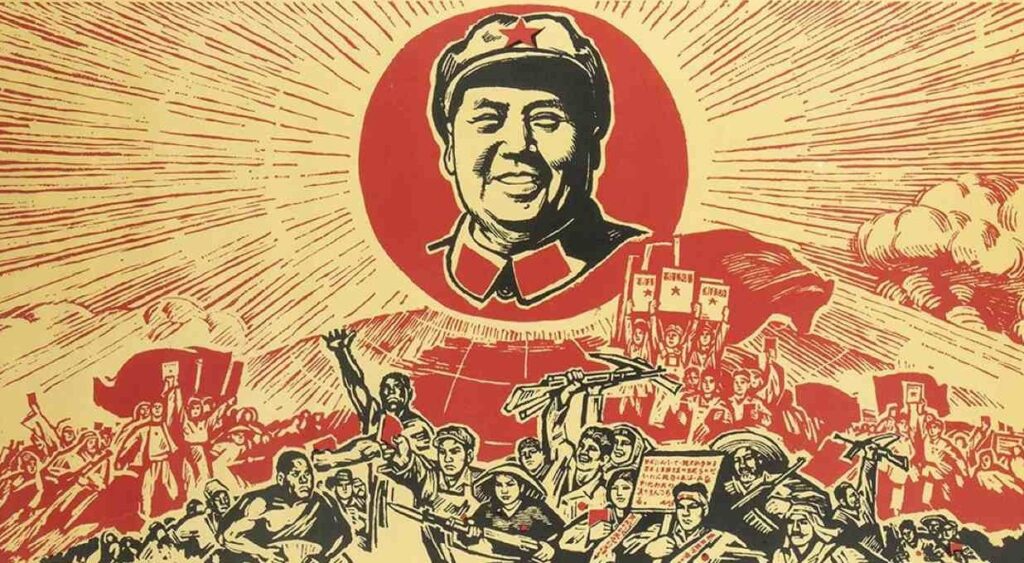
The Union Home Ministry had announced that China-sponsored Maoist Naxal terrorism would be completely eradicated by March 31, 2026. Now, significant progress has been made in the elimination of extremists.
Security experts state that since the elimination of the notorious extremist leader Basavaraj, the Naxal organization has been disintegrating. Bastar, which had been the epicenter and stronghold of Left-wing terrorism since the 1980s, is now becoming ‘extremist-free.’ With the cooperation of state governments, Naxals have been neutralized on a daily basis. Many surrendered. It can be said that India is winning the war against China (and US-Pak) sponsored terrorists.
It may take some more time for the nuisance of Maoist slogans to subside. To effectively face the problem of slogans, the problem of guns must first be resolved. The Home Ministry and security forces are succeeding in that task.
Many still perceive Maoist violence as a local issue. This is due to attempts to portray it as a “socio-economic problem.” Experts say that creating such intellectual confusion is the responsibility of the ‘urban Naxals.’ These Naxalite intellectuals throw dust in the eyes of the public by portraying forest-dwelling Naxal attackers as heroes fighting a pro-people struggle for development and equality.
The nuisance of Chinese Maoism is a global phenomenon. It goes by different names in different countries; in India, Maoist extremism is launched under the name ‘Naxalism.’ Their primary propaganda tactic—common to all brands of terrorists worldwide—is to claim that theirs is merely a reactive ‘struggle,’ that they are facing ‘injustice,’ and that the struggle will stop automatically if the injustice is rectified. A major portion of their budget is spent on propaganda strategies. All large terrorist organizations have ‘front offices’ consisting of intellectuals, influencers, and ‘elites.’ Their job is to ‘rationalize’ terrorism by giving it a veneer of morality. Portraying the nation’s security system as villains, projecting terrorist ideologies as idealism, and promoting terrorists as socially concerned individuals are all part of the Maoist strategy.
If terrorist acts become excessive and difficult to justify immediately, they have a standard tactic for that too. In such situations, the intellectual supporters of terrorists argue:
“It is wrong to measure the core ideology through the violent acts of a few. Maoism is the voice of the oppressed, the suffering, the victims of injustice, and the grassroots communities. Reactionary forces are misinterpreting it. Who is responsible for warm-blooded youth picking up guns in the name of Mao? These youths have set out to face injustice in their own way. Even if their method is wrong, the existence of injustice is real. A permanent solution is not possible through police operations. Counter-violence is not the answer to violence. Is it not true that injustices are happening? Who is supposed to resolve all that? It is natural for people to become frustrated when you fail in your duty. Pushing people into such frustration is dangerous.”
This has been going on for many decades. To justify Maoist extremism, examples of different ‘injustices’ are given in different countries. This is what is meant by the ‘rationalization’ of terrorism.
Global Strategy of the CCP
Since the beginning, the Communist Party of China (CCP) has been involved in the mischief of cultivating Communist pockets within the world’s democratic countries. Until the 1960s, the Soviet Marxist Communist Party acted like a high command for all Communists in the world. After 1962, its grip loosened. At the same time, the CCP’s influence began to increase over the Communist parties of many countries. China’s invasion of India also happened in 1962; it was no coincidence. The era when ‘Naxalism’ began to sprout under the leadership of Charu Majumdar and Kanu Sanyal (1967) was also no coincidence. These were all systematic plans of CCP expansionism. If one observes world history, it becomes clear that ‘Naxalism’ is part of a global grand strategy to expand CCP control. (Some Naxal leaders who escaped India in the 1960s went to China and personally held secret meetings with Mao Zedong. A ‘first-hand narrative’ of how he promised them all cooperation was reported in detail in the Outlook weekly a few years ago).
The CCP seized power in China by following the ‘Protracted People’s War’ strategy formulated by Mao in the 1920s and 30s. Later, thinking it possible to capture power in other countries using the same tactic, Maoist Communists started unrest at a global level. In the 1960s, the CCP created rifts in the Communist parties of many countries. The Albanian Labour Party joined the CCP. The Communist parties of Burma, Thailand, New Zealand, and Indonesia joined hands with the CCP. Initially, all Communist organizations that sprouted ties with the CCP added fancy names like ‘Marxist-Leninist’ or ‘Revolutionary’ after their names. Gradually, the direct name ‘Maoist’ came into use. These were all the offspring of an attempt to create a new international Communist movement under Mao’s leadership as an alternative to Soviet leadership.
‘People’s War’ does not mean a war of the people; it is a ‘war’ conducted by the Maos in the name of the people. ‘Protracted People’s War’ is happening in many countries. According to experts, money and weapons flow to Indian extremists from China, Pakistan’s ISI, and many other international sources. Strategies are taught. They also collect money through criminal and unethical means like extortion and robbery, by taking ‘security commissions’ from contractors and businessmen, and by imposing ‘taxes’ on the people. They also plan to gain the support of enemy countries and enemy organizations of respective nations. ‘People’s War’ is a global concept similar to ‘Jihad.’
Tactics and Infiltration
China’s is a ‘mobile’ war strategy (Mao called it Yundong Zhan). In this, there is no ‘declared’ battlefield. There need not be a direct confrontation of missiles and tanks. It is a form of ‘Kutayuddha’ (clandestine warfare). The Chinese themselves decide what the ‘battlefield’ should be. They create conflict in border areas convenient for them. The soldiers of the ‘People’s Liberation Army’ are not those who fight ‘for their motherland.’ They are not soldiers of the nation; rather, they are soldiers of the CCP. They fight for a political party, not for a country. Since the CCP has no idealistic dimension, it naturally does not pay heroic honors to its martyred soldiers. In China, even military war is planned like guerrilla warfare. There is a similarity between the ‘war’ of Chinese soldiers and the ‘conflict’ of Naxal extremists. Just as there is no difference in the behavior of ‘official’ soldiers and ‘unofficial’ Jihadis in Pakistan, there is no difference in mentality between the guerrilla force and the military force in China. A clue to this mentality is found in Mao’s book On Guerrilla Warfare (Yuji Zhan).
According to Mao, guerrillas must start their armed activities in rural and hilly areas. One can observe the military behaving in the same way! In cities and towns, elite and intellectual supporters are planned to conduct a ‘propaganda war.’ China’s method is generally to ensure that conflict occurs in places unfavorable to its opponents. Identifying weak targets, launching sudden attacks, and then escaping is its standard tactic. Propaganda war, psychological war, and cyber war—all are employed. The CCP makes changes in these tactics according to the context and daily requirements.
By bagging influencers from various democratic countries including America, Europe, and Australia, ‘semi-Communist’ style ideas are being pushed into democratic politics. For this, the CCP is ready for everything from corruption to ‘joint ventures.’ It has come to light that several members of the Democratic Party (and some in the Republican Party) in America have had illicit dealings with China. More than 1 billion dollars flowed from China to the company of Joe Biden’s son. The last thing Biden did before leaving power was granting a presidential pardon to his son! Money is being invested by China-based companies into the companies of Donald Trump and his children, who are obsessed with cryptocurrency. Private companies in China are not fully ‘private’; they remain under the control of the government, i.e., the CCP. The CCP is the sole power behind all the political, military, and economic spheres of the Chinese government.
Maoist armed terrorism is active in India, Nepal, and Bangladesh. Maoist violence exists in Peru in South America and among Turks in Asia. In the Philippines, an independent Maoist organization called the ‘Communist Party of the Philippines’ has engaged in violence under the name ‘New People’s Army.’ Left-wing terrorism exists in Germany too. The stand of Maoist Communists is that “Maoism must become the world system.” They do everything with a purpose. There is a calculation behind their every step and a very detailed action plan.
Even if the attraction of Chinese Maoism has now faded in India and extremists are surrendering, one cannot assume the ‘Maoist’ nuisance is over as long as the CCP is active. It is important to continuously prevent extremists from ‘regrouping.’ A comprehensive action plan is needed for that. After eradicating the nuisance of forest terrorists, the other challenges that the CCP has already created—and may create in the future—must also be conquered.
Author