People generally feel that the train is very “modern.” It is natural for the common man to assume that other mechanical or motor vehicles existed first and the train came later. Surveys conducted in many countries have shown that most people hold this opinion. However, the reality is quite different. We transitioned directly from bullock carts, horse carriages, and pushcarts to train travel. The train is much older than motor cars and buses. Trains were invented even before the bicycle. The petrol car came into use in 1885. The ‘Penny Farthing’ bicycle, with its one large wheel and one small wheel, was produced in 1870. The airplane arrived in 1903. But the passenger train came into use as early as 1825. Even before that, other models of rail wagons existed.
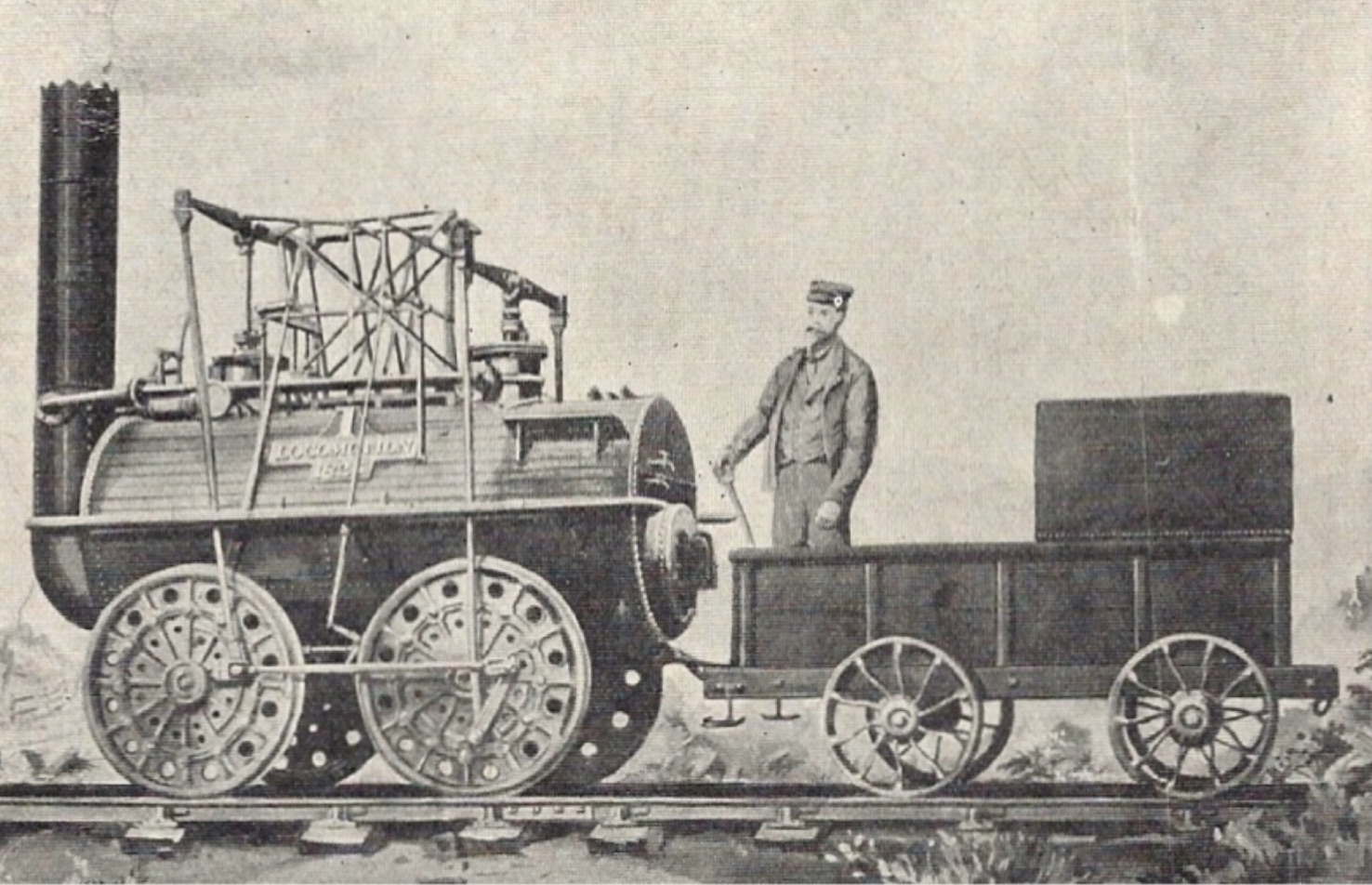
In 1825, British engineer George Stephenson built the first passenger steam railway. That year, his first engine, ‘Locomotion No. 1,’ set off pulling small carriages filled with passengers. This first rail journey took place from Stockton to Darlington in England on September 27, 1825. Its maximum speed was 25 kilometers per hour. It has now been exactly 200 years since the birth of rail travel.
The train used in 1825 was a steam engine. A commercial steam engine called ‘Salamanca’ had been built as early as 1812. An experimental engine model was ready by 1804. James Watt, the Scottish scientist, played a vital role in developing the knowledge of steam engine manufacturing.
Vehicles running on tracks have existed since much earlier. When I say “train” here, I am referring specifically to the passenger steam-train. In reality, “Rail” means “laying bars” or “rows of beams.” From that perspective, the history of rail carriages goes back many more centuries. In those ancient times, there were unique kinds of rail wagons. They were vehicles for transporting goods and cargo. Small bogies would be fitted onto railway tracks and pulled by horses. In such “horse-trains,” there was no system for taking people for a fee. Viewed this way, it has been 200 years since people began traveling by train. People welcomed the steam train that entered public use on September 27, 1825, with a mixture of immense joy and fear. They were thrilled by the speed of 25 km/h, calling it “super speed”! They celebrated how quickly one could travel from town to town. Some, however, were terrified that “traveling at such speed might cause suffocation.” A few scientists added their voices to this, offering the “scientific opinion” that “speeds exceeding 30-40 km/h are not good for health. It might cause breathlessness!”
All of that is thrilling history. Railway travel has come a long way since then. Once the railway, which only transported goods, transformed into passenger transport, the picture of the world changed. Distant towns began to feel “close” to people! Visiting the homes of relatives and friends became easy. The spread of art, culture, and literature became smooth. News dissemination and journalism grew. There was a revolution in postal services. The contribution of trains to world literature is immense. “Rail travel” itself grew into a major literary genre. The experiences of rail travel began to provide a level of inspiration even greater than that provided by long sea voyages. To savor the global rail travelogues of the previous generation, one must read the books of American novelist Paul Theroux. He has beautifully reconstructed the Indian railway experience as well. Sometimes, reading about it is more delightful than seeing it in person!
Those who wish to have a true travel experience—slowly, without haste or urgency—should travel by train. To see any country well and to understand and experience the life of its people, rail travel is essential over air travel. Then and now, sitting on a train and reading a book is pure bliss!
The history of Indian Railways is also fascinating. It began in the mid-19th century. Railway engineers of that era, like Roland Stephenson, John Chapman, and Arthur Cotton, were big dreamers. Roland Stephenson (even back then!) reportedly had an irrepressible dream of laying railway tracks from Calcutta to London! Similarly, it was his (and the British officials’) dream to lay a rail route from Calcutta to Peking (now Beijing) and Hong Kong. Although the British goal was to loot and easily transport India’s wealth, imagine what a magnificent tourist project those international rail routes would have been today! Globally, it would have been a network of tourist trains more attractive than the Trans-Siberian Railway. Arthur Cotton apparently dreamed of connecting India’s rivers and creating waterways across the country, similar to rail routes. That project was discussed in the British Parliament in the 19th century. Ultimately, as a result of “Railway lobby politics,” it was decided: “No to waterways, let’s focus on rail routes.”
Today, there are no engineers who dream such international dreams and yearn for them intensely, nor is there the political consensus to make them a reality. There are NGOs to obstruct everything, “activists” to protest everything, and courts to grant “Stay Orders” on everything. Geopolitics has deteriorated to the point of creating a series of wars just to block the ‘India-Middle East-Europe Economic Corridor’ trade project.
In India, too, train services began before bus services. On April 16, 1853, the first train in British-ruled India departed from Bori Bunder station. What joy the people felt that day! There were about 400 passengers on this first train. The rail service, started by the British to facilitate the transport of Indian goods to their country, gradually grew like a giant banyan tree. Today, the Indian Railways has a network of over 132,000 km of tracks. Every day, about 30 million people travel together in Indian trains without any distinction of caste. Castes exist only in the minds of wicked politicians.
The “Chuku-Buku” history of India, which began in 1853, has crossed many milestones and hurdles to come a long way. Although it lags slightly behind the railway companies of wealthy nations in terms of quality, amenities, cleanliness, and speed, “Indian Railways” is like a separate world in itself. Along with rail travel, it includes hotels, meals, snacks, its own police force, and a separate medical system. Despite its shortcomings, Indian Railways is a magnificent institution that has influenced six or seven generations and transformed the country. It is now a company owned by the Government of India and one of the largest railway companies in the world. At one time, Indian Railways was considered the “largest employer in the world.” Even now, more than 1.2 million people work for Indian Railways. The organization possesses more than 13,000 passenger trains and is currently capturing global attention with the high-quality ‘Vande Bharat’ trains.
This is the era of new kinds of rail carriages. Many generations of old trains that used to travel making the “chuku-chuku” sound on the tracks have ended up in museums. Across the length and breadth of Japan, high-speed trains known as ‘Shinkansen,’ famous as ‘Bullet Trains,’ are running. The Japan Railways has a wonderful train schedule and signaling system where not even a minute is misplaced. With Japan’s help, work is underway to establish Bullet Train services between Mumbai and Ahmedabad in India. Another amazing technology is using electromagnetic force to make trains move at extreme speeds. This technology is being used successfully in Europe, Japan, and China. It is called ‘Maglev.’ ‘Maglev’ is the short form of ‘Magnetic Levitation.’ These trains do not have tracks; they have special guideways. Due to magnetic force, the train floats slightly in the air above the ground and moves forward rapidly. The Maglev train has set a record by traveling at 581 km/h! However, it is not possible to travel at that speed all the time. Generally, Maglev trains travel at an average speed of about 250 km/h.
When the train was seen for the first time in the world, many opposed it. Irish scientist Dionysius Lardner argued strongly that “Rail travel is difficult. If the train travels at high speeds, people will die of suffocation.” Today, traveling at 500 km/h has become “common”!
Author