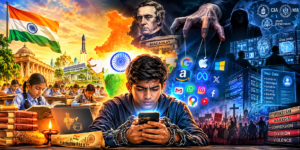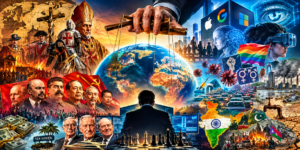
Though India has officially been a “Sovereign Democratic Republic” for 76 years, there are still many areas where true independence and self-reliance have not been achieved. One of the most crucial sectors where India remains deeply dependent on America is the digital technology sphere, which holds both economic and strategic significance. The indirect control, surveillance, and dominance of American companies over India’s 1.5 billion people — from stealing personal data to influencing daily lives — continues to persist. Many of America’s tech giants, including those in AI, work closely with U.S. military and intelligence agencies such as the CIA and NSA, often without the public’s full knowledge.
When you buy a smartphone, smart TV, smartwatch, smart car, or even a personal computer, you are unknowingly purchasing a product that is already “hacked.” The companies that create these devices, operating systems, and software are continuously stealing your personal data — your every move, live location, camera images, habits, weaknesses, purchases, health, income, loans, arguments, and court cases are all being harvested. This is the global “intelligence” technology that the U.S. government has created to collect data from the entire world, constantly surveilling us. The term “smart” is nothing more than a clever marketing tool to make us feel secure. If you think of these devices as “spy” devices (Spy Phone, Spy Watch, Spy TV, Spy Car), the true nature of these tools becomes apparent.
The digital slavery that Indians are trapped in is vast, with about 90 crore internet users. India remains the largest user of platforms like WhatsApp, which is now equipped with AI surveillance — more so than even the American users. While Chinese citizens have WeChat as their domestic platform, India remains the largest user of WhatsApp globally, with over 860 million users. The U.S. has provided AI-driven chatbots for free to Indians (and you can guess the real reason for that). Indians, largely unaware, have become lab rats in the “AI” experimentation conducted by the U.S. intelligence agencies, becoming the largest consumers of American digital services.
While there are several major global powers, only four countries can truly be called “sovereign”: the U.S., Russia, China, and, to a large extent, India. Among these, India has yet to achieve full sovereignty in digital and technological matters. China realized the dangers of over-relying on U.S. technology and developed its own indigenous systems long ago. Russia, after severing its ties with the U.S., has been developing its own systems out of necessity. However, India has neither the foresight nor the urgency to sever ties with American tech companies. Instead, through investments, partnerships, and compromises, India has fallen deeper into America’s technological grip, struggling to escape from it.
India, in the guise of its “Digital India” mission, still relies on American technology to drive its progress. This mission, under Prime Minister Narendra Modi, has not been aimed at achieving complete independence. Instead, it has been about harnessing existing American technologies, working with U.S. Big Tech companies, and making India’s economic infrastructure digital by relying on their investments. This approach, though perhaps necessary at the time, has made India more vulnerable in the long run.
China understood the importance of technological independence long before India did. Had India shared the same foresight, it could have achieved complete digital sovereignty by now. However, India’s recent initiatives, such as the “AI Vision,” “Semiconductor Mission,” and “Quantum Development,” are still at critical stages and may take several more years to materialize. The rapid pace of progress made by Indian scientists and engineers, while commendable, has not been enough to overcome the disadvantages of starting late.
In terms of defense, India has made notable strides in ensuring that the digital technologies used by its military are largely indigenous. The military’s computers run on their own operating system (“BOSS Linux”), and there is a separate operating system for military mobile phones (“BharOS” — Bharat OS). India has also created independent cloud storage and cloud computing systems. In government departments, India has moved away from using CIA-backed platforms like Gmail and Yahoo, shifting to its own indigenous email platform, Zoho Privacy Mail.
India’s digital sovereignty is progressing, but the pace is still too slow. The “Digital Personal Data Protection Act” (DPDPA 2023), which will be fully implemented by 2027, has provisions for data security, but it is not enough to completely disconnect from American surveillance systems. While there are developments in securing government systems, the digital freedom of ordinary citizens is still a long way off. The real question is how much control India can take over its digital destiny when the vast majority of its tech infrastructure is still dependent on American systems.
Even though there have been some major improvements, India’s public systems, security infrastructure, and digital autonomy are far from self-sufficient. One area where India has made a remarkable achievement is the Unified Payments Interface (UPI), which is now being globalized. UPI has reduced dependence on the dollar and provided many countries with a cost-effective and efficient payment system. However, such self-sufficient systems are still limited to a few sectors. The UPI’s success is a shining example of what India can achieve with its own digital innovations, but there is still no substitute for creating homegrown solutions across all domains.
The biggest tech companies in India continue to rely on American investments, partnerships, and technological dependence. Most large service companies do not have their own products; they rely on partnerships with American companies for their services. The American tech giants control the systems that power our daily lives, from Microsoft Windows to Apple products. India lacks its own computer chips, operating systems, search engines, and even web browsers. While there have been efforts to create alternative operating systems like “BharOS” (developed by IIT Madras), they have not been made widely available. The “Ula” browser, a homegrown product, still relies on Google’s “Chromium” open-source code and Google’s protocols, meaning it’s still under American control.
Without a truly indigenous operating system, India will continue to be a digital colony. Google Play Services are essential for almost all apps to function, and without a competitive alternative, India’s digital sovereignty remains in jeopardy. China and Russia have overcome such challenges by developing their own operating systems and digital ecosystems. Meanwhile, in the U.S. and Europe, open-source operating systems like Graphene OS are gaining traction, offering people more choices and freedom. In India, however, there is little encouragement for such alternatives.
Thus, while India has made strides in some areas of digital self-reliance, there is a long road ahead. The question of whether India can break free from America’s digital hegemony and develop a truly sovereign tech ecosystem remains unanswered. Without a comprehensive plan to develop homegrown systems in areas like operating systems, chips, and internet infrastructure, India’s digital future will always be at the mercy of external forces. The government must create the conditions for the public to be part of this revolution, so that “government independence” does not equate to “people’s digital slavery.”
(C) G. ANIL KUMAR
Author