In many ways, 2030 is an important year, and the decade of the 2030s is a crucial one. By 2030, many of India’s current security projects are expected to reach a decisive stage. If everything proceeds as planned, the major rockets and missiles currently under development will be completed and inducted into the military by then. More than a hundred Su-57 fighter jets from Russia and Rafale fighter jets from France and Israel—which have already been ordered—will have been delivered. New nuclear submarines and naval bases will be ready. At the strategically important southern tip of Nicobar Islands, the planned air and naval security base is expected to be largely operational.
India’s self-reliant digital initiatives currently under development—security satellites, navigation technologies, indigenous semiconductor chip-sets, and homegrown AI products—are also expected to be ready for deployment. By 2030, India is projected to emerge as the world’s third-largest economic power. With such achievements, it would become difficult not only for Pakistan, but even for China and the United States to act adventurously against India.
Therefore, the next 4–5 years are extremely critical for India. During this period, it is vital to ensure internal stability, security guarantees, political determination, economic foresight and resilience, scientific and educational quality, effective international engagement, commitment to national interests, and timely reforms. Any deviation in these areas could hinder preparations for 2030.
According to many global security experts and think tanks, the 2030s could become a decade of major wars. Current geopolitical developments suggest that this concern may not be unfounded. Fears that were dismissed as “ridiculous” five to ten years ago now appear increasingly realistic, given the visible and invisible forces shaping global events. Global alignments, political inheritances, and strategic equations are changing rapidly, almost daily. Whatever challenges arise, India has no choice but to be fully prepared and capable of overcoming them. If the major obstacles on the path to 2030 are not removed swiftly, the country could face serious difficulties.
Only if several factors align properly—availability of natural resources, agricultural land and productivity, favorable climate, industrial growth, appropriate educational advancement, civic values of peace and harmony, social and political stability, relationship-based economic systems (reducing excessive government burden), efficient supply-chain management, and technological development—can a country achieve substantial self-reliance and remain insulated from the worst impacts of global turbulence.
Due to war, Europe’s economy is in decline. Eastern nations such as Japan and South Korea are not seeing significant economic progress. China faces political and economic challenges. Despite obstacles, Indian society has not collapsed. Henry Kissinger had clearly warned that if the Russia–Ukraine war did not end soon, it could escalate into a global war. As someone deeply familiar with the hidden mechanics of global power politics, his warning cannot be dismissed lightly.
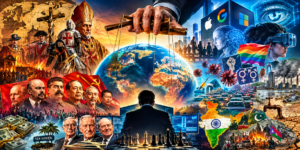
It appears that certain forces are deliberately pushing the world toward serial conflicts and possibly a major war. The revelations surrounding the Jeffrey Epstein files have exposed the demonic faces of influential global elites, underscoring the need for vigilance against unscrupulous and uncivilized forces. The dominance politics of the U.S. dollar, oil geopolitics, control over strategically important territories, supply politics of rare minerals, and the nexus of drugs, crypto, and terrorism—all seem to be fueling a possible “dark plan” for 2030.
Amid global crises, India stands out as the only large country achieving an average economic growth rate of 7–8%. Yet even a slight lapse in vigilance regarding obstacles ahead could prove costly. Nations and forces that cannot tolerate India’s continuous rise are creating new challenges and barriers—and will likely continue doing so. In international relations, there are no permanent “friends” or “natural allies.”
Border expansions and violations of limits often serve as preludes to major wars. For the first time since the 1940s, this decade once again presents fears of a global war. Geopolitical tensions that once unfolded over a decade now erupt within months. The churn is so intense that by 2030, the fate and even the maps of certain nations could change dramatically. More turbulence and upheavals are likely in the coming years.
Across sectors, divisions into “Left” and “Right” camps have deepened. In the United States, the conflict between neo-liberal and neo-conservative ideologies is intensifying, with global repercussions. Silicon Valley companies, asset management firms, and the “military-tech-industrial complex” are ready to invest enormous funds into their respective strategic agendas. Some corporations now have market capitalization exceeding the GDP of entire countries. Funds are strategically directed toward universities and media. Countries are pouring money internationally to advance their interests. Educational institutions and courts appear increasingly ideologically driven, sometimes prioritizing theories over constitutional principles. Governments that call themselves “democratic” are enacting laws resembling—or even harsher than—communist systems. An “ideological system” is visibly emerging worldwide.
A strategy to steal and control global data—thereby controlling individuals and even nations—is not widely understood. Even when governments are aware, many lack the economic and technological strength to counter it. Though India has the potential to respond, it currently lacks sufficient preparation and capital, leading to confusion about the right path forward.
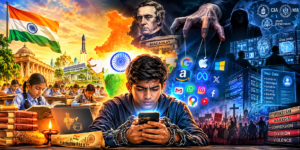
This stems from gaps in digital technology. Even if India advances in AI, if services from major American companies such as Google, Microsoft, Amazon Web Services, and Cloudflare were abruptly halted, the internet backbone of most countries—including India—would collapse (China’s national network might be less affected). India’s mobile services depend heavily on Google and Apple. Much of India’s celebrated digital infrastructure rests on American foundations. From the perspective of potential developments in the 2030s, this is India’s greatest vulnerability. In this era, military strength alone is insufficient; technological strength is the true power. Countries that have handed over their technological “levers” to others—including India—remain vulnerable.
Criticizing America is easy, but its achievements in human intellectual advancement are undeniable. The same applies to China. While its political system and assertiveness are criticized, its rapid advances in certain branches of science and technology—even surpassing America in some areas—cannot be ignored. Its intellectual hunger is as strong as its political ambition.
Over 75 years, India has made progress, but its role in transformative global technological revolutions has been minimal. From computers and the internet to smartphones and cryptocurrencies—developments that reshaped world history—the United States has been central. Indian technologists have excelled abroad, earning reputations as capable professionals. But how many groundbreaking technologies have been created for India itself? Though India has many talented individuals and some institutions produce world-class research, the scientific intellectual output of 1.4 billion Indians does not match that of 330 million Americans. Many Indian achievers contribute to the growth of other countries. This is a major obstacle on India’s path to 2030.
What if technologically dominant, militarily powerful, financially driven, and ideologically extreme forces cross strategic boundaries? That possibility now appears real. Some forces aim to spread jihadist ideologies and communist governance globally. The United States has long harbored a desire to maintain global dominance. Irresponsible nuclear-armed or ambitious nations such as Pakistan, Iran, Saudi Arabia, Qatar, North Korea, and Turkey are expanding assertively. Powers like United States, China, Russia, and Israel increasingly display open strategic assertiveness.
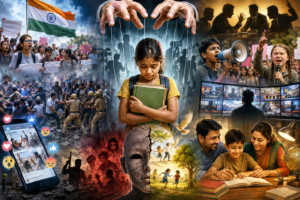
Before a “World War,” a “Culture War” is being amplified. An “Information War” has already begun. A global “Cyber War” is likely to move to the forefront. These are the battlefields of our time; military confrontation would be the final stage.
All these factors are becoming major global challenges, and their heat is beginning to affect India as well. In such circumstances, it is difficult for any nation to fully flourish. Yet India is somehow continuing to rise. However, its technological dependence remains massive. In the 2030s, even major corporations may become direct participants in conflicts—something already witnessed in parts of Europe, Iran, and Russia.
This means that India’s pursuit of technological self-reliance must accelerate with the urgency of a wartime mission.
(C) G. ANIL KUMAR
Author