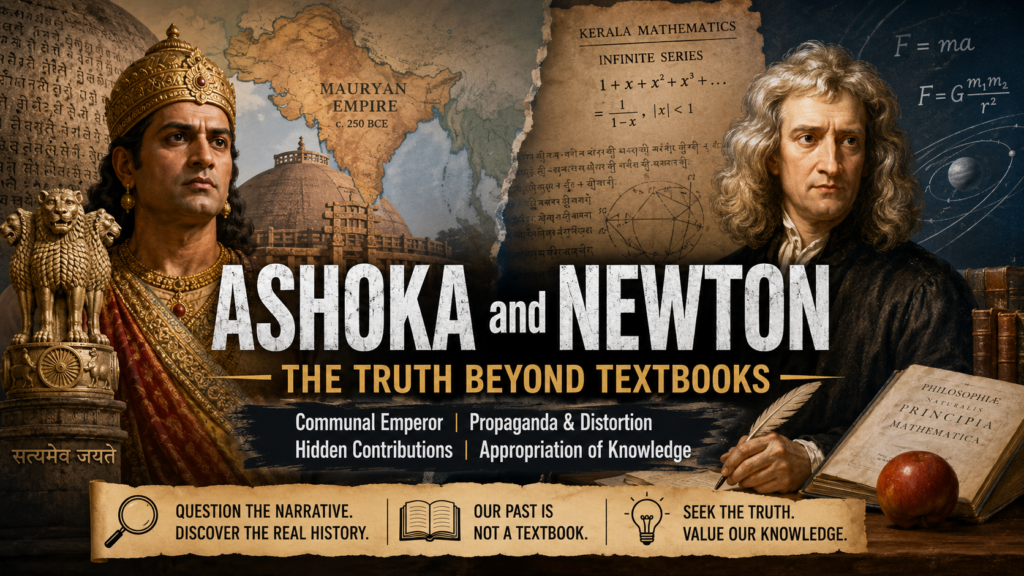
Our textbooks proclaim, “Ashoka was India’s peerless, greatest emperor.” They celebrate him as the first emperor to rule the entirety of India (as per the 1946-47 map). They praise him as the great “messenger of peace” of that era. It is believed that “his ideals served as the model for the new Indian Republic of 1950.” The Ashoka Chakra and the Lion Capital of Ashoka are recognized as our official national emblems. Yet, it is an interesting point to note that Emperor Ashoka was traditionally never accorded the revered status of an ideal king, nor did he ever attain the legendary hero status enjoyed by someone like Vikramaditya.
In Indian tradition, many great kings and emperors are remembered. Numerous Puranas name hundreds of royal dynasties. If one combs through the entire history of Classical Studies in the West, the collection of ancient dynasties found there is dwarfed by the massive treasury found in the Indian knowledge tradition. Even after the era of Puranic compositions ended, Indians wrote historical texts that fit modern definitions. Descriptions of many administrations have also been handed down through oral traditions. Not only in Vedic texts, but also in Buddhist and Jain texts, several ancient post-Puranic kings are revered as ideals. For instance, calendar eras (Shakas) came into use in the names of kings like Vikramaditya and Shalivahana. Similarly, Chandragupta Maurya and Chanakya are also remembered. However, in this tradition, no great devotion or reverence is seen toward Ashoka. It is not as if the authors, who wrote so detailedly and respectfully about so many kings, knew very little about Ashoka.
“Ashoka converted to Buddhism, which is why scholars of the Vedic tradition ignored him”—this is a common argument put forth by intellectuals. But did the Vedic tradition not accept Buddha himself as an “avatar of Vishnu”? The Shaiva tradition of Kashmir and the Nath traditions historically shared excellent relations with the Buddhist Tantric tradition. Even though Ashoka’s own grandfather, Chandragupta Maurya, converted to Jainism, no Vedic follower considered him an “outsider.” Furthermore, shouldn’t the ancient Buddhists at least have worshipped Ashoka? Yet, the Buddhist text Ashokavadana mostly lists and describes the negative aspects of Ashoka.
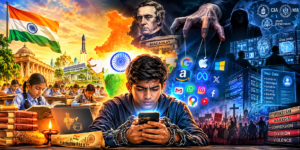
The glorification of Ashoka began during the British era. It was known to everyone that he ruled a massive empire and implemented several “social” projects. But the British wrote that he was “the first emperor to establish the empire-nation called India.” They proclaimed that “Ashoka was a secular king.” British author Charles Allen wrote a book titled Ashoka: The Search for India’s Lost Emperor. It repeats the same narrative: Ashoka was India’s founding father; a messenger of peace who advocated non-violence even before Gandhiji; one who achieved victory solely through moral means; one who brought global recognition to a small religion, and so on. “Ashoka was a messenger of peace. After invading the kingdom of Kalinga, he was deeply pained by the massive casualties of war. He then converted to Buddhism and became a pacifist,” our textbooks declare. Here, there seems to be an underlying implication to project that “before becoming a Buddhist, he belonged to a religion that preached violence.”
The reality is that Ashoka was the first and only communal emperor in Indian history. Just as King Constantine in Europe forcibly converted his subjects after converting to Christianity himself, Ashoka personally spearheaded the propagation of Buddhism. His administration carried an official religious character. His true nature is exposed by historian and economist Sanjeev Sanyal in his book The Ocean of Churn. The empire of Ashoka’s grandfather, Chandragupta Maurya, stretched from Afghanistan to Bengal. After him, his son Bindusara became the emperor. He died suddenly due to illness in 274 BCE. Bindusara had already appointed his successor, and that successor was not Ashoka. Bindusara had anointed his son Sushima as the crown prince and future emperor. However, when Bindusara died, Sushima was engaged in a war in the region of present-day Pakistan-Afghanistan. By the time he received the news of his father’s death and rushed back to the capital Pataliputra (present-day Patna), his stepbrother Ashoka, with the help of Greek mercenaries, had slaughtered all the prominent figures of the palace and seized the throne. Out of his lust for power, Ashoka had 99 of his stepbrothers and many senior palace officials killed. “It appears he did not spare Sushima either,” Sanyal writes. The only one he spared was his own full brother, Tissa. Yet, according to British and Marxist historians, he is the “Founding Father of India,” the one who “laid the foundation of moral governance in India.”
According to Sanyal (and also according to Charles Allen), Ashoka had converted to Buddhism even before the Kalinga War. He attacked the kingdom of Kalinga in 262 BCE. However, according to rock edicts, he had converted to Buddhism two years prior to that. This means there is no basis for the claim that he turned to Buddhism upon witnessing the violence of Kalinga. Buddhist texts like the Ashokavadana reveal that no religion was responsible for his actions; he was cruel by nature. He reportedly held the nickname “Chandashoka” (“Cruel Ashoka”).
Did he at least become a messenger of peace after converting to Buddhism? The edict where he expresses remorse for the Kalinga war was found in present-day Pakistan, not in Kalinga. Sanyal suggests that he might have run a propaganda campaign through edicts in distant regions to burnish his image. This is because, although many edicts from his reign have been found in Kalinga (present-day Odisha state), not a single one contains a hint of an apology. Even in the “remorseful” edict found toward the Pakistan-Afghanistan border, he delivers a threatening message: “I feel remorse for Kalinga. That being said, if you act up, the same fate awaits you.” The Buddhist text also records that sometime after the Kalinga incident, he massacred 18,000 Ajivikas in a single instance.
Furthermore, Ashoka was the first king to appoint officials akin to a religious “Thought-Police” to control people’s emotions and thoughts. Before him, there was no separate “department” in India to police people’s thoughts. When freedom of thought was systematically suppressed in Ashoka’s kingdom, what is there to praise him for? It is no surprise that the Indian tradition, which sung praises of Vikramaditya’s honest justice system, ignored Ashoka.
Another textbook hero like Ashoka is Isaac Newton. Europeans credit Newton and Gottfried Leibniz with creating the field of mathematics known as “Calculus.” In reality, it is argued that Newton might have acquired the research details of calculus from Indian sources. Newton never disclosed this. There were disputes between contemporaries Newton and Leibniz over who should be projected as the father of calculus. Neither of them uttered a word about India. However, the renowned mathematician Prof. C. K. Raju states that the entire credit for developing calculus belongs neither to Newton nor to Leibniz.
While India may not be the source of all knowledge, it is true that it was the source of most of the ancient world’s thought. It is also true that most Westerners covered up and hid where they received their primary intellectual inspiration. Even now, the common belief among our “educated” class is that “science is the West’s gift to the world.” This is a parrot-like lesson taught by colonial textbooks. Is Science Western in Origin?, a short book written by Prof. C. K. Raju, is a must-read for everyone. It reveals just how vast the web of systematic lies from the colonial era truly is.
The moment we think of Isaac Newton, two things come to mind: his laws of motion and the law of gravitation. There is no doubt that he was one of the geniuses. However, the statement that “he was the driving force behind the development of calculus in mathematics, and that the discipline did not even exist before him” is completely baseless. Prof. C. K. Raju effectively exposes the hollowness of this argument through his numerous books, articles, and lectures. In an official statement released by the University of Manchester on August 13, 2007, it was stated that the mathematicians of the ancient Kerala region of India were the true inventors of calculus.
The reality is that 250 years before Newton, Indians discovered the “Infinite Series,” which is the cornerstone of calculus. But the university went further, explicitly stating: “At that time, a team of Western Jesuit missionaries had come to India (Kerala). While designing the new Gregorian calendar, the experts of the committee formed by Pope Gregory XIII—particularly the German Jesuit Clavius—were interested in learning how the Kerala mathematicians calculated calendars. Jesuit missionaries had come to Kerala and took many mathematical notes back with them. There is circumstantial evidence suggesting that Newton later saw them. It can be said that he looked at them, learned from them, and then presented calculus (without naming the source).” (This was discovered by Dr. George Gheverghese Joseph, a mathematician at the university, who discusses non-European roots of mathematics in detail in his book). The University of Manchester added another paragraph at the end of its initial statement, saying: “Since the release of this statement, it has been brought to the attention of the University of Manchester that other researchers, like us, have done research on this matter and discovered the transmission of calculus from Kerala to Europe. The university wishes to recognize and acknowledge the research of all of them, especially that of Prof. C. K. Raju. It would have been better had we mentioned his name in our statement earlier.”
Author