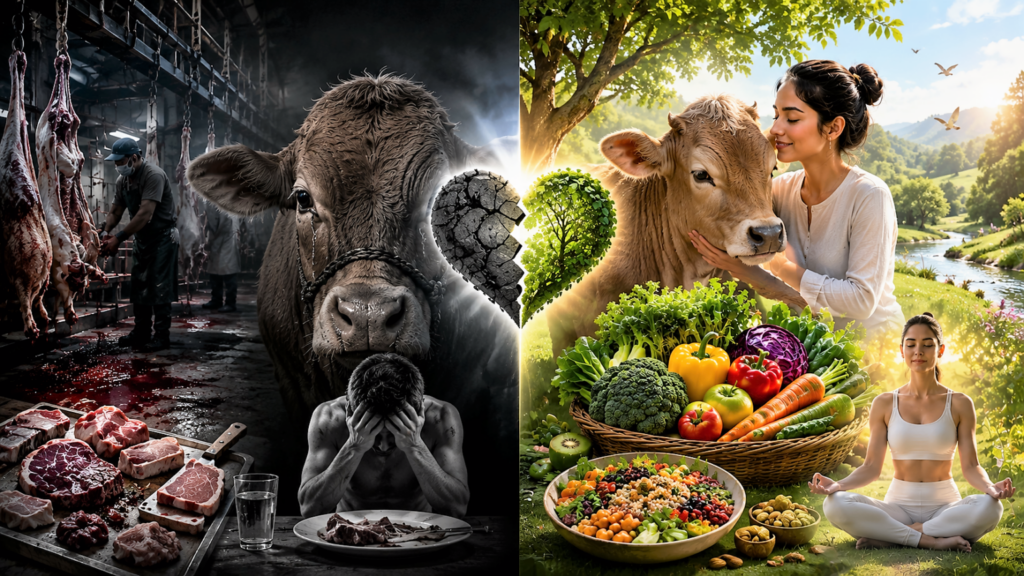
“Non-vegetarian food, especially processed meat, causes cancer and heart diseases, and it is harmful to health”—this is a fact that was proven long ago in the scientific field. However, on October 26 (2015), the World Health Organization officially adopted a report clearly declaring this through the official voting of 22 international scientists on the study committee.
The current political sludge in India is such that if anyone expresses this scientific fact, they can expect to be labeled with “food intolerance”! A delegation might even go all the way to the President against them!
The situation is no different in America. America’s Time magazine analyzed this very topic as its cover story (in its November 9, 2015 issue). It illustrated how the commercial interests of the “meat industry” there have already pounced upon the World Health Organization.
Power of Commercial Lobbies
Today, almost all policies in the world are determined by commercial factors and self-serving lobby groups. In America (and many other such countries), non-vegetarian food is not just food; rather, it is one of the world’s largest industries. Similarly, the tobacco industry is also highly influential.
The lobby groups of these industries first strive to ensure that health-related research does not receive proper funding. If that fails and research is conducted anyway—yielding reliable reports backed by evidence—they then work to point out non-existent flaws in those reports! Currently, the meat industry in America is doing exactly this.
Lobbyists have even started questioning the credibility of the World Health Organization itself! The North American Meat Institute (NAMI), which represents 95% of the meat processing commercial enterprises in the North American continent, is now spitting fire against the World Health Organization. Much like the beef-activists in our country, they have started novel forms of protests (protests against a scientific study!). Recently, at the NAMI headquarters in Washington D.C., a protest was held against the World Health Organization by distributing “red meat” dishes to all staff members for free! Perhaps India’s food activists were their inspiration.
Evolution and the Anatomy of Diet
It is true that forcing any diet on anyone is not the right approach. However, there is no need to hesitate to speak the truth proclaimed by scientific research. Trying to create awareness and understanding among people is everyone’s duty. As life evolves, killing another living being and eating it does not reflect a civil civilization. Once the hunting phase ended and the agricultural phase began, humans had no need for it at all.
When I started reading scientific books in my childhood, a belief formed in me:
“As the evolutionary journey progresses, the structure and mental framework of the human body change. The next major stage in human (Homo sapiens) evolution is to become completely vegetarian.”
Today, numerous scientific studies and books are available that reinforce this belief.
Are Humans Truly Omnivores?
Based on the way animals consume food, we classify them into three categories:
- Herbivores: They eat nothing except plant-based food.
- Carnivores: They eat only other animals and their meat (this group can also include insect-eating organisms).
- Omnivores: They eat both plant-based food and meat.
From this perspective, when we observe human dietary habits, they are often placed in the “omnivore” group because humans consume both plant-based food and meat. But did Nature really design humans as omnivores? Is it Nature’s intention that man should be an omnivore?
Why are these questions important? Because it is difficult to compare humans directly with other animals. Look at this: animals do not cook their food. Humans prepare a variety of dishes to eat. Under these circumstances, what is the natural category for humans? Having learned to cook, humans might have drastically altered their original dietary habits.
According to some historians, humans are omnivores who have consumed both plants and meat throughout history. However, many scientists today do not agree with this statement. Humans might have started consuming meat at some point in time out of necessity, but their argument is that humans are fundamentally herbivores.
Example of Milk
Humans belong to the class of mammals. Immediately after birth, the first food a human infant consumes is mother’s milk. Is this vegetarian or non-vegetarian? According to many scientists, even though milk is an animal-derived product, it is neither vegetarian nor non-vegetarian. It is simply the natural food of mammals. For all mammal species, their mother’s milk is the natural initial food. Therefore, leaving milk aside, we need to evaluate the solid foods we consume.
Comparing the Biology of Carnivores, Herbivores, and Humans
Scientists who conducted research into what kind of food humans are anatomically designed to eat found distinct differences between the body structures of carnivores and herbivores. When studying the teeth, digestive organs, and digestive processes, certain traits were found to be universally common across all carnivorous animals, while entirely different traits were common among herbivores.
Based on these studies, it can be said: Nature created the tiger explicitly as a carnivore, and the cow explicitly as a herbivore. What did Nature design man to be?
When examined from the perspective of body structure and internal chemical reactions, many scientists state that humans belong to the group of herbivorous animals. None of the anatomical characteristics of pure carnivores match human biology.
If humans had not developed “civilization,” had not learned to cook, and had not altered their dietary habits, how would they live “naturally” in the wild? Scientists say: “Observing the external and internal anatomy of humans, their natural, original food consists of fruits, vegetables, tubers, and nuts.”

Key Anatomical Comparisons:
- Claws: Carnivorous animals have curved, sharp claws convenient for tearing flesh. Herbivores do not have such claws. Neither do humans.
- Sweating: Carnivores do not have pores in their skin; they cool down and sweat through their tongues. Herbivores sweat through pores in their skin. Humans also sweat through their skin.
- Teeth: Carnivores have sharp, long canine teeth designed for tearing and cutting meat. Herbivores have flat molar teeth designed for grinding and chewing. Humans possess the same flat molars.
- Chewing Habits: Carnivores do not chew their food thoroughly; they tear, cut, and swallow it whole. Herbivores must chew their food extensively. Humans also need to chew their food thoroughly for proper digestion.
- Intestinal Length: The length of a carnivore’s intestine is short—only about 2 to 3 times the length of its body. This allows meat, which rots quickly, to pass through the body rapidly. The intestine of herbivores is 10 to 12 times longer than their body length. Humans also possess an intestine that is 10 to 12 times their body length.
- Stomach Acid: A highly concentrated, powerful hydrochloric acid is produced in the stomachs of carnivores to dissolve meat easily. The stomach acid of herbivores is about 20 times weaker. The acid released in human stomachs is similarly 20 times weaker.
- Saliva: Carnivores do not require salivary glands that break down fruits and vegetables. In herbivorous animals and humans, digestion begins right in the mouth through saliva, which is rich in enzymes needed to digest grains and fruits.
- Salivary Enzymes: The saliva of carnivores lacks the specific enzymes needed to predigest grain carbohydrates, whereas the saliva of herbivores and humans contains them.
Scientists point out several such biological facts. If Nature truly intended for humans to be meat-eaters, would it have given them a body that shares so many fundamental realities with herbivorous animals?
Author