Recently, a misconception has been brewing among some that Brahma (the Ultimate Reality) equates to Shunyatva (Emptiness or Void). Many who are famous as “New Age Gurus” are bringing this concept of “The Void” to the forefront. Consequently, Vedic rituals and philosophies are being misunderstood. According to some, devotion (Bhakti), rituals, and worship are merely preliminary preparations to realize this Emptiness.
Even in the past, various atheistic philosophies gained prominence. At one point in time, Buddhist texts and universities expanded the concept of Shunyatva immensely. While the debate over what Gautama Buddha truly taught remains unresolved, the Buddhist texts that emerged after his era modified the wisdom of the Upanishads (Vedanta) to claim that “The Void” is the ultimate truth. Due to this influence, even Shankara Bhagavatpada—who upheld the Vedic declaration of Ekam Sat (Truth is One)—was misinterpreted. A false notion developed that the Path of Knowledge (Jnana Yoga) has no need for God.
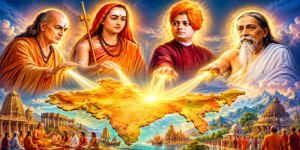
Similarly, at another point in time, misconceptions grew regarding the Path of Devotion (Bhakti Yoga). People began to believe that only a frenzied, emotionally volatile “blind faith” was superior. Although the Bhagavad Gita clearly shows that Devotion and Knowledge are not separate, nor are their ultimate fruits different, these misunderstandings persisted in pockets. It is a historical reality we must note: the three great Acharyas (Shankara, Ramanuja, and Madhva) were both “Knowledgeable Devotees” and “Devoted Scholars.” Their philosophical differences are a separate matter; we should view them through the lens of diversity. The variety within Vedic philosophies is a sign of India’s intellectual wealth.
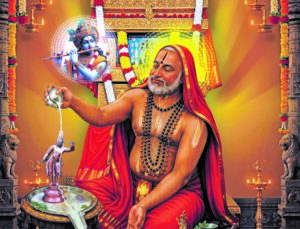
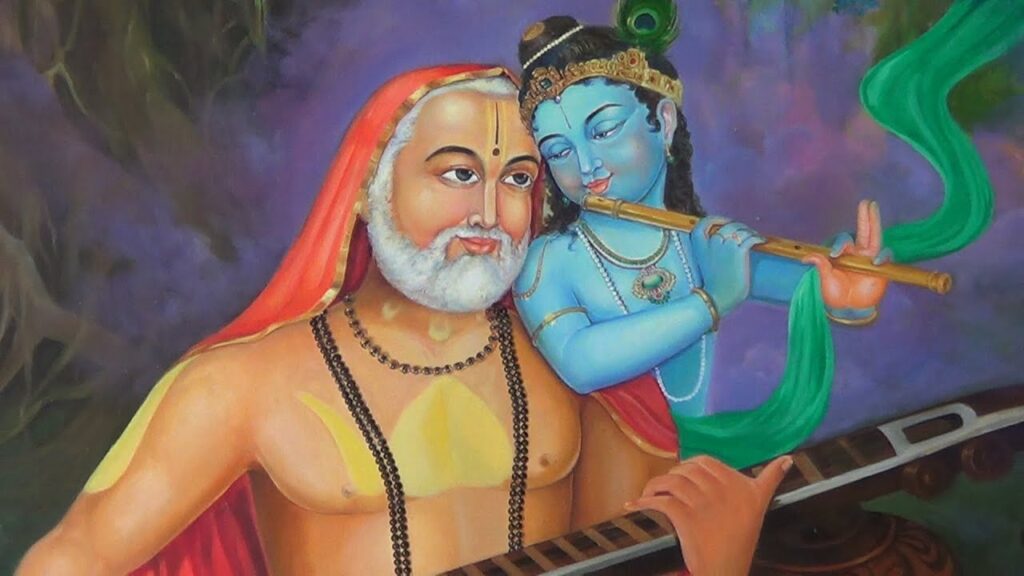
One of the prominent masters who enriched this wisdom is Shri Raghavendra Teertha, a monk of supreme knowledge and devotion from the lineage of Shri Madhwacharya. He is a true Teertha (sacred water/shrine) personified for our land and our intellectual tradition. Popularly known simply as “Rayaru,” Shri Raghavendra Teertha today isn’t just a primary link in the Madhva lineage. While that position is eternally his, the common people have elevated him beyond the boundaries of all sects, philosophies, and monasteries. His portrait shines in the prayer rooms of people across all castes and creeds. The belief that “Rayaru is there” is protecting and sustaining many homes and hearts.
For a Sanyasi (monk) to head a monastery (Peetha) is the realization of a grand concept of Karma Yoga. Building, nurturing, and preserving an unbroken tradition of scriptures was the intent behind establishing these Mathas (monasteries) and seats of Dharma. It is the Karma Yoga of these monasteries to safeguard rituals and traditions from losing their purity while providing spiritual and religious frameworks. Therefore, it is India’s duty to provide space for the preservation, dissemination, and study of all diverse Guru-lineages. Only when our unique religious and spiritual wealth is preserved does a great ideal remain for the entire world. Otherwise, the world will be left only with “Religions” based on Commands, while “Dharma” based on Consciousness will vanish. Religions at war and political ideologies in constant conflict will destroy the world. The alternative path of self-study (Svadhyaya) and penance (Tapas) will cease to exist.
Shri Raghavendra Swamy is the great confluence of Knowledge and Devotion. His is an unparalleled devotion to Vishnu. In the Vaishnava path, Hari is Supreme; Hari is the Lord of All. In the Vishnu Sahasranama (from the Mahabharata), Bhishma says:
“Jagatprabhum devadevam anantam purushottamam…” If one constantly praises, worships, meditates upon, and bows to the Lord of the Universe, the Infinite Supreme Being, after rising… then by the grace of Shri Vishnu, the Lord of all worlds, one transcends all sorrows. This is a simple spiritual path available to everyone. Just as the Bhagavad Gita says, “I myself look after the welfare of those who remember Me constantly,” the simple method of this Bhakti Yoga is to explain the universe through the compassion of that Maha Vishnu.
It was our Bhakti Yoga that saved India from wicked foreign forces. Patriotism (Rashtra-bhakti) is also a part of it. Spiritual inquiry that does not begin through Devotion ends in the Void. Those who travel the path devoid of Devotion become proponents of Shunyatva. However, according to the Upanishads, the ultimate truth is not Emptiness. It is the Supreme Soul (Paramatma) principle which is greater than the Void. That is the Causal Principle of everything. Shri Raghavendra Swamy is a great saint of the path of Devotion. It is the firm belief of followers that he can awaken the realization of God in them. For his devotees, he himself is Divine!
Author