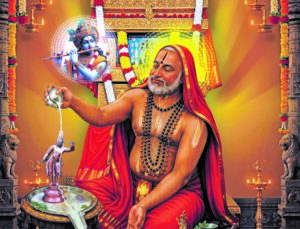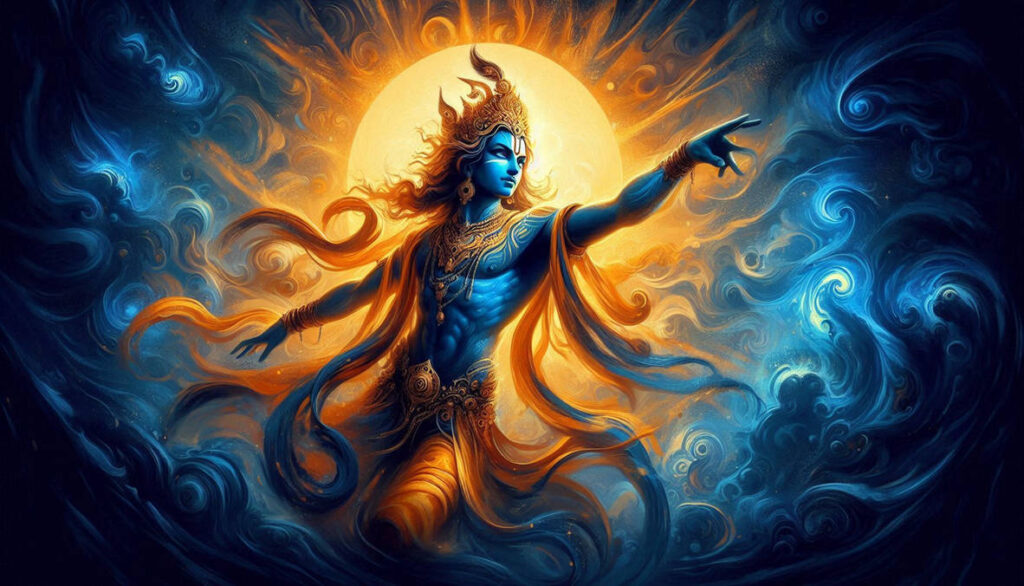
To everyone, “Balakrishna” (Child Krishna) is a beloved deity. Gokulashtami, his birthday, is a festival filled with butter, laddoos, chakkuli, and other fried delicacies. We adore his chubby face, his graceful gait, his calm mind, and the adventures and miracles of his childhood. But we must not forget that Shri Krishna is much more than just this.
Shri Krishna is a historical figure. For researchers, no other major figure of any religious tradition in the world offers as much evidence—ancient texts, artifacts, references, subterranean and underwater ruins, historical inscriptions, temples, astronomical alignments, and an unbroken oral tradition. Yet, many ill-intentioned writers have portrayed leaders of other faiths as historical figures while dismissing Shri Rama and Shri Krishna as merely imaginary characters of faith and devotion. While the belief that Krishna is an Avatar (incarnation) of the Divine is a matter of faith, everything else about him is backed by historical record.
The Mahabharata, Harivamsa, Bhagavata, and Vishnu Purana all state that Shri Krishna was the Purnavatara (complete incarnation) of Maha Vishnu, appearing at the end of the Dvapara Yuga. It is believed that the Kali Yuga began immediately upon the conclusion of his incarnation (though some argue it started during the Kurukshetra war). According to studies using planetarium software to fix planetary positions, researcher Nilesh Oak places Krishna’s era at approximately 7,500 years ago. According to the calculations maintained by the Aryabhatiya almanacs, it was about 5,200 years ago.
Shri Krishna was born in the city of Mathura (in present-day Uttar Pradesh) to Vasudeva and Devaki. Devaki was the daughter of King Ugrasena. Her brother was Kamsa, a man who possessed both the nature and form of a demon. Knowing that Devaki’s eighth child would cause his death, Kamsa imprisoned his sister and her husband, killing every child born to them in the cell. On the eighth day (Ashtami) of the dark fortnight of the month of Shravana, under the Rohini star, the eighth child—Shri Krishna—was born at midnight. While the guards slept, Vasudeva secretly carried him to the village of Gokula, to the home of Nanda and Yashoda. This is the essence of the birth story. The “Janmasthan Mandir” stands in Mathura; the actual spot of his birth is now in a basement behind the temple, which is currently occupied by a mosque.
According to ancient lore, Krishna’s birth star is Rohini. Thus, Janmashtami is celebrated every year on Shravana Krishna Ashtami. Depending on the region, the festival is called Gokulashtami, Krishnashtami, Janmashtami, or Shri Krishna Jayanti. Usually, the Rohini star coincides with the Ashtami; if not, they may fall a day apart. There is a tradition of celebrating “Shri Krishna Jayanti” specifically when the Rohini star is present, often involving midnight worship. Temples perform special Abhisheka (ritual bathing), and homes prepare offerings of butter, flattened rice (avalakki), and sweets.
All this is fine; the worship of Balakrishna should continue this way. However, our devotional songs (Keerthanas), popular hymns, plays, and films have painted Shri Krishna largely as a “Romantic Hero.” Works like the Gita Govinda have emphasized the Shringara Bhava (erotic/romantic sentiment) so much that the supreme purpose of the incarnation—and the actual contributions of the historical Krishna—have been obscured. In Northern India, the infatuation with Radha-Krishna (or Radha’s “infatuated devotion”) is what is primarily worshipped. In the environs of Vrindavan today, Radha is more popular than Krishna himself! The greeting “Radhe Radhe” reigns supreme. Interestingly, the ancient Bhagavata Purana does not mention Radha. It is in the Brahmavaivarta Purana (likely when its interpolated versions became popular) that Radha’s story becomes central. There is no flaw in such faith, but today, people remember the “Cuddly Krishna” or the “Charming Krishna” more than his Kshatra (warrior) lineage. Is Shri Krishna just about butter and the flute?
For many reasons, we are failing to see the “Real Shri Krishna.” Both his Brahma (intellectual/spiritual) and Kshatra (warrior/political) dimensions have vanished from popular literature. He is the Gitacharya—the Great Teacher, the World Teacher (Jagadguru), who explained spirituality to humanity in its right form. In the Gita, he says: “I told this to the Sun, I told it to Manu… but over time, this knowledge was lost on Earth.” He then teaches it again to the world through Arjuna. This is his Brahma dimension. Even as a youth, he was the powerful warrior who killed Kamsa in a wrestling match. He was the greatest statesman and master of war strategy of the Dvapara age. In our preoccupation with butter and curd, we have forgotten this warrior dimension.

Shri Krishna gave three “Gitas”: the Bhagavad Gita, the Anugita, and the Uddhava Gita. Among these, the Bhagavad Gita is the most famous. Its language and teaching appear simple on the surface. The Anugita, which appears complex even at a glance, has not been commented upon by any major Acharya (spiritual master). In contrast, almost every prominent Acharya has written a commentary on the Bhagavad Gita. Even today, thinkers continue to write interpretations. Historically, there has been immense debate over the “core essence” of the Gita—whether it emphasizes Jnana Yoga (knowledge), Karma Yoga (action), or Bhakti Yoga (devotion) equally. Each Acharya has argued that the Gita supports their specific philosophy (Advaita, Dvaita, Vishishtadvaita), and these debates have provided many profound insights.
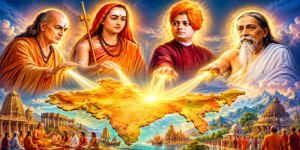
In modern times, the Bhagavad Gita was a guiding light for social reformers like Sri Aurobindo, Bal Gangadhar Tilak, Swami Vivekananda, and Gandhiji. Similarly, many famous foreigners were influenced by it: Aldous Huxley, Robert Oppenheimer, Ralph Waldo Emerson, Hermann Hesse, and Henry Kissinger. Even those who do not accept Krishna as a deity have praised the rational aspects of the Gita. Today, the Gita is taught in management courses at several Western universities.
However, the fact that “famous foreigners have praised it” is not the ultimate proof of the Gita’s greatness. Even if they hadn’t read it, the Gita’s importance would remain. Similarly, some (in)famous people have raised objections to it, but that hasn’t diminished its value. The Gita’s significance comes from its internal strength and inner light, not from external “endorsements.”
In foreign lands, certain missionary and political forces have looked at the Gita with hostility. Missionaries of the Russian Orthodox Church once filed a lawsuit against Srila Prabhupada’s translation of the Gita, arguing it was “extremist and a threat to social harmony in Russia”! Ironically, the Old Testament of the Bible (especially Deuteronomy) contains calls to torture, kill, and burn non-believers. Was the Bible banned for that? In a democracy, one cannot ban scriptures. The Calcutta High Court made this clear in 1985 (Chandmal Chopra vs. State of West Bengal) while rejecting a petition to ban the Quran. The Gita is neither a sectarian text nor a missionary book.
Despite being a master of all knowledge, Shri Krishna never forced his teachings on those who didn’t ask. His own children and kinsmen, who lived in the same house as this Great Knower, never asked to be taught. Everyone knew Krishna’s greatness, and many secrets of wisdom could have been learned from him! It was an era where the number of “unworthy” people was increasing. Even wise men like Bhishma, Yudhishthira, and Vidura missed the rare opportunity to learn wonders from the World Teacher. Had Dvaipayana Krishna (Vyasa) and Shri Krishna discussed higher subjects, perhaps the world would have received another supreme “Gita”!
Knowledge must always be sought and requested. Because Arjuna and Uddhava asked, the world benefited. Even though Arjuna knew Krishna’s greatness, he did not view him as a “Guru” until the Kurukshetra war. It is noteworthy that Krishna never taught Arjuna on his own accord. Only after Arjuna admitted, “I am standing here confused… please tell me decisively what is good for me. I am your disciple” (Shishyaste’ham… 2:7), did Krishna begin to speak. After teaching everything, Krishna says, “This is the secret of all secrets; it should not be told to everyone.” In the 18th chapter (verse 67), he says: “Never speak this to one who lacks penance, or devotion, or the desire to listen, nor to one who finds fault in Me.”
Those who lack the urge to acquire knowledge or true curiosity are “outsiders” to that wisdom. Forced propagation—”Come, come, believe this, it’s a passport to heaven”—is the method of deluded missionaries, not spiritualists. Unworthy forces like Henry Kissinger or the CIA should not have access to this “secret of secrets”; if they do, they will misuse it, much like Ravana or Indrajit.
By the grace of Veda Vyasa, many great subjects are available to us today (though he may have intentionally withheld some things, what he did write is a mountain!). The Bhagavad Gita contains religious, spiritual, and political elements. It offers guidance on every facet of life. If we view it only as a “Science of Liberation” (Moksha Shastra), we lose sight of its other practical wisdom. Just like during the time of Kurukshetra, we need timely guidance today. We must not forget that Indian civilization paid a heavy price in history because we forgot the real Shri Krishna and Chanakya. Today, along with the sweetness of the flute, we need the “Sudarshana Consciousness” (the awareness of the divine wheel/justice) to be awakened.
Author