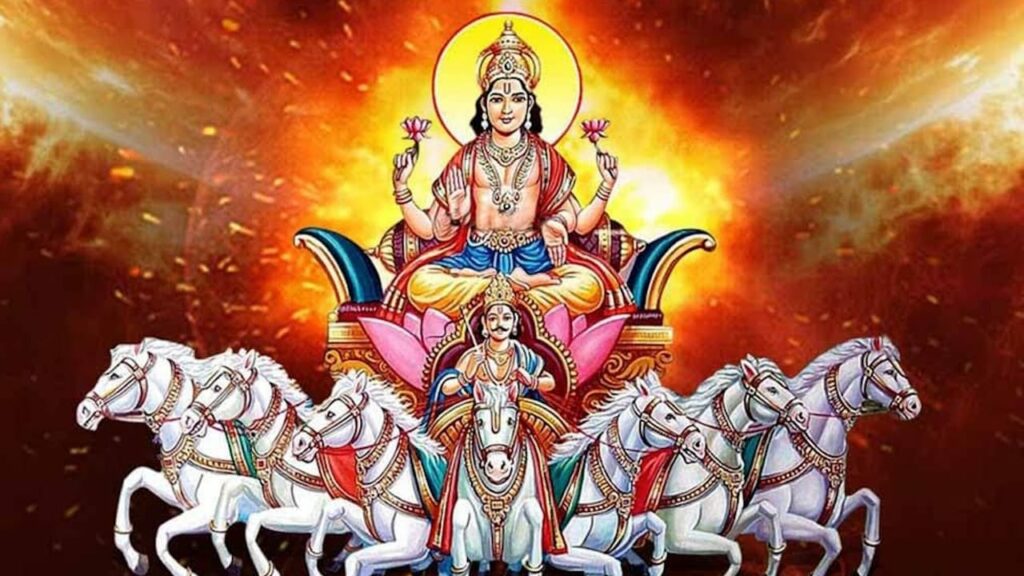
Makar Sankranti is predominantly associated with Surya, the Sun god, who holds a special place in both astronomical and spiritual realms. The Uttarayana period, a time when the sun transitions to the northern hemisphere, is considered auspicious for those seeking liberation, as mentioned in the Bhagavad Gita, where Bhishma waits to depart from his mortal body during this period. The main message of Makar Sankranti is Surya Upasana—the worship of the Sun. As the Earth orbits around the Sun, it establishes that our world revolves around this central source of energy. Historically, the worship of the Sun was widespread across the world, but it is now only practiced in its original form in Sanatana Bharat (Eternal India).
Surya: The Manifest Power
Surya is a manifest power—a massive sphere of fire, radiating intense heat and light. Even though there are other stars in the universe that are larger and brighter, Surya is the closest to us, and hence, appears the most radiant. 99.8% of the mass of the entire solar system belongs to the Sun. This makes the Sun the central force that sustains life on Earth. Its energy fuels life, providing warmth, power, health, and vitality. Without Surya’s radiance, life on Earth would not exist in its present form. The varied seasons, crops, rainfall, and even our food and sleep cycles are all directly tied to the Sun’s energy.
Despite being 109 times the size of Earth, the Sun is located about 15 million kilometers away from us—an ideal distance that is neither too hot nor too cold, allowing life to thrive on Earth. The surface temperature of the Sun is 5700°C, but its atmosphere is much hotter, reaching millions of degrees.
The Sun’s Cosmic Role
The Sun, according to modern science, is about 450-460 million years old and has enough fuel to burn for another 500 million years. While the solar system revolves around the Sun, the gravitational pull of Surya holds the entire solar system in its orbit, preventing the planets, moons, and other objects from flying off into space.
The Sun’s gravity keeps everything, from planets and their moons to comets and asteroids, in a state of constant motion around it. Even the Earth’s Moon is bound to Earth due to its internal gravitational pull. If this force were absent, the planets and moons would drift away, and chaos would ensue. In the vast space beyond the planets, there are other regions such as the Kuiper Belt (which contains smaller objects) and the Oort Cloud (a distant, icy region).
Beyond the Solar System
The influence of the Sun extends far beyond the outer limits of our solar system. The heliosphere, the bubble of solar wind that surrounds the solar system, stretches far beyond the Oort Cloud. Even beyond this, there are other regions of space where cosmic dust and hydrogen exist, known as the interstellar medium.
Our nearest star, Proxima Centauri, is about 4.2 light years away, while the famous Alpha Centauri system is 4.3 light years away. Space between stars is known as interstellar space, and it contains a mix of gases, dust, and possibly dark matter—elements that modern science still struggles to understand fully.
The Infinite Universe and Sun’s Place in It
The universe, as we know it, is an immense web of interconnected systems. No entity, not even the Sun, exists in isolation. The stars, galaxies, and other celestial bodies all interact in a vast cosmic dance. Our Sun is just one small part of a much larger system. The Milky Way, our galaxy, contains an estimated 300 billion stars, including our own. It is believed to be centered around a massive black hole, a region of space where gravity is so strong that not even light can escape.
The Milky Way is just one of hundreds of billions of galaxies in the universe. Between these galaxies, there is intergalactic space, which could contain other black holes or clusters of cosmic dust. These galaxies, which can range from the size of a few hundred thousand light years to much larger expanses, form the vastness of the universe we observe.
The Interconnectedness of All Things
In ancient Indian thought, everything in the universe is interconnected and interdependent. Surya, along with countless other celestial bodies, plays an integral role in this grand cosmic cycle. Ancient sages and scientists of India perceived the Sun, along with other natural forces, with deep reverence, recognizing them as life-giving sources. Their spiritual consciousness allowed them to worship not just the Sun but all natural forces, seeing them as manifestations of the divine.
In contrast, many modern religions, especially in the Kali Yuga, have ignored or misunderstood this reverence for nature. They often focus on human-centric philosophies, forgetting the crucial role of nature and the environment. This disrespect for nature has led to significant environmental damage, as human-centric ideologies dominate the discourse.
Surya in Ancient Cultures
Surya’s worship was not confined to India alone. In ancient times, the Sun was worshipped across the globe:
- In the Middle East, before the rise of Islam, the Sun was a prominent object of worship.
- In Ancient Rome, the Sun was revered as Sol Invictus, the Unconquered Sun. December 25th, a day dedicated to the Sun god, was later co-opted as the day for Christmas in the 4th century AD after Constantine’s conversion to Christianity.
- The Greeks worshipped the Sun as Helios, and the Egyptians revered it as Ra.
The ancient Mithraic religion, originating in India, also worshipped the Sun, and it spread to Persia, Britain, Germany, Spain, and other regions. The Sun’s divine status transcended cultural boundaries, as seen in the proliferation of solar deities across ancient civilizations.
The Decline of Sun Worship
In modern times, many countries have forgotten the importance of Surya Upasana, a practice deeply embedded in Sanatana Dharma. However, Bharat continues to uphold this tradition. Surya is considered one of the principal deities in the Vedas, and daily practices like Surya Gayatri mantra, Surya Namaskar, and Arghya (offering water to the Sun) still continue. Festivals like Makar Sankranti, Ratha Saptami, and Mas-Sankrantis celebrate the Sun and its power, emphasizing the continuity of this ancient tradition.
In rural areas, people still rise early to salute the Sun and offer gratitude, acknowledging the life-giving energy that sustains all. Makar Sankranti is also a time of thanksgiving for the harvest, where people show appreciation for the Earth, cattle, and the Sun.
Conclusion
The Sun is not just a celestial body in the sky; it is the very life force that drives the universe, and its worship symbolizes our connection to the cosmos. The ancient Indian culture’s reverence for Surya reflects a profound understanding of the interconnectedness of all things. Our survival, prosperity, and health are all linked to the Sun, and recognizing this fundamental truth is at the heart of Sanatana Dharma.
The modern world must return to these roots, understanding that humanity cannot exist independently of nature. The Sun, as the central deity in the cosmic order, reminds us that we are part of a greater whole, and acknowledging this truth is the path to harmony with the universe. The festivals and practices associated with Surya are not just rituals but expressions of this cosmic gratitude, ensuring that we never forget our source of life.
Author