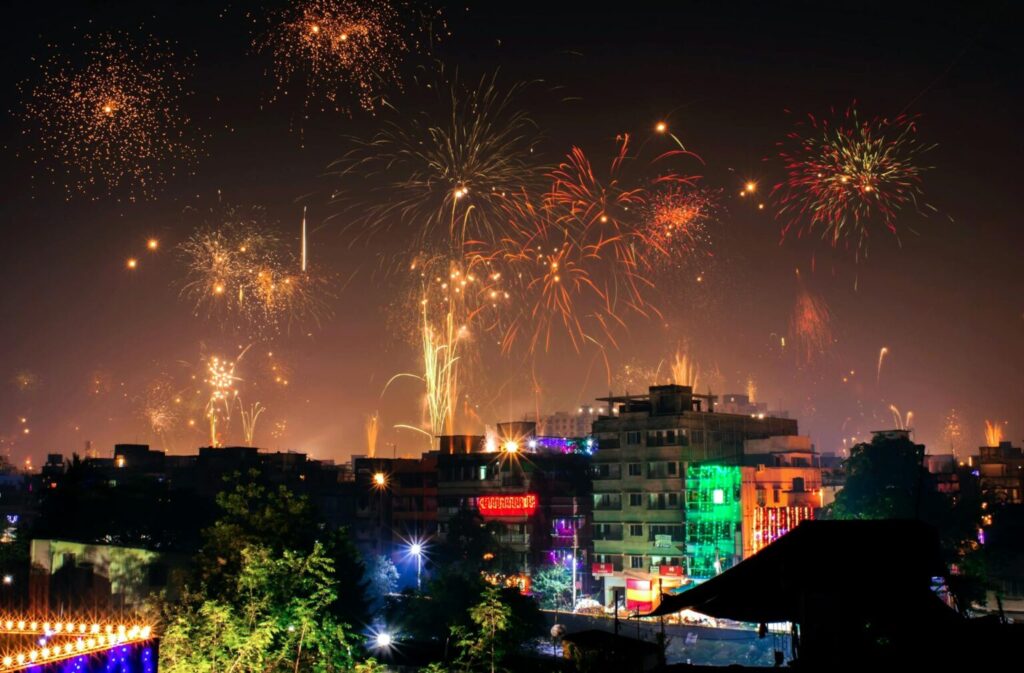
From ancient times, fireworks and the festival of Diwali have been inseparable. Diwali is not just the festival of lights; it’s also the festival of the sounds of triumph. When Lord Rama returned to Ayodhya after defeating Ravana and completing his exile, the people celebrated his victory by lighting lamps and firing crackers. Similarly, during the Dvapara Yuga, on Naraka Chaturdashi, Lord Krishna, along with Satyabhama, defeated the demon Narakasura. People rejoiced by bursting crackers. Today, both events are celebrated with fireworks.
According to the Skanda Purana, Goddess Parvati observed a 21-day Kedarishwara Vrata and concluded it on Diwali, thereby gaining half of Lord Shiva’s body. This practice is popularly known as Kedar Gauri Vrata. On Diwali night, the worship of Goddess Lakshmi, the goddess of wealth, is a significant tradition. On Bali Padyaami, King Bali, a devoted follower of Lord Vishnu, is said to return to the earthly realm from Patala (the underworld). Bali Pooja is especially popular in Southern and Western India. The Bhagavata Purana mentions that on Kartika Shukla Padyami, Lord Krishna defeated Indra, and people celebrate this by worshipping Lord Krishna and performing Govardhan Puja.
In Jain tradition, Lord Mahavir attained Nirvana on the day of Diwali. In Sikh tradition, Guru Har Gobind Ji and 52 Hindu kings were released from Mughal captivity on this day, and Sikhs celebrate Diwali by lighting lamps in the Golden Temple of Amritsar.
In ancient India, fireworks existed in some form. Texts like Shukraniti, Neetiprakashika, and Rajalakshminarayana Hridaya mention them, though without specific details on their types. In warfare, substances like gunpowder (referred to as “Agni Churna”) were used to create smoke and confuse the enemy. Around 2,000 years ago, new types of fireworks were invented in China. By the 7th century, these firecrackers had spread to other countries. It is assumed that this period marked the introduction of new types of fireworks to Diwali celebrations in India.
Today, China accounts for about 90% of the world’s total firecracker production and export. In the 13th century, Arabs also began making gunpowder-based fireworks, which eventually reached India. By the 15th century, fireworks became popular in Europe. According to historians, in 1609, Sultan Adil Shah of Bijapur organized a grand fireworks display at his daughter’s wedding, costing a whopping 80,000 rupees at the time! In 1633, a similar grand firework display was held at Dara Shikoh’s wedding.
In recent years, Delhi has made headlines for its air pollution levels during Diwali due to the large-scale bursting of firecrackers. The argument “Diwali should remain a festival of lights, not firecrackers” has gained traction in some quarters. “In reality, Diwali is a festival of lights; people should light lamps at home, but refrain from bursting crackers in the streets, as they cause noise and air pollution” is a view that is frequently heard. This view, although reasonable, overlooks some important aspects.
The most significant contributors to pollution in Delhi, according to an IIT Khargapur report, are road dust, vehicle emissions, and the burning of stubble by farmers in Punjab and Haryana. Diesel generators, construction activities, and factories also contribute significantly to the pollution levels. Instead of addressing these widespread issues, there has been an emphasis on restricting firecrackers during Diwali for a few days.
Fireworks are a global industry, and celebrating with firecrackers is a common practice worldwide. No country suffers from daily fireworks displays as a routine activity. Instead, firecrackers are typically used during specific holidays or celebrations. For example, on July 4th, America’s Independence Day, firecrackers are a common sight in homes, cities, and at public events. Similarly, in Singapore, the National Day celebration on August 9th is renowned for its spectacular fireworks display. Australia’s National Day on January 26th is marked by a massive firework display near Sydney Harbour Bridge. Malta’s annual fireworks festival in April is another famous international event. In Britain, November 5th is celebrated as “Guy Fawkes Night,” which includes firework displays, akin to Diwali.
During New Year’s Eve on December 31st, fireworks shows take place in cities like Dubai, United Arab Emirates, and Rio de Janeiro, Brazil. Even though this tradition is relatively new, there is no restriction on it. In fact, in Dubai, the New Year’s Eve celebration is often even grander than Diwali celebrations in India, showcasing a truly magnificent display.
Interestingly, in international media, fireworks controversies are not a common theme. Fireworks are not a subject of debate in most countries. However, in India, a peculiar trend has emerged where there are frequent discussions and objections regarding traditional festivals like Diwali, Holi, and Ganesh Chaturthi. While some people call for restraint, the celebrations continue unabated in many other parts of the world.
The central question that arises here is, why do people in India need to face criticism or restrictions on their traditional celebrations? No one objects to practices like the slaughter of animals during Bakrid or cutting down trees for Christmas trees. However, when it comes to Diwali or Holi, there seems to be a persistent desire to impose rules, often driven by ideological motives. This raises a valid question: “Why is it that some people want to dictate how Hindus should celebrate their festivals?”
In India, some people have been voicing their opinions that fireworks should be banned during Diwali, and in the process, they have even labeled children who burst crackers as “criminals.” This view is highly misguided. Festivals are part of religious and cultural freedom, and the goal should be to maintain social responsibility while allowing people to celebrate. There needs to be a balance between freedom and law, especially when it comes to religious practices.
In India, the majority of those who celebrate Diwali with fireworks are from middle-class or lower-income families. For many children, this is the only opportunity to experience the joy of bursting crackers. For just a couple of hours in a year, the excitement of bursting crackers brings immense joy to them. Criticizing this joy as harmful or criminal is not only unfair but also misses the point of celebrating cultural traditions.
Environmental damage from vehicles, stubble burning, factories, and industries continues year-round in India, causing far more harm to the environment than firecrackers during Diwali. The rivers, which are already polluted due to industrial waste, continue to deteriorate. However, when firecrackers are targeted for a few hours during the Diwali festival, it seems like an overreaction. Addressing pollution is important, but it requires more comprehensive solutions, including stricter regulation of industries and factories.
It is essential that those who celebrate Diwali with firecrackers follow some basic safety guidelines. Ensure that the firecrackers you purchase are legal and from certified manufacturers. Safety is paramount. Always light firecrackers in an open area, away from flammable materials. Keep a bucket of water or a fire extinguisher nearby for emergencies. Never handle firecrackers directly with your hands, and always ensure that they are safely away from your body. It is also wise to avoid wearing synthetic clothes, as they are highly flammable.
Lastly, when buying fireworks, be mindful of the price hike during the festival. Enjoy them in moderation and within your budget.
Author