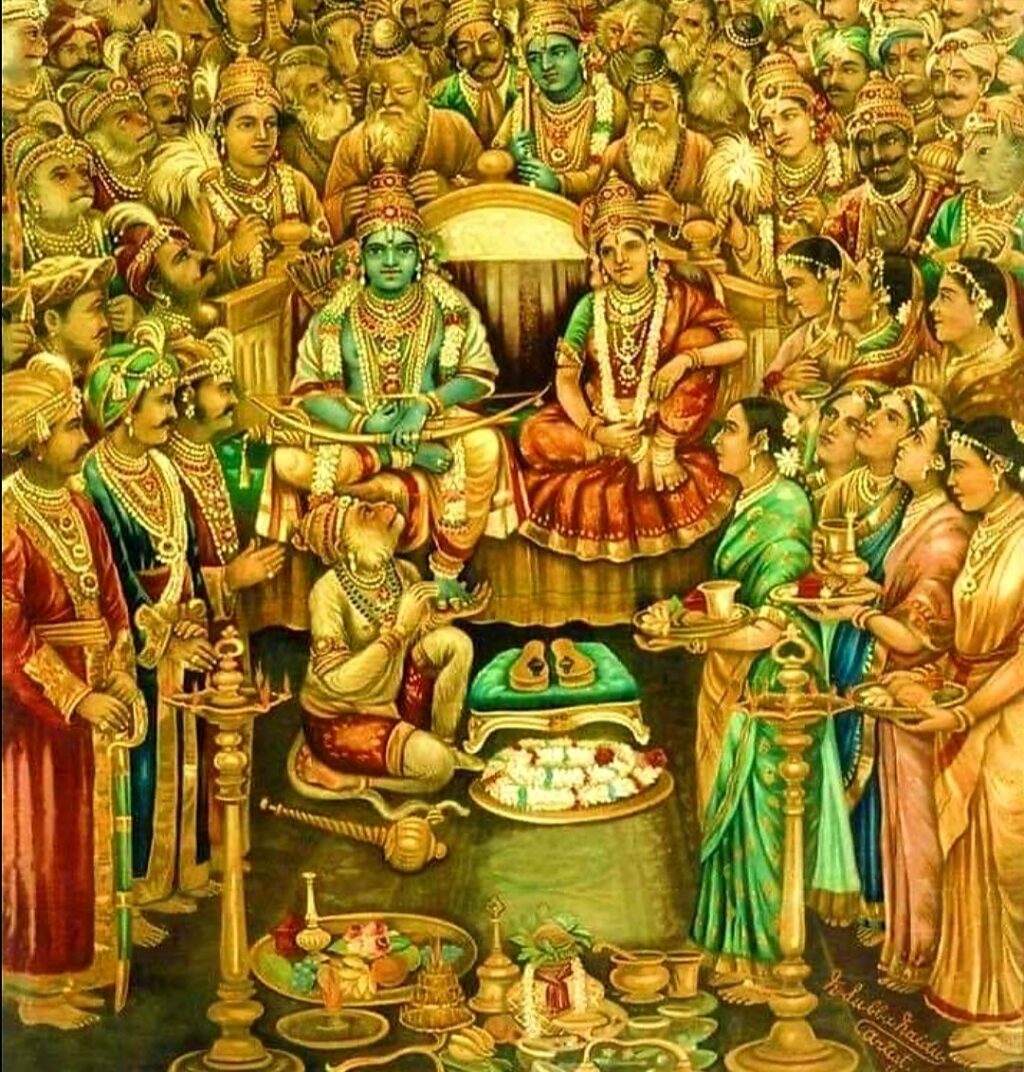
Among the forces that have kept India as ‘India,’ Srimad Ramayana is the most prominent. It is the total essence of all our life values. It is a collective treasury of all life ideals. It is life-water that oozes no matter how much you dig or draw.
The Ramayana is an ideal not just for India, but for all of mankind. It is unknown how many translations, adaptations, narrations, and analyses of the Ramayana have emerged across how many languages until now. The first poet, Sage Valmiki, gave this exquisite life-essence to the world, influencing everyone. The narration of the Ramayana appears even in the Mahabharata. This means that Sage Vyasa was also one among the countless readers of Sage Valmiki!
According to tradition and Valmiki himself, he became a sage through the power of the name of Rama. Narada was the inspiration for this. He was also the original inspiration for the Ramayana. Valmiki asks Narada: “In this time, in this world, is there anyone who is virtuous, heroic, a knower of dharma, grateful, truthful, firm in resolve, of good conduct, and a well-wisher of all living beings? If so, who is that person?” Narada’s answer to this is ‘Sri Ramachandra.’ He provides an introductory description of Rama to Valmiki. This is how the inspiration for composing the Ramayana was found. The rest is history.
It is not just ‘the rest’ (Valmiki beginning to write) that is history. The entire Ramayana is history (Itihasa), meaning it is a recorded event, not a fictional story. Yes, it is a magnificent poem. It is an inspirational creation that brings tears to the eyes, touches emotions, and makes one ponder over ideals. It is an epic so influential and glorious that no one else has been able to create its like until now. But it is as much history as it is an epic. Its nature exceeds the modern definition of ‘history.’ Questions like “Should we believe Ravana had ten heads?” naturally arise. That is why it is said that our ancient histories are of a nature that transcends current ‘academic’ definitions.
Suppose a person lived for 10,000 years. Could one go to that 9999-year-old person and ask, “Show me your birth certificate”? If asked, could they show it? Firstly, a ‘birth certificate’ is a concept of this era, not of 10,000 years ago. Naturally, they wouldn’t have all that. Even if we assume some record from that time existed, how could any record be kept safe for 10,000 years? Is it possible to easily keep current digital records for the next 10,000 years? It is difficult to keep hard disks and solid-state disks properly for even 10 years. Additionally, digital file formats change within a span of 10 years. Already, cassette players have disappeared. Even if a cassette exists, it is difficult to know what is in it! We do not know if software to ‘read’ a current ‘PDF’ file will exist in the next 100 years. Therefore, asking a 9999-year-old elder for documents is a ridiculous behavior.
It is not just about documents. Memory is also difficult. A person might have lived for 10,000 years. But how can anyone remember the events of every single day over such a long period? It is even harder if only one person lives that long while others do not. For, is it possible to keep track of how many were born and how many perished before that person’s eyes? Does a 9999-year-old man remember the full details of his wedding that took place in his 25th year? If one person can see about 400-500 generations, who can collect, record, and remember without forgetting the details of how many children, grandchildren, and great-grandchildren there are, and mark them on a calendar? How to carefully preserve the horoscope commissioned by one’s parents for 10,000 years?
The meaning is simply this: the longer life becomes, the way you look at the world and the way the world looks at you will not be as they are now. This is the ‘Golden Rule’ that those who write ‘history’ must remember.
Leaving aside the subject of a person who lived for 10,000 years, come to the subject of a culture and civilization that has lived for 10,000 years and is still living. Place Indian Sanatana culture in the position of the person analyzed above. Now think. Does it seem like an ordinary thing to preserve the memory of a civilization for an extremely long period of more than 10,000 years? Our ‘modern knowledge’ is failing even at telling the life story of one or two thousand years. A hundred versions and dozens of myths have attached themselves to the story of just the last century. Such being the case, it is imprudence, excess, foolishness, and arrogance born of ignorance to expect Indians to remember and record stories spanning vast ages (Yugas) along with specific calendar years.
So, did Indians not keep history in memory? They did. They have preserved a memory more detailed than anyone else in the world. How? In the form of poetry! In the form of stories. How many people will read this editorial of mine after 100 years have passed? Instead, if I write an ‘immortal poem’ or a ‘wonderful story’ encompassing this same subject, there is a possibility that even more people will read it, isn’t there? Stories and poems can achieve a greater immortality than records carved on stone. That is why stories older than stone inscriptions are found in the Puranas! If one stubbornly insists, “I will consider only stone inscriptions as evidence, the rest are just stories,” many useful subjects and pieces of information will be lost. What needs to be understood here is this: our ancients kept history alive in the form of immortal poems that remain forever. It is natural for some exaggeration or emotional intensity to occur in poetry. Otherwise, people would forget it within a span of 200-300 years!
How long can you preserve a raw mango? For a few days, right? What if you make it into a pickle? It lasts for several months, doesn’t it? Similarly, if the details of events that actually happened are written down like a pickle, they last for a very long time. Here, the poetic form can be thought of as a ‘method of long-term preservation.’
In our tradition, the Ramayana and Mahabharata are clearly called ‘books of history’ (Itihasa Grantha). They have not been called ‘Puranas.’
I wonder which blessed souls formulated the ‘dry’ formula that our textbooks ‘must be written this way’! No one even touches them after the exams are over! These people lack the ‘common sense’ of how to tell the story of human beings. Once, while speaking at a meeting of education officials, I said, “Try presenting history textbooks like Amar Chitra Katha.” Had they done something like that, history lessons would have remained secure in homes and minds just like Amar Chitra Katha! If Valmiki had written the Ramayana in the style of current textbooks, it would have joined the dustbin of history and disappeared within a century or two of being written. Fortunately, in Valmiki’s time, education and research were not in the hands of government heads. It is noteworthy here that Valmiki himself created a new poetic form called ‘Shloka’ specifically to write the Ramayana.
The Ramayana is a culturally and socially most significant and most influential text. Had it not been so, and were it just a book of literary interest like the Iliad or Odyssey, it would have remained a dry analytical text for universities. Since the Ramayana is actually perceived as one of the pillars of Indianness, Sanatana civilization, and a religious ideal life, there is so much curiosity and so much turmoil (halahala) surrounding it. ‘Medieval’ (this term is wrong; yet used here for easy comprehension) Arab writers, colonial imperialist writers, Christian missionaries, Jewish, and atheist ‘liberal’ analysts—everyone has pulled and tugged at the Ramayana. Looking at it that way, the Ramayana might be the first Indian text to open up to the world beyond the circle of traditional readers.
Each writer has tried to portray the Ramayana according to their own purpose. Without understanding the truth, messages, and meanings hidden behind Valmiki’s narrative—which appears to be a simple narration on the surface—they have attempted to show their own arguments, ‘isms,’ and emotions according to their respective faiths. Thus, infinite narrations and infinite analyses of the Ramayana are available. This is both the greatness of this text and its misfortune.
The influence of the Ramayana has spread throughout the world. There are two reasons for this. One, the extraordinary personality of Sri Rama and the ideal of Ramarajya. Two, the magnificent composition of the original Valmiki Ramayana and the fact that a very long time has passed since its composition. Over a long period, it is true that various poets, foreigners, followers of other faiths, and wandering minstrels have changed Valmiki’s Ramayana according to their imagination. This has been happening for thousands of years. In some parts of Northern India, Tulsidas’s Ramcharitmanas is more popular than Valmiki’s Ramayana. The Kamba Ramayana of Tamil and others are similar. A.K. Ramanujan has written an essay titled ‘Three Hundred Ramayanas.’ Among the several versions he cites, tradition has accepted only Valmiki’s Ramayana as authentic. This is because Valmiki was a contemporary of Sri Rama. He had presented the history he wrote in front of Sri Rama himself. That said, it cannot be claimed that he wrote everything. There are examples where other sages wrote other details that he left out.
Author