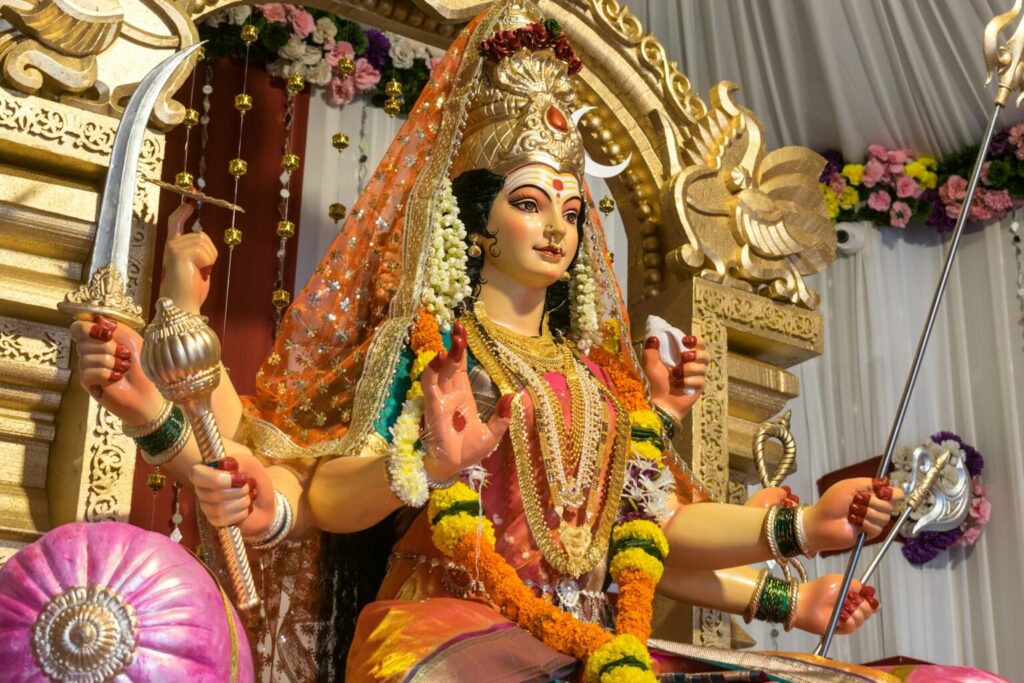
‘Dasara’ (Deshera, Dashahara, Dasharatri) or ‘Navaratri’ is a magnificent festival of Sanatana Dharma and Sanatana civilization. It is a festival that worships the Primordial Shakti—Adishakti—who, in the form of Nature, is the Mother of all creation.
Before the birth of Christianity and Islam, various civilizations housed temples for female deities. As Semitic faiths expanded through war and conversion, they began to suppress the worship of female divinities. The prohibition of Goddess worship by Abrahamic faiths is a dark chapter of history. Today, the Sanatana civilization of India stands as the only civilization in the world that continues to revere female deities and the Mother Goddess.
‘Navaratri’ is an ancient festival—a form of Mother-worship practiced by commoners and rulers alike. The custom involves worshipping the nine forms of Shri Durga Devi. For thousands of years, Indian rulers have celebrated Vijayadashami as a symbol of the victory of righteousness over unrighteousness and justice over injustice. It is believed to be the day Shri Rama slew Ravana and the day the Pandavas worshipped the Shami (Banni) tree. Thus, it carries a deep-rooted heritage. In Nepal, it is famous as ‘Dashain,’ a national festival traditionally celebrated for 15 days. Navaratri and Vijayadashami are celebrated across India; in Bengal, Durga Puja is recognized as a massive community festival. While ‘Dussehra’ is popular in North India, ‘Dasara’ is a beloved festive season in the South.
In Sanatana Dharma, ‘Woman’ is the personification of Creative Power (Shakti). She is the Mother-figure, supreme above all. Those who came to preach Marxism in the name of “Feminism” failed to understand or appreciate it. The saint-composer Purandara Dasa praises Lord Vishnu playfully, saying, “Your wife Lakshmi is my mother; show me your mother!”
Since the era of the Vijayanagara Hindu Empire, this festival has been celebrated with grandeur as the official Nada Habba (State Festival) of Karnataka. Later, the Maharajas of Mysore continued this state tradition without fail. That same heritage persists today, as the Government of Karnataka has adopted the Mysore Palace Dasara celebrations as its own State Festival. For us, the foundation of every festival, fair, and celebration is Dharma, and the foundation of Dharma is spirituality. This is why they command such public reverence. The habit of secularized, “Dharma-less” celebrations does not exist in the Sanatana temperament. Prosperity (Artha), desire (Kama), and liberation (Moksha) are attained only when one walks the path of Dharma.
Our religious rituals were formed to perceive and recognize how all biological consciousness manifested from the unmanifest, and to honor the specific divine causal powers responsible for this expression. Consequently, there are more festivals in India than anywhere else in the world. We differ from countries that hold a monotheistic imperialist concept of God through our worship of multiple deities. Many nations that constantly shout about “Democracy” become “Exclusivist” when it comes to religious matters, failing to respect plurality. In the polytheism and theistic consciousness of Sanatana Dharma, there are various levels. Even while knowing the One Truth, mystics and seers recognize that at worldly levels, many distinct powers conduct the affairs of the universe. They have accorded all those powers the respect, honor, and devotion they deserve. Thus, polytheism here is not a problem or a complication, nor is it a cause for conflict. It is a natural recognition given to universal reality. In civilizations that embrace multiple deities, it is natural to have special festivals for various gods.
In Sanatana Dharma, ‘Woman’ is the personification of Creative Power (Shakti). She is the Mother-figure, supreme above all. Those who came to preach Marxism in the name of “Feminism” failed to understand or appreciate it. The saint-composer Purandara Dasa praises Lord Vishnu playfully, saying, “Your wife Lakshmi is my mother; show me your mother!” Whether it is Sitapati Ramachandra, Lakshmipati Narayana, or Umapati Shiva—even the male Gods in our culture derive their identity through their wives! Just as Rama is called ‘Sitapati’ or ‘Sitarama,’ no one calls Sita ‘Ramasati.’ No one calls Lakshmi ‘Haripatni’; rather, Shri Hari is called ‘Lakshmipati.’ A King cannot have a coronation if no Queen stands by his side. No matter how great an Emperor, he must remove his crown before his mother. Sanyasa (renunciation) cannot be granted to someone without his mother’s permission (the father’s permission is not mandatory!). A father may bow to his Sanyasi son, but a mother does not; the Sanyasi himself must bow to his mother’s feet. This is the Dharma that has existed since the Vedic ages and survives today. No matter how mighty Bhima was, he was a little boy before Kunti!
Sanatana culture is, and has always been, female-centric and mother-centric.
We worship our country as ‘Bharat Mata.’ We call the entire earth ‘Bhu-Mata – Mother Earth.’ We revere water as ‘Ganaga-Mata – Mother Ganga.’ Even in the forests, we see ‘Vanadevi.’ It has been the custom since ancient times for every village in our country to have a Gramadevata (Village Deity), who must be a female deity. What a unique tradition! This exists in no other country.
Identifying divinity in every inch of the soil is the Indian nature. Worshipping land and water in female and maternal forms is found only in Sanatana Dharma. There is also the worship of ‘Sthaladevata’ (deity of the place) in forest regions. Every home and lineage has its own ‘Kuladevata’ (family deity). Similarly, we see every province and state worshipping its own specific deity (though everyone has the freedom to worship their Ishtadevata or personal favorite deity at an individual level). We do not just love this country; we worship it. In the light of this awareness, we must contemplate our state and national festivals.
The various forms and stages of Bhakti (devotion) have been discussed only in India. In the Sanatana way of life, Bhakti is not mere “belief.” It is an intense tool of realization—attaining a grand philosophy through fierce faith, a sense of oneness, and one’s own temperament. Bhakti is the act of tuning your internal frequency to the “frequency” of divine powers that are beyond the perception of your senses, thereby creating a state of union. Possessing the awareness of such high devotion at the level of consciousness is Jnana (knowledge). Thus, Bhakti and Jnana are complementary; both are indispensable in spiritual practice.
Devotion without knowledge is merely blind faith; likewise, knowledge without devotion is just dry intellectualizing. Ours is a civilization of Jnana-Bhakti. At the primary level of devotion, external rituals play a huge role. Even in our classical music, Bhakti is the primary Rasa (essence) and foundation. The opinion of our traditional composers is: “What is the use of rhythm and melody in a song devoid of love?” and “There is no musical knowledge without Bhakti.” Bhakti encompasses divine love, loyalty to truth, attachment, respect, meditation, communication, bonding, and merging. Special festivals, vows (Vratas), and penances—all these are rituals of devotional practice.
Navaratri and Dasara are grand festive seasons dedicated specifically to Mother-worship. It is noteworthy that in Sanatana Dharma, Mother-worship always receives the first priority. It can be said without doubt that the culture where women are revered and female deities are worshipped is the most superior culture. In Karnataka, this great tradition was protected for our times by the Maharajas of the Yadu dynasty of Mysore. Ruling for nearly six centuries, they continued the noble works of Vijayanagara and preserved both Dharma and the Kannada language. Had the Kings and Queens of Mysore not made the effort, the Kannada language might not have survived. Mother Bhuvaneshwari of Vijayanagara and Mother Chamundeshwari of Mysore are both forms of Mother Parvati, Mother Durga—essentially, the Adishakti. She is Mahalakshmi, She is Saraswati, and She is Parvati.
It is the tradition of the Mysore region for Navaratri to begin with special prayers at the Shri Chamundeshwari Temple atop Chamundi Hill, one of the country’s prominent Shakti Peethas. This royal-era tradition continues today. Shri Chamundeshwari is worshipped as the Nadadevi (Goddess of the Land). In the past, on Vijayadashami, the Kings would perform worship and then set out on a victory procession seated atop an elephant. After the end of the monarchy, the idol of Goddess Chamundeshwari herself is placed in the golden Ambari (howdah) for the procession. Mentioning ‘Mysore’ immediately evokes the divine radiance of Mahishasura Mardini (The Slayer of the Buffalo-Demon). The religious splendor of the Mysore Dasara celebration is further enhanced by the procession of Goddess Chamundeshwari.
Until Vijayadashami, one can witness Durga Puja, fasting, meditation, Ramlila, grand feasts, the victory-jubilation of the destruction of demons, the resolve for truth, divine music, celestial dance, and the sweetness of the zest for life across various parts of the country.
Author