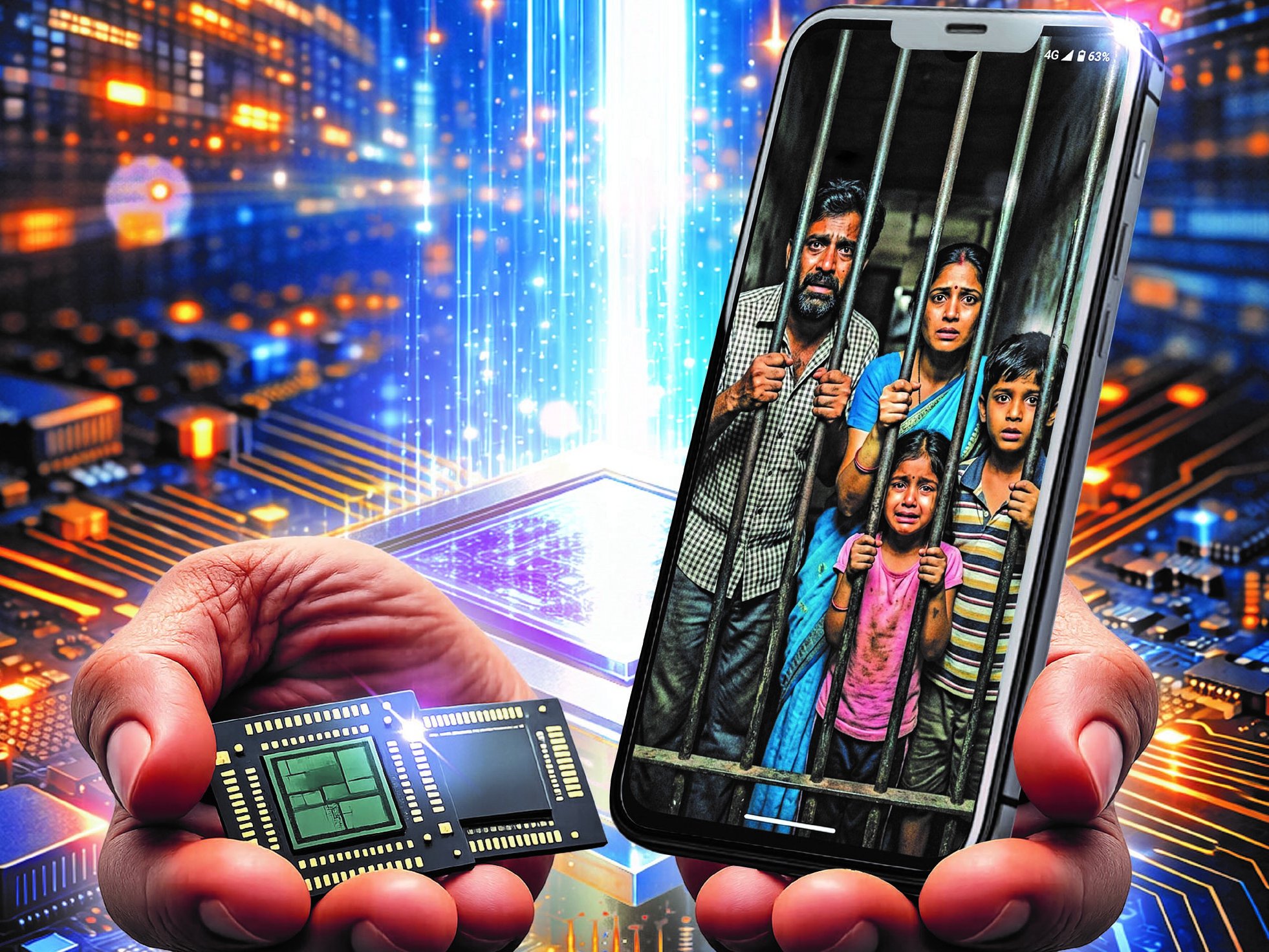
For the many users who use a smartphone for every task, who proudly believe “we belong to an advanced era” and remain constantly online, this is a wake-up call. Through the media, people are gradually realizing that smartphones continuously monitor them. Yet most still lack clarity about the scale of surveillance, its depth, breadth, and background. Full public awareness will take more time.
Your every movement, live location, habits, hobbies, political opinions, purchases; your health conditions, illnesses, medicines, lifestyle, food patterns; your address, phone numbers, Aadhaar and PAN numbers, bank account details, loan information, educational background, marks obtained; even your secrets, weaknesses, and personal behaviors; the mobile messages and emails you send to loved ones; your passwords and OTPs — in short, your entire data is constantly being collected.
This data is then compiled and sent to companies like Google, Apple, various app developers, and data brokers. Even if you do not have a specific company’s app installed on your smartphone, that company may still purchase your personal data from data brokers and store it. Intelligence agencies of various countries also continuously receive comprehensive information through smartphones.
Your every movement, live location, habits, hobbies, political opinions, purchases; your health conditions, illnesses, medicines, lifestyle, food patterns; your address, phone numbers, Aadhaar and PAN numbers, bank account details, loan information, educational background, marks obtained; even your secrets, weaknesses, and personal behaviors; the mobile messages and emails you send to loved ones; your passwords and OTPs — in short, your entire data is constantly being collected.
Until the mid-1990s, what we had were merely “talking phones.” Now everywhere we see “tracking phones.” How the talking-phone era transformed into the tracking-phone era is a long history — we shall discuss that another time.
The problem lies in how companies have designed modern phones. Android and iOS operating systems, GPS systems, and apps have been deliberately designed in a way that enables constant surveillance. Earlier, in talking phones, we could easily remove the battery. Now batteries are sealed inside so that the phone “never truly turns off.” To prevent users from disconnecting by removing SIM cards, eSIM chips are increasingly being made mandatory. These are not natural technological evolutions — they are strategic implementations according to corporate plans.
Governments are also deeply embedding digital systems based on these very phones. This system creates a situation where people are pushed into dependency and their choices are limited. Companies and governments together — knowingly or unknowingly — are creating, in the name of convenience and security, the dystopian reality of constant surveillance described in George Orwell’s 1984.
Why has the current digital revolution been designed this way? Could it not have been implemented more securely? When Edward Snowden, who worked on the U.S. NSA’s surveillance program (PRISM), fled and exposed everything many years ago, the world was shocked. Gradually, other governments and politicians realized: “Digital surveillance currently benefits the U.S. We cannot stop it. So why not use the same technology to gather information ourselves?” From there began rapid global digitization — and an open invitation to the AI revolution.
Governments are also deeply embedding digital systems based on these very phones. This system creates a situation where people are pushed into dependency and their choices are limited. Companies and governments together — knowingly or unknowingly — are creating, in the name of convenience and security, the dystopian reality of constant surveillance described in George Orwell’s 1984.
Surveillance is embedded in the internal architecture of smartphones. Both Android and iOS (iPhone) continuously transmit location, usage patterns, app activities, and phone IDs to their servers. Companies claim this is to provide “personalized ads.” But even if users disable personalized ads in settings, data transmission does not stop.
By default, “Location History” and “Web & App Activity” are turned on. Most users do not even know how to turn them off. Even when turned off, it may not help. A 2018 a study revealed that Android phones continued sending location data to Google servers 14 times per hour even when location was disabled. In 2022, a lawsuit filed by a researcher alleged that iPhone App Store apps were silently recording every user touch and tap.
Many apps come preinstalled when you purchase a phone. These cannot be deleted. Such apps are called bloatware (unnecessary default apps). There are different types:
- Apps installed by operating system makers like Google and Apple.
- Apps installed by phone manufacturers like Samsung or Xiaomi, and by carrier companies.
- Companies like Facebook (Meta) even pay to have their apps preinstalled before you buy the phone.
These “preinstalled” apps cannot be deleted — and they are often the first to collect data. Along with them come the many apps you voluntarily download. A 2021 tudy found that about 80% of preinstalled apps on Samsung phones transmitted user information to third parties without user knowledge or consent.
Google Ads, Facebook Pixel, Unity, and similar companies provide Software Development Kits (SDKs) used by about 80% of app developers. Even if you don’t have Google or Facebook apps installed, their SDKs embedded within other apps continue tracking you. They can identify you across different apps and websites and consolidate all your activities in one place. A 2023 Oxford study examining around one million Android apps found that 88% secretly sent information to Google — even when users did not use Google services.
Wealthy Big Tech corporations do not fear fines. They treat them as the cost of business — the price of stolen data. Once stolen and transferred, data cannot be retrieved. And so the practice continues.
Apps like Facebook, Instagram, and Google Assistant (Gemini) keep the phone’s microphone active and constantly listen to conversations. Companies argue this is necessary for voice commands. However, a 2019 Northeastern University study found many apps were secretly transmitting microphone data to third parties.
Meanwhile, government intelligence agencies continuously monitor citizens’ information and activities. Many apps marketed as “safe and secure” reportedly contain backdoors for surveillance agencies. Technologies like Pegasus represent a major global phenomenon of covert data transfer. Edward Snowden revealed that companies like Google cooperated with intelligence agencies.
In 2024, Google was fined €50 million and Meta €1.3 billion for violating Europe’s GDPR data protection law by transferring data to the U.S. The Supreme Court of India recently warned WhatsApp (Meta), questioning who authorized it to exploit citizens’ personal data and cautioning that it could be expelled from the country. Yet, despite court cases and some public awareness, the so-called “digital mafia” has moved far beyond such limitations, backed by powerful governments.
Wealthy Big Tech corporations do not fear fines. They treat them as the cost of business — the price of stolen data. Once stolen and transferred, data cannot be retrieved. And so the practice continues.
Many more studies and investigations could be cited. But the core issue is clear: the flaw lies in the overall design of today’s “smart” technology.
Your smartphone (or even a Windows personal computer — both are similar in surveillance capability) is not truly your smartphone. It is a device designed for others to continuously monitor, spy on, and harvest your data — and placed in your pocket or bag. And you are paying a high price to buy it.
Google is, above all, an advertising company. Around 97% of its revenue comes from advertising. Its business model is to attract users with free services, collect their data, and sell it to advertisers and data brokers (and, according to Snowden, provide it to U.S. government agencies). It is like letting your child play with strangers on the street.
Apple earns by charging 30% through its App Store and selling expensive devices. Its model is like letting your child play with selected strangers inside the house.
Do not think, “Is there really so much demand for my data? Who wants it?” According to a 2022 study, companies earn about $200 per smartphone user per year (approximately ₹19,000) by selling user data. Over five years of your phone usage, they earn around ₹1,00,000 from your data. If this continues, perhaps one day phones will even be given away for free.
Imagine a road full of snakes, and you have no alternative path. If you know beforehand that snakes are present, you proceed carefully and take precautions. If you are unaware, you walk straight in without protection.
On today’s “smart” tracking-phone path, awareness of the snakes is absolutely essential.
Author