The Sages instituted the tradition of celebrating the festival of Yugadi as the anniversary of the day the first Satya Yuga of the Brahma-Kalpa commenced on Earth. Puranas state that the current Kali Yuga began at the moment Sri Krishna’s avatar concluded. Aryabhata I provided the calculation for how many years had elapsed from the beginning of Kali Yuga up to his time. According to that calculation, it is understood that 3102 BCE is the starting year of the 28th Kali Yuga of this Manvantara.
Experts in traditional matters calculate that ‘Kali Yuga commenced on the midnight of February 17/18, 3102 BCE.’ This is merely one computation. Certain experts who have conducted research on the astronomical phenomena mentioned in the Mahabharata state that Kali Yuga began even before 5000 BCE. Renowned Indology expert Nilesh Oak states that 5561 BCE is the year the Mahabharata war took place.
Be that as it may, the practice of the New Year beginning at midnight must have probably originated from this starting point of Kali Yuga!
According to Vedic astrology, which existed even before Kali Yuga (during the time of Sage Parashara, Vyasa’s father, whose Brihat Parashara Hora Shastra serves as the foundational text for present-day astrology), that was the starting point of the Kali Yuga epoch, not the starting point of each day. The beginning of the Satya Yuga or Krita Yuga was marked by sunrise. Since then, calculating the start of the day in our tradition is based solely on the time of sunrise at respective locations.
Almanacs (Panchangas) display this kind of cosmic cycle and time-reckoning. This standard has been adopted by the “National Calendar” (and the Rashtriya Panchanga), which has been officially published by the Government of India since the 1950s.
The calculation of time is extremely ancient. Pinpointing its exact starting point is difficult. Even the so-called primitive humans possessed a basic concept of time. In the Rigveda, the world’s most ancient repository of knowledge, one can observe a highly complex system of time-reckoning. No one knows exactly how ancient the Rigveda is. Estimates regarding its antiquity vary widely, ranging from 8000 BCE to 70,000 BCE. By factoring in the 27,000-year sidereal cycle, its origin point can be traced back through successive preceding sidereal cycles!
The abstract principles and complex calculations of time, along with the specific astronomical phenomena of respective eras, are expounded exclusively in the tradition of the Sanatana Sages. In ancient India, mathematical and temporal knowledge was advanced enough to measure time spanning from tens of times less than a second to trillions of Yugas!
According to Vedic astronomy and Vedic astrology, ‘one day’ means the duration from today’s sunrise to tomorrow’s sunrise. Long ago in India, the calculation was based on Ghati and Vighati. This remains present in our Panchangas even today. According to it, a single day consists of 60 Ghatis. One Ghati comprises 60 Vighatis (referred to as Ghalige and Vighalige in Kannada). In the hour-and-minute format, one Vighati equals 24 seconds, and one Ghati equals 24 minutes. The Sanskrit word Ghatika became Ghadi (time-keeping instrument) in Hindi, and evolved into Gadiyara (clock/watch) in Kannada.
In the zodiac of Vedic astrology, 27 Nakshatras (constellations) are recognized. Each Nakshatra has 4 Padas (quarters). 27 \times 4 = 108. The number of divine names of the Almighty used in the Ashtottara Sata (108 names) chanting is also 108.
There are further fascinations. If you add the digits of 108, i.e., 1+0+8, it yields 9. The number 9 represents the creator, Brahma. Based on this, according to the calculation of the Chaturyugas, the duration of Satya Yuga (Krita Yuga) is 1,728,000 years. Adding these digits also yields 9: 1+7+2+8 = 18 = 1+8 = 9. Similarly, the durations of Treta Yuga, Dvapara Yuga, and Kali Yuga also resolve to 9. In this manner, 1,000 Chaturyugas constitute a single day of Brahma, which is the period when Brahma carries out creation. If the 12 Horas of Brahma’s daytime creation are multiplied by Brahma’s number, 9, the result is 108! The Sanskrit alphabet contains 54 letters. Each letter has dual aspects—Shiva and Shakti. 54 \times 2 = 108. Those who restrict their breathing to exactly 108 respiratory cycles per day through Pranayama are called Mahayogis. The total number of Upanishads that expound Brahma-Jnana (supreme knowledge) is also 108. The product of the 12 zodiac signs and 9 planets in astrology is 108. The number of Lord Mahavishnu’s holy shrines, Divya Desams, is 108. Thus, the number 108 is utilized as a symbol of many fascinating occurrences.
The numbers 24 and 60 have been used since ancient times. Utilizing 60 as a base number, the angles of a circle are measured in ‘degrees’—such as 360°, 180°, 90°, and 60°. Since the astronomical zodiac is also a circular concept, the same numerical system was implemented for its calculation, which translates into the calculation of time. Time is measured in units of 60 and 24—such as 24 hours of 60 minutes, or 60 Ghatis of 60 Vighatis. In astrology, 2.5 Ghatis are called a Hora. This came into usage from the word Ahoratra (day and night: A-Hora-tra). According to Hindu astrology, a day consists of 24 Horas. It is this very word that Europeans adapted as ora, oer, hoar, avur, hour! One Hora is equivalent to one modern hour. Exactly 2.5 Ghatis make up 60 minutes.
If an imaginary line is drawn across space between the points of sunrise and sunset (in the East and West), the path of the sun appearing to traverse the sky becomes apparent to us. That is a semicircle of 180°. Similarly, during the night, the other half of the circle lies on the opposite side of the Earth, totaling 360°. Hence, like the measurement of circular angles, a 60-based numerical system (called the sexagesimal system) is used for measuring time, rather than the metric system based on 10 or 100 (though the decimal system of 1, 10, 100 also originated in India).
To facilitate the study of astronomy, ancient science divided the 360° entire sky into twelve segments, calling each 30° part a Rashi (zodiac sign). Modern science has accepted this ancient method and continues to determine the positions of planets and stars based on this primordial zodiac. Our physics, sky-maps, and planetariums all identify the locations of celestial bodies using the names of the various signs from the old zodiac.
As a consequence of the Earth’s 23.5° axial tilt, the sun appears to change its zodiac signs (its eastern and western points of sunrise and sunset) to an observer on Earth. To an observer from Earth, the sun appears to tilt toward the Northern Hemisphere after Makara Sankramana (Winter Solstice) and toward the Southern Hemisphere after Karkataka Sankramana (Summer Solstice). It doesn’t just appear that way; after Makara Sankranti, the northern part of the Earth receives more light. Daylight emerges at the North Pole (the polar regions experience continuous six months of day and six months of night!). The South Pole gradually plunges into darkness. After Karkataka Sankranti, the Earth’s South Pole becomes illuminated. If you have a window facing east or west, you can observe the direction of sunlight entering the house shifting.
Our ancient seer-scientists (Rishis) knew that the actual cause for this was the Earth’s motion. From the perspective of human life on Earth, people referred to this as ‘the sun’s entry into a zodiac sign.’ Describing it constantly as ‘the effect of Earth’s motion’ in daily life would be highly cumbersome! Even though the sun neither literally rises nor sets, we identify it as ‘sunrise’ and ‘sunset’ for the convenience of human life on Earth. Do we ever say out of a stubborn passion to ‘speak only scientifically’: “As a consequence of the Earth rotating on its axis, the star Sun has now become visible to us, and light has commenced falling upon our region”? We simply say, ‘the sun has risen!’
Even though the sun does not literally rise, it is not unscientific to consider that ‘the sun has risen for us’ when sunrise occurs at our location. This is because heat, light, and everything else become available at our location following sunrise. Nature also recognizes these changes. Flowers bloom. Vegetation grows. Ocean water heats up, evaporates, and forms clouds. The atmosphere is affected as well. While viewing everything perpetually from the Earth’s perspective may not be the complete cosmic truth, dealing with things from the viewpoint of the effects produced on human life on Earth is certainly not unscientific.
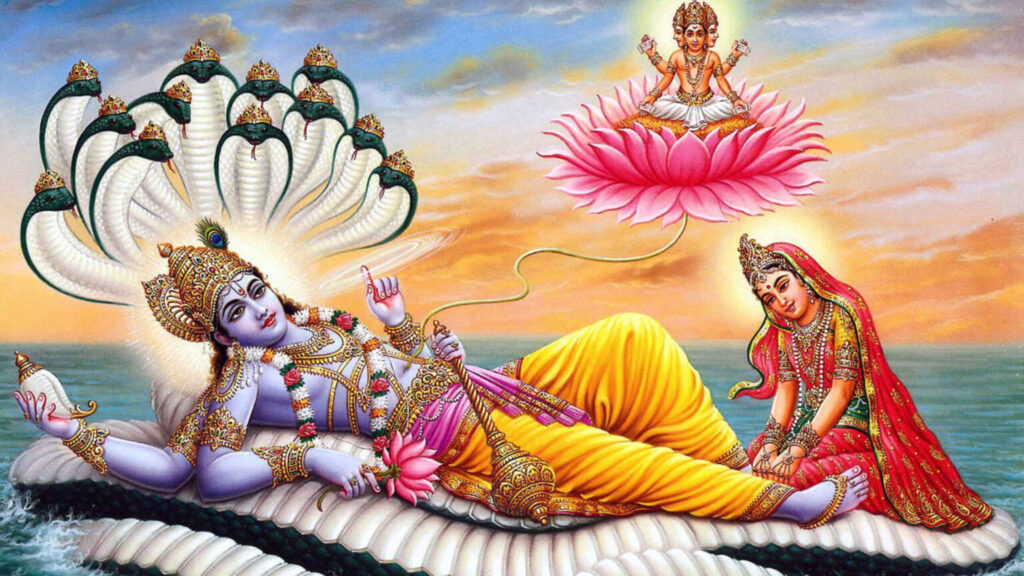
A Kalpa signifies a single day of the creator, Brahma. What we refer to as a day or dina is called a Kalpa in the transactions of Brahma-loka. Our single day is not one Kalpa of Brahma. The commencement of Brahma’s Kalpa is not dependent on the position of the sun or the movements of the Earth. Once Brahma’s day begins, he starts creating every specific object in this universe. When Brahma’s day began, our sun, Earth, and all celestial bodies did not even exist. Brahma initiates the work of creation after awakening from his Yoganidra (cosmic sleep). Sages explain science to us in the form of stories, stating that Brahma recreates everything exactly as it existed in the previous Kalpa (his previous day), which had dissolved back into seed form at the conclusion of that prior Kalpa. There are Vedic mantras that express this.
Thus, the Sages were the ones who recognized that astronomy, time, measurement, perception, creation, existence, and Yoga are all in perfect harmony with one another. It is for this reason they are called Drashtaras (Seers). As propounded by them, ‘Yugadi’ is the very day on which the first Satya Yuga of this Kalpa commenced on Earth.
Author