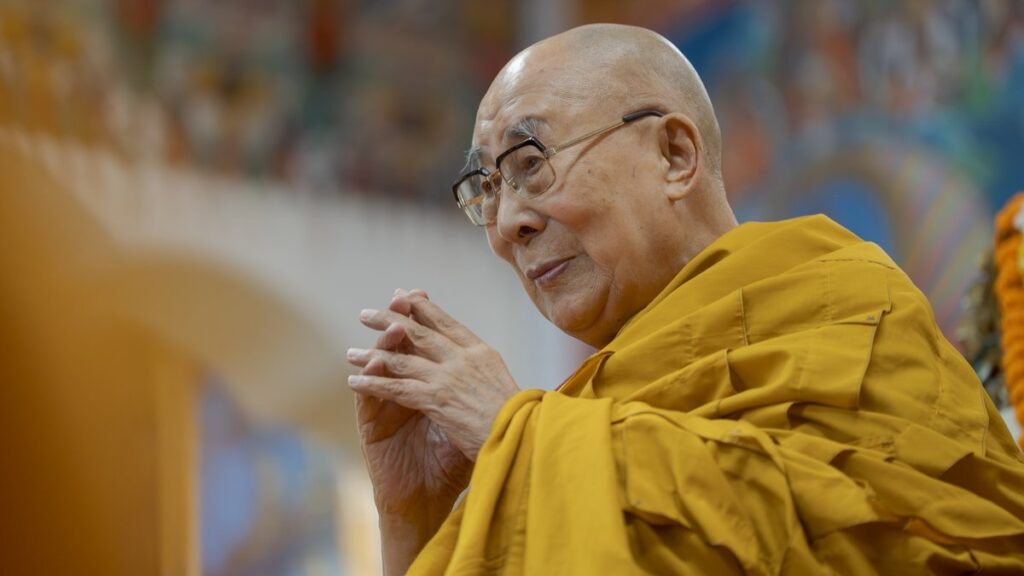
The supreme guru of Tibetan Buddhism, the Dalai Lama, has celebrated his 90th birthday. Along with that, there emerged a new harassment from China regarding his ‘successor’. As you may know, Dalai Lama is not the name of an individual. It is the title of a religious guru’s position. The person holding that position has come to be recognized simply as the ‘Dalai Lama’. His actual name is unknown to most people. In the lineage of Tibetan Dalai Lamas, the current Dalai Lama is the fourteenth. He was born on July 6, 1935. Born into a poor farming family after the demise of the 13th Dalai Lama, his birth name was Lhamo Thondup. After becoming the 14th Dalai Lama, he gradually gained recognition as a unique humanitarian personality and also became a Nobel Peace Laureate in 1989. This Buddhist guru has now completed 90 years.
There is a belief that Tibetan Lamas, after their death, are reborn into a Tibetan family. When a search was conducted based on this belief, infant Lhamo was found. Upon examining the characteristics of the infant, he was proclaimed to be the ‘reincarnation’ of the 13th Dalai Lama. Later, the child was given a new monastic name, Tenzin Gyatso, and was imparted Buddhist education. Tenzin Gyatso received his initiation and political authority as the 14th Dalai Lama in 1950. Around the same time, China invaded Tibet. Subsequently, due to the direct aggression of the Chinese Communist government, the Dalai Lama fled to India in 1959 along with his countless disciples and subjects. Since then, India has provided shelter to him and his people. It was from Indian soil that he managed the affairs of the exiled Tibetan people for decades. Even though he later relinquished political authority and continued solely as a religious guru, there are no two opinions within the Tibetan community regarding his supreme leadership.
The Dalai Lama has given up hope of gaining full independence from China, which claims the ancient and beautiful country of Tibet as its own. Declaring that it would be enough if Tibet achieves greater autonomous status (a level of status slightly below full independence), he has continued his non-violent struggle for it. For the past few years, he has scaled back his daily political activities and leaned more toward spirituality. Nevertheless, China repeatedly brings the dispute over who his successor will be to the forefront.
As soon as he turned 90, political maneuvering regarding his succession began once again. The stubborn stance of the Chinese Communist regime is that only someone chosen by them should become the next Dalai Lama. Tibetan tradition does not accept this. Their tradition dictates that the Dalai Lama himself indicates how his successor should be identified. It is the belief of those people that he will be born again. According to another belief, the Dalai Lama can transfer his consciousness to someone else while he is still alive. Whatever the case may be, the enthronement of his successor is a process that must take place after the paranirvana of the current Dalai Lama. Recently, perhaps to escape China’s harassment, the Dalai Lama declared that he would live for another 30 to 40 years. He has stated multiple times in the past that it is certain he will live for at least the next 20 years.
China is in an extreme hurry regarding his successor. The Communists of China are not ready to leave such matters to the Tibetan people and their tradition. They possess the stubbornness that the next Dalai Lama must be someone designated by them. Although the idea of Communists selecting religious and spiritual gurus is ridiculous, China has engaged in political maneuvers to establish several ‘Communist Lamas’ in the past. Accordingly, choosing various Lamas as per its wishes, placing them on desired seats, and manipulating them at whim is a major ‘geopolitics’ tactic. Is all of this possible in this day and age? It is natural to think whether the ‘international community’ will remain silent while China does all this. The CCP of China, which possesses a demonic policy—especially under Xi Jinping, who is like a younger brother to Hitler—cannot be expected to respect global opinion. In the coming months and years, the selection of the Dalai Lama’s successor may turn into a subject of intense political exploitation and unrest.
In any case, where is this ‘international community’ right now? All communities are pushed into a corner. Does the ‘United Nations’ have any strength? America, which used to stand firmly on the side of Tibetan Buddhists, is now in confusion. Its President, Donald Trump, is acting like a deranged person by altering his stance day by day, and the prominent countries of the West are suffering due to a lack of unity. ‘NATO’ was sidelined long ago without a clear long-term vision. The ‘liberals’ who favor China are flourishing in all democratic countries. Just as termites consume a tree from within, they are occupying public administration, courts, media, and education inside many countries, making everything hollow from the inside. This has taken place systematically over the last few decades. America’s influence in the United Nations has diminished, while the influence of China and Islamists is growing. China supporters have infiltrated all major political parties. It seems as though ‘someone’ is designing plans to ensure that every country except China gets caught in some war vortex. Under such circumstances, it is not surprising if China floats in the illusion that no one currently possesses the strength to confront its misadventures.
Tibet is a country with a history thousands of years older than China. Having been a part of the Indian Sanatana civilization since the times of Ramayana and Mahabharata (the pre-Buddha era), it subsequently remained an autonomous country for thousands of years. Historically, Tibet is India’s neighboring country, not China. In very ancient times, it was a part of India’s Sanatana civilization itself. Sanatana sacred sites like Mount Kailash and Lake Manasarovar are located right there. It was from India that Tibet accepted the Buddhist tradition and formulated its own unique techniques. It came to be regarded as India’s neighboring brother nation. The Indian Sanatana civilization recognized this as well. There has been an intimate relationship between the sadhus and yogis of the Himalayas and the Tibetan Lamas since the very beginning. There are countless examples of them meditating together like friends or as guru and disciple in the same cave, a practice that continues even now. Even today, the Dalai Lama refers to India as his second mother and his spiritual guru.
Throughout ancient history, Tibet was never a part of China. Even though some Chinese emperors attempted to control Tibet during certain periods after the 12th century, they had recognized its religious and spiritual autonomy. Distorting this, China claims that Tibet has been a part of it since the era of the emperors. However, in official Chinese records prior to 1949, Tibet was recognized strictly as a ‘foreign country’. The ‘problem’ was created anew during the era of the Communists. By invading Tibet, Communist China has come to sit right next to India. Besides Nepal and Bhutan, India’s Ladakh, Himachal Pradesh, Uttarakhand, Uttar Pradesh, and the northeastern states have come within China’s arm’s reach, giving rise to new anxieties.
One must learn from the Dalai Lama how to live harmoniously with a foreign country. The way he grew into a guide for the entire world after arriving as a refugee is unique. Today, the whole world listens to his ideas. Political leaders and experts from various fields seek life-guidance from him. Physicists and psychoanalysts have held dialogues with the Dalai Lama for years and brought out many books. The Dalai Lama’s train of thought has flowed across many subjects essential to everyone, such as life, the world, mind, happiness, life satisfaction, contentment, civilization, religion, science, medicine, world peace, global harmony, and psychosomatic harmony. He is also a great ‘mind-management’ guru for the modern world. His thoughts have turned into words, and his words into writings, influencing the world. Even in the words he speaks while casually sitting and drinking tea, there is deep thought, an X-ray-like insight, a clear analysis, and a sharp opinion filled with wise sayings. The casual conversations he holds are like a major thesis for others! Most of his major volumes have been prepared based precisely on the conversations held with him. His power of thought is that strong and deep.
The moment the inkling arose in the West (through eastern gurus) that whoever achieves ‘mind-management’ in the right manner grows into a powerful global force, a new dimension of global politics opened up. A massive demand began for the mental-power practitioners of the Eastern countries. The West began to view the Dalai Lama, who is considered foremost in this kind of awareness and realization, from the perspective of a great ‘mind-master’. Gradually, the Dalai Lama came to be considered a major leader globally (and also made news for certain unnecessary controversies). Perhaps, agencies like the CIA might have calculated whether his ‘soft-power’ could be utilized against China. Whatever the case may be, it is true that the importance of the current Dalai Lama has grown in the ‘geopolitical’ dimension as well. Previous Dalai Lamas had not attained this kind of global stature.
This very stature of the Dalai Lama has become a thorn in China’s side. Its conspiracy is to place one of its puppets in the position of the Dalai Lama as early as possible and bring a permanent end to the Tibet issue. To prevent any opportunity for this, the Dalai Lama is formulating plans regarding his successor. India is supporting him.
Author