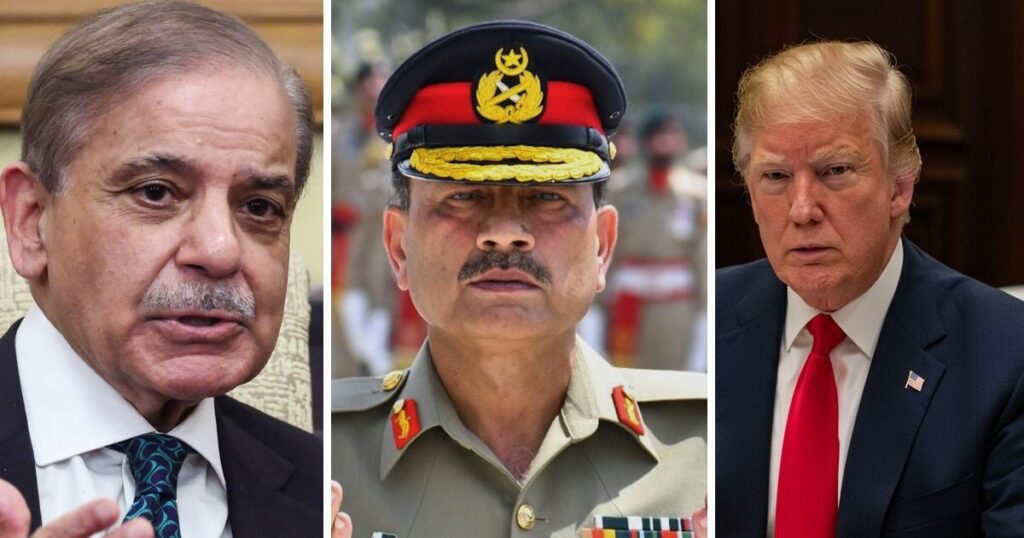
Why did US President Donald Trump step forward to rescue Pakistan when it was on the verge of being completely decimated by India? Why did he ensure that thousands of crores of rupees reached this sinful nation through the IMF at a time when Pakistan’s terrorism had crossed all limits? — These are questions residing deep within the hearts of many Indians. The reason these questions take birth is the belief that “now America is truly our ally, and Donald Trump is a sincere leader who stands by India.” This is merely a belief, nothing more. The reality is entirely different.
Pakistan mastered the diplomatic art of extorting money from various countries long ago by projecting messages along the lines of: “My weakness is catastrophic for the world. Therefore, hold my hand and protect me, so that you too may survive. Otherwise, it will spell trouble for you.” True to form, Western powers have historically saved Pakistani jihadists from biting the dust completely, rescuing them from time to time. The common belief was that “Donald Trump will not follow this policy; his stances are different.” Trump has shattered that belief and adhered to the old policy.
It is noteworthy that Donald Trump had spoken harsh words about Pakistan during his first presidential term as well, yet even then, the Pakistanis were prevented from hitting the streets. Even now, financial aid and other resources continue to flow into Pakistan through American benevolence (via the IMF, World Bank, etc.). Behind this lies a dual calculation: on one hand, the strategy dictates that “a power capable of challenging India must remain alive right next to India,” and on the other hand, there is a cautious watch to ensure that “Pakistan does not slide completely into China’s embrace.” Keeping forces that challenge each country active right in their backyards—China against India, India against Pakistan, Pakistan against Afghanistan, Afghanistan against Iran, Iran against Israel, Israel against Yemen—so that America alone can dominate, is an old and deceptive American tactic. It has not changed even now. One cannot expect it to change in the future either (even if Vivek Ramaswamy becomes president).
“India is the world’s largest democracy. America is the world’s oldest democracy. It is only natural that these two should become allies”—this statement resonated loudly during the tenure of Prime Minister Atal Bihari Vajpayee. “India and America are natural allies” was the aspirational phrase that echoed in both nations at the time. This is an ideal concept. However, real-world situations do not always exist in an ideal state. The message bequeathed to his country by Henry Kissinger, the cunning strategist who profoundly influenced American foreign policy, was: “There are no permanent friends and permanent enemies, there are only permanent interests.” This very concept, which had existed as America’s unstated foreign policy from the beginning, gained an official status through Kissinger. No matter which government comes to power there, this policy persists. While an alliance is possible in specific circumstances where the self-interests of America and India happen to align, even that is not permanent. Thus, while India and America can be called permanent friends on an ideal plane, on the plane of reality, India too—much like America—must take steps according to its own “self-interest” of the day.
Currently, both India and America are facing various kinds of threats from China. Both are confronting Islamic terrorism. They are also dealing with homegrown elements acting on behalf of terrorist forces. Although there is a vast difference in the quality of leadership between the two nations (Trump cannot be deemed entirely trustworthy), there is a certain similarity in the internal and external challenges they face. Shared challenges bring common elements among self-interests to the forefront. Therefore, under the current circumstances, Donald Trump is not standing against India. Had Kamala Harris won instead of Trump, the likelihood of her turning completely toward Pakistan was distinct. Indian Prime Minister Narendra Modi has recognized this. Despite Trump’s eccentricities, finding a certain utility in him has become a necessity for India at this juncture.
During the Cold War era, the situation was even more cryptic. It was hard to discern who belonged to which side. It is difficult to claim that the threads of old connections no longer exist, and the reason for this is the very nature of America’s (and most countries’) intelligence agencies. They preserve all old threads. The CIA is particularly notorious in this regard. Operating with thousands of overt and covert personnel and a multi-billion-dollar budget, the CIA is like a vast, separate world. Within its main anthill lie hundreds of other anthills, within them several more, and within those lie even more secret anthills—making it a massive labyrinth. Who can truly know which snakes reside in which anthill and what they are up to? While on one hand there are snakes nurturing Pakistan to challenge India, on the other hand, there are snakes that have ‘helped’ India by informing, warning, and ‘alerting’ it about many secret plots of jihadist terrorists. It is said that while on one side there are CIA analysts cooperating with the US government to fight against jihadists in the ‘War on Terror’, on the other side, there are agents keeping the back door open, instigating jihadists to fight against forces opposed to them. Many former CIA directors and agents have written books about their agency, bringing many of its controversial actions into public debate. Among these, it is impossible to know what is true and what is not. One cannot fathom how many heads or how many hats the US Presidents and CIA Directors responsible for the CIA might possess.
The CIA and Pakistan’s ISI have together nurtured many jihadist organizations; within the CIA, there is a large and influential faction that opposes Donald Trump’s stance. Similarly, one cannot assume that Trump will completely diverge from all stances taken by the CIA. The ISI is privy to many CIA secrets. Consequently, it is difficult for America to completely shake off Pakistan, which has clung to its body. Even with Trump as president now, the stains of past actions committed by the CIA will inevitably stick to his hands.
Behind the discrepancy between the words Donald Trump spoke about Pakistan during the election campaign and the tones he is emitting after entering the White House lie secret commitments. America does not consider anyone its permanent friend or permanent enemy. Its calculation rests entirely on what benefit it can derive from each entity. Its long-standing position is that no other power in the world should grow besides itself, and that it alone must continue as the sole superpower. A president who loudly proclaims outside that “India and America are natural allies; the economic and strategic alliance between us is shaping up to be stronger than ever before,” sits inside thinking, “How do we suppress India’s growth?” Keeping forces that pose a challenge to each country alive is America’s deceptive policy. No matter who becomes president, the story remains the same.
Until they win, presidential candidates naturally remain unaware of all the tasks America has executed, the secret operations it has carried out, and the numerous clandestine agreements and commitments it holds. When they win the election and reach the ‘transition of power’ phase, they are given a secret ‘intelligence briefing’. That is the first stage of shock treatment! After taking the oath and assuming office, detailed intelligence data is provided. At that moment, many of the new president’s old stances vanish. The burden of numerous secret understandings forged during the tenures of past presidents falls squarely upon the new president’s head. Even if the new president firmly intends to change past courses of action in certain matters, it takes a tremendous amount of time to comprehend how far the old links extend and to grasp the wide-ranging consequences that such a change might trigger.
Historically, America has never conducted itself in a completely trustworthy manner. From the very beginning, it has followed a policy of ‘containment’ regarding terrorism. It is a deceptive policy that avoids completely eradicating terrorists, ensuring instead that their field of operation remains somewhere else. The formula is: “Do whatever you want anywhere, just do not interfere with our country’s direct interests.” America has followed this principle since time immemorial. It has plunged into ‘war’ only when American soil and interests were directly threatened.
Barack Obama, who assumed power while mocking that “George Bush knows nothing other than giving money to Pakistan,” subsequently went ahead and displayed even greater generosity than Bush. Later, Trump, who assumed power criticizing Obama’s policies, began imposing conditions that India must take steps honoring American commercial interests if America was to distance itself from Pakistan for a while. This turned into a hot potato for India—something it could neither swallow nor spit out. Even now, while waging a ‘trade-war’, Trump floats in the illusion that he is a magnificent, wise leader handling all nations—India, Pakistan, China, Russia, Iran, and Israel—simultaneously.
No one can harbor dreams of global safety and stability by relying on an erratic country like America. A genuine concept of global security has never entered its policies. For its own selfish gains, that country can create anyone, ally with anyone, and betray anyone. American foreign policy is built precisely upon such a treacherous foundation. The harsh reality remains that all American administrations adhere to a peculiar policy: “Through our shrewdness (and dominance), we will subdue and keep everyone in check, manage everyone simultaneously to create challenges among themselves, while we alone remain secure.”
Author