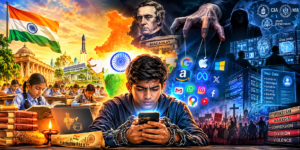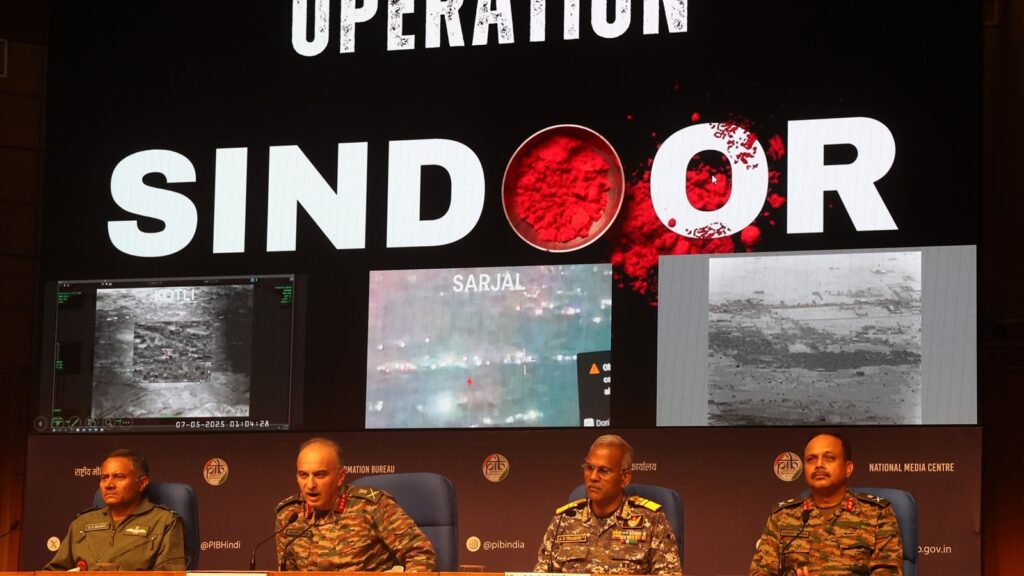
At the time of writing this, India’s “Operation Sindoor” has achieved phenomenal success. The precision of Indian strikes, the utilization of cutting-edge indigenous technology, and especially India’s AI military technology have captured the attention of the entire world. While Indian military professionalism was already well-known globally, the revelation of hidden domestic technological achievements has left powerful nations, including America and China, completely astounded. On one hand, the terror-military bases of the sinful nation of Pakistan have been decimated, while on the other hand, even China has been compelled to think twice before attempting any misadventure. A clear message has been delivered: “India and the Indian leadership cannot be taken lightly.” Pakistan’s nuclear blackmail games will no longer work.
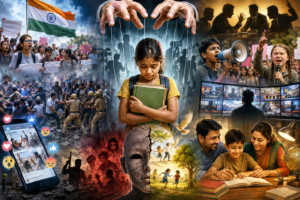
However, behind-the-scenes anti-India machinations are likely to take higher priority now. It is not just Pakistan. China, Western deep-state entities, and America might prioritize plans to derail India’s superpower potential. Extreme vigilance and high alert are required regarding Pakistan-sponsored jihadist sleeper cells, pro-Pak and pro-China intellectuals, and deep-state maneuvers. Tactics to internally fracture Indian society could intensify, and the deployment of internal subversives might increase. Comprehensive strategies are needed to repel them.
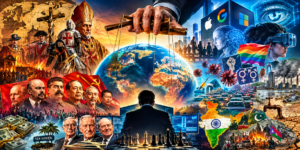
Connecting a few international dots reveals a larger picture. The same forces that orchestrated the proxy war against Russia through Ukraine, and forced Israel into an inevitable conflict using Hamas, might have also planned to draw America into the arena through Iran-Houthi dynamics, and India through Pakistan. After attempts to provoke India into war via Bangladesh failed, it appears they directly pushed Pakistan onto the battlefield. For now, America is postponing its direct involvement in major wars, yet attempts to provoke it through Iran continue. Directly or indirectly, major military powers like Russia, India, and Israel are currently active in conflicts. Who could be designing these plans to embroil all major nations in various wars? China is currently the only major power remaining distant from active combat.
While bombs have been rained down on Pakistan, thinking ahead about what else is required is crucial. Having Ajit Doval, a consummate expert in these matters, is a reassuring factor. The current team—comprising a capable leader like Narendra Modi and an efficient Finance Minister like Nirmala Sitharaman, who ensured our economy did not collapse but rather grew during Covid—inspires immense confidence in the public. The balkanization of Pakistan is truly good for India and beneficial for world peace. However, in our efforts to achieve this, we must ensure that our military and economic strength do not get depleted. China remains India’s principal adversary, and strategies to diminish its strength must take priority. If a situation arises where we are forced to clash with China, matching that with appropriate capacity building must be our ultimate goal.
Even though a significant number of jihadists have been eliminated for now, how do we stop the jihadist hydra from sprouting again in another location under a different name? It is remarkable to look at which forces backed the world’s massive terror outfits in the past, and which forces back them today. Historically, America, Russia, and Europe all nurtured jihadists by providing funds, weapons, and short-term objectives. In the next phase, Qatar, Turkey, Saudi Arabia, and Iran poured money like water. Religious provocations were engineered, and ‘Fidayeens’ (suicide bombers) were actively encouraged with allurements of heavenly pleasures awaiting them in the afterlife. Countless mosques across the globe were repurposed as nerve centers for terrorist activities, and new strategic religious organizations mushroomed. To arrest India’s growth, clandestine assistance was provided to Pakistan’s nuclear projects by all the aforementioned countries.
Pakistan has historically been the epicenter of global jihadist activities. The partnership between the ISI and the CIA runs deep. Amidst this, China formulated a strategy to offer cooperation that surpassed even America’s involvement. It began assuming the responsibility of sponsoring and managing the jihadist network of Pakistan and the wider world. Today, Pakistan, China, elements within the CIA behind the curtain, and the Euro-American deep-state continue the game of continuously generating terrorists to use them for their respective designs. Some provide financial, moral, and ideological backing, while the Pakistani army supplies logistics, strategy, religious fanaticism, safe havens, and nuclear backing. Looked at closely, Pakistan does not need separate terrorists; the Pakistani army itself functions as a terror outfit.
The objective of the jihadist network is to establish Islamic rule in Europe, Israel, America, and India, and subsequently subject the entire world to a ‘Khilafat’ (Caliphate). For this, they have secured the backing of internal forces within these nations. Globally, it is an open secret that influential self-proclaimed liberals stand in favor of Wahhabi fundamentalism. It is universally acknowledged that Khalistani and Maoist extremists enjoy the backing of the ISI. The fact that Maoist Naxals work for pro-Pakistani interests is well-documented. Different iterations, different names, different games, different players—but the objective remains identical. According to experts, these projects do not suffer from a lack of funds; money is amassed through the illicit trafficking of weapons, currency, gold, and drugs. Terrorist organizations are created and floated like soap bubbles. Experts note that no matter how many bubbles burst, the shameless perpetrators harbor the audacity to simply create more.
At one point Al-Qaeda takes the lead, at another time ISIS comes to the forefront. If they are destroyed, another sprouts somewhere else. Previously, under the umbrella of Osama bin Laden’s ‘IIF’, jihadist terror outfits like Pakistan’s Lashkar-e-Taiba, Jaish-e-Mohammed, and Sipah-e-Sahaba had congregated. Later, Pakistan’s ISI tilted them toward ISIS, and experts state that today, the ISI itself functions as a nodal agency coordinating between outfits operating under various aliases.
“Terrorism has no caste or religion” is a slogan routinely mouthed by certain ‘leaders’. Yet, terrorists explicitly call for violence in the name of religion. This plunges ordinary followers of that very faith into absolute confusion. In such scenarios, religious reformists and liberals ought to come to the forefront to distance their faith from extremism. However, during critical situations, they invariably retreat into silence.
Ayan Hirsi Ali, a Somali-born US-based ‘ex-Muslim’ author and researcher, has candidly discussed the religious dimensions and happenings of the Muslim world and Islamic society in her books (as a result of her bold writings, she has to live under security protection). According to her, the vast majority of Muslims in the world are very good people who quietly focus on their practices like prayer and fasting. They do not support extremists, nor do they have an interest in violence. However, they do not mingle freely with others either; they create their own separate enclaves and remain within them. The remaining elements are the prime targets of extremists. If extremists succeed in corrupting their minds and winning them over, it spells trouble because their population runs into millions. They are possessed by the madness to conquer the world, and their influence and authority within the community are substantial. Pakistan has historically handpicked a few such individuals within India to sow pro-Pakistani infatuation, aided by certain liberal intellectuals. Devising a way to stop this must now become a universal concern.
Ayan Hirsi Ali argues that to achieve all this, the beliefs and strategies of jihadists must be subjected to proper critique, and discussions regarding ‘what reforms are possible’ must be held dispassionately. However, she notes that fundamentalists and the ‘liberal’ ideologues supporting them do not allow this. In her firm opinion based on personal experience, academic and political activists who call themselves ‘liberal’ obstruct reforms far more than religious extremists do. Her books contain numerous examples illustrating this.
Why do most ‘liberal’ intellectuals ideologically support extremist jihadists? What benefit do they derive from extremists? These are questions with no definitive answers. It is uncertain how many of the intellectuals who offer such support even know the answer, or how many have been troubled by the question, “Yes, why are we supporting them?” They are aware that they must offer support for some strategic purpose. However, the likelihood that everyone knows what that strategy is, or who formulated and manages it, is minimal. Nevertheless, a blind conformity has taken over, summarized by the attitude: “Let us just align with how our group behaves.” It is bizarre that such individuals consider themselves ‘intellectuals’ and ‘independent thinkers’!
The former Soviet Union, Europe, China, and America all nurtured multiple jihadist groups for their respective contemporary interests. Even now, the backing of left-wing forces within these countries continues. Jihadist violence has been intertwined with the leftist concept of violent revolution. This is a peculiar strategic alliance. In the 1970s and 80s, the notorious Venezuelan terrorist Ilich Ramírez Sánchez wrote a book titled Revolutionary Islam while inside prison! This can be viewed as an external literary symbol of an old ideological alignment. This left-wing terrorist, infamous as ‘The Jackal’ or ‘Carlos the Jackal’, converted to Islam after being incarcerated. A few European newspapers excerpted elements from his book in 2003. It is said that in the book, while justifying the 9/11 attacks carried out by bin Laden, he asserted: “Watch how in the coming years, jihadist terrorism will plague democratic nations as a daily nightmare.”
In the post-Cold War era, Samuel Huntington’s theory posited that people’s religious and cultural identities would become the primary source of conflict at the global level. His proposition was that Islamic fundamentalism would turn into a global challenge. Huntington wrote an essay titled “The Clash of Civilizations?” in the Foreign Affairs magazine in 1993. In 1996, he expanded that essay into a book under the identical title to present his theory. Prior to him, in 1990, Bernard Lewis analyzed ‘why Muslim extremists hate the West’ and wrote that ‘this hatred will very quickly assume political and military dimensions.’ What both these authors omitted to write was that “the backing of a self-proclaimed liberal army of democratic countries, along with the support of powerful, invisible forces of the West, would grow globally for jihadist extremism.” To dismantle global jihadist networks and arrive at a full-scale, permanent solution, one must look past all these forces and move forward. That remains the monumental challenge confronting the world.
Author