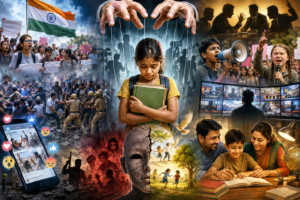
This is a sleepless civilization! Between “corporate culture,” the excesses of “nightlife,” and digital distractions, people’s sleep has diminished significantly. The average daily sleep duration for urban Indians has plummeted to 5–6 hours. Even children aren’t sleeping properly anymore. If this continues, a “Sickly India” will be the result.
Depending on age, physical-mental condition, and necessity, 7 to 9 hours of sleep is essential. In the past, daily activities generally took place from morning until afternoon. Earning food through physical labor (hunting or farming), collecting water, and other life-sustaining activities happened during this period. Modern employment systems were modeled on this very cycle. However, after the advent of electric lights, a new era of “stress” and the 24-hour work concept began. Both people’s sleep and health started to collapse.
According to a study conducted by ASSOCHAM (Associated Chambers of Commerce and Industry of India) in April 2015, 42.5% of private sector employees in India suffer from severe clinical depression! Driven by the “work hard, party hard” craze, 38.5% of employees sleep less than 6 hours a day. Long working hours, mounting expectations/targets, high stress, performance-linked incentives, the “work hard to save your job” ultimatum, and sleepless drinking parties are the root causes. This has led to an increase in physical ailments, mental illness, and neurological disorders. There is a marked rise in the consumption of caffeine, alcohol, and tobacco; even those who previously didn’t smoke (such as many women) have now taken up the habit. This report was based on studies across 18 industrial sectors—including KPO, BPO, Media, and Telecom—covering all major states and metropolitan cities.
“Occupational stress” is the greatest problem of our times. Because of it, the use of cigarettes, drugs, drinks, and junk food is becoming excessive. In the quest to boost industrial productivity, families and societies are suffering. Millions of employees have lost their family lives and personal time. Meanwhile, awareness has cropped up here and there that “working excessive hours is hazardous to health.” Some CEOs have begun talking about “work-life balance” and stating they “don’t work on weekends.” Yet, sleep duration across all classes has dropped sharply, fueled by various attractions and “nightlife” habits.
The concept that a “Good King has no personal pleasure” has existed since ancient times. In terms of sleep, they are not role models for the public! Chanakya’s policy was: “A king must never fall into a deep, oblivious slumber; he must bolt upright even at the rustle of a leaf.” Many Yogis do not sleep at all. Arjuna is said to have conquered sleep, which is why he is called ‘Gudakesha’ (Gudaka means sleep). In current times, it is said that Prime Minister Narendra Modi hardly sleeps. Since his days as Gujarat CM, he has had the habit of working late into the night. Officers are inevitably forced to stay awake with him. According to those close to him, just when they think the day’s work is over and head to bed, he wakes up at 5:00 AM and starts making phone calls. For those who rule the country or guard it, sleeplessness sometimes becomes inevitable. Once, someone supposedly asked Napoleon, “How much sleep does one need?” He replied, “Six hours for a man, seven for a woman, and eight for a fool.” Since Napoleon is no authority on health, we needn’t take his word seriously.
According to a 2005 survey by the Sleep Council, the people who sleep the least in the world are “on-call” hospital doctors, with an average of 4.5 hours. Following them are politicians and administrators, with an average of 5.2 hours.
Various world leaders have experimented with sleep. Gandhiji is prominent among them; his experiments with food and sleep were numerous, eventually compiled into his book Key to Health. Another leader who studied the importance of sleep was the famous American scientist and statesman, Benjamin Franklin, who wrote Early Rising. Franklin popularized the Aristotelian adage—”Early to bed, early to rise, makes a man healthy, wealthy, and wise”—through his poems. It was a reflection of his personal lifestyle; he would sleep before 10:00 PM and rise around 4:00 or 5:00 AM, getting about 7 hours of sleep.
A common trait is found in the lifestyle of centenarians (those over 100) and those past 90: sleeping early in the evening and rising early in the morning. In our state, scholars like Pt. Sudhakar Chaturvedi, Sri Shivakumara Swamiji, Sir M. Visvesvaraya, and Dr. Shivarama Karanth all believed in this formula. Journalist and author Khushwant Singh also followed the rule of “must sleep by 9:00 PM” for many years. Once, when then-PM Rajiv Gandhi was supposed to visit his house at 9:30 PM, Khushwant Singh flatly refused, saying, “I will be asleep at that time, so he shouldn’t come!”
In certain regions and communities, the number of centenarians is exceptionally high, such as Okinawa (Japan), Sardinia (Italy), Loma Linda (California), Nicoya Peninsula (Costa Rica), and Ikaria (Greece). Dan Buettner authored a fascinating study called “Blue Zones” on this subject. He discovered nine major lessons from their lives; a common factor was that no centenarian had a “nightlife” obsession.
Just like food, there are various beliefs and theories regarding sleep. While some studies suggest 5 hours is enough, most others declare that sleeping less than 7 hours is dangerous. There is also an argument that in ancient times, people didn’t sleep for 7–8 hours continuously. Primitive humans didn’t sleep in one stretch; they would sleep for 3–4 hours, stay awake for 1–2 hours, and then sleep for another 3–4 hours. This is called ‘Biphasic Sleep’. Even ‘Polyphasic Sleep’—sleeping and waking frequently throughout the day—has gained traction. There are “Gurus” who teach that those on the path of Yoga do not need much sleep. Much like fad diets, strange “sleep fads” are currently in circulation.
According to the Nobel Prize-winning scientific theory of Circadian Rhythm, the biological clock inside humans depends on the external day-night cycle. According to this, midnight should be the midpoint of your sleep. This means you should sleep around 8:00 or 9:00 PM and wake up before sunrise. Wasn’t this the method followed by most people before the arrival of electric lights? Except for nocturnal creatures, all animals and birds follow this rhythm.
“Sleep is vital for physical and mental balance; one must sleep within the first quarter of the night (by 9:00 PM),” says Ayurveda. ‘Pratarutthanam’—rising in the early morning (4:00–5:00 AM)—is the stance of all Ayurvedic authors. The Bhagavata says Shri Krishna would wake during the Brahmi Muhurta (3:00–4:00 AM) to meditate. Similarly, in the Gita, Krishna says, “Yukta-ahara-viharasya…” His teaching is that both food and sleep should be “Yukta” (appropriate)—neither too much nor too little. Excessive sleep increases Tamas (lethargy), while too little increases Rajas (restlessness).
The “almost universally accepted” stance is that sleeping for about 8 hours (on average) is the right way. One should not think of it as wasting one-third of one’s life in sleep. For health and longevity, sleep is a must. If two-thirds of your life is to be good, you must spend one-third in sleep! Newborns sleep 21–23 hours out of 24. Children and teenagers need 10 hours. Adults need at least 7–8. The quality of sleep is also crucial. According to surveys, 30 out of every 100 adults snore; the exact reason isn’t known, so there is no definitive cure to stop snoring entirely.
In a seven-and-a-half-hour sleep cycle, about 60% is light sleep, 20% is deep/restorative sleep, and the remaining 20% is the “dreaming” phase. You don’t dream the entire night, nor do all dreams happen at once. Dreams occur in the interval between light and deep sleep, known as the Rapid Eye Movement (REM) period. Much like TV programs with commercial breaks, you watch a “movie” (dream) for about two hours a night!
A belief has somehow taken root among children, parents, and teachers that “if you lose sleep and study, you can get a rank.” Forget increasing memory; losing sleep actually reduces the memory you already have. It stunts brain power. Sacrificing sleep leads to “insomnia” problems. If you have insomnia, no amount of study will help. Like Karna in the Mahabharata forgetting his mantras during battle, those who are sleep-deprived lose the ability to recall what they’ve read. During sleep, the brain and the cells of the entire body repair themselves. People even continue to learn while sleeping; a subconscious memory works without our knowledge during sleep. Your brain isn’t idle while you sleep; it organizes your perceptions and systematically records them in memory cells. That is why the mind is clear and the intellect is sharp after a good night’s rest.
Author