“People have the opportunity to follow whichever religion they want in their private lives, or follow none at all and live merely by obeying the law of the land. They also have the opportunity to voluntarily undergo personal conversion from one faith to another” – this is the declared concept of ‘Religious Freedom.’ This kind of ‘religious freedom’ emerged in the West only very recently.
Barring a few non-Christian and independent philosophers of ancient Greece, Europe during the Christian era possessed an administration (rulers) with a religious framework similar to present-day Saudi Arabia. Church authorities controlled the state. After this system caused much injustice and violence, people became fed up. As a result, a concept emerged that ‘the Church and the government should not be one and the same; they must be separate; one should not interfere in the domain of the other.’ They called this ‘Secularism.’ Once ‘secularism’ and ‘democracy’ took root, religious practice became confined to private life in fully democratic countries. The argument that ‘religion’ is irrelevant in public life and government affairs grew stronger.
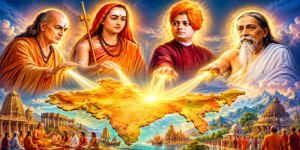
True ‘Religious Freedom’ existed in India from the very beginning. Various kinds of philosophies, visions, sects, and faiths all coexisted. There was also the opportunity to easily and fearlessly convert from one sect to another. When the Buddhist faith newly emerged, where did its followers come from? Some people from the pre-existing Vedic and other traditions embraced Buddhism. Many among those who went eventually returned to their mother faith. When the Khalsa sect newly began, Vedic Hindus joined it, often with one person from each household. The same happened across various philosophical schools. Many Vedic Hindus of Karnataka accepted the Jaina tradition. Later, most of them accepted the Basava philosophy (Veerashaivism/Lingayatism) and became followers of that tradition. Mandana Mishra accepted the Shankara Vedanta philosophy. The Jaina king Bittideva accepted Ramanuja’s ideas and became a Shrivaishnava, taking the name Vishnuvardhana. Emperor Chandragupta Maurya, a disciple of Chanakya, accepted the Jaina philosophy. King Ashoka, who had a Vedic and Ajivika background, had converted to Buddhism even before the Kalinga war. Thus, ‘Religious Freedom’ existed in our country from the beginning, both individually and collectively, and that tradition continues even today.
The problem started during an excessive phase when Europeans and Middle Easterners began using Christian and Islamic conversions like a political weapon—a weapon to establish their religious hegemony. In the eyes of the proselytizers, converting others became synonymous with ‘Religious Freedom.’ First, it was the concept of “I have the right to convert.” But what they advocated was the concept of “We have the right to convert others!”
This went even further and took a new form: “Historically non-proselytizing religions and faiths should not start doing all that ‘now.’ Nor should they pose obstacles to religions that have historically been converting people. That alone is true religious freedom!” In other words, this means: “Ours is a converting religion, yours is a non-converting religion. Hence, we are free to convert you, but you cannot convert us, nor can you obstruct our conversion efforts!”
It is based on this very argument that the American government’s ‘USCIRF’ (United States Commission on International Religious Freedom) has been issuing its ‘official’ reports. Rants are being directed against many countries, including India. Behind the false allegations that “injustices are happening to minorities in India” lies the anger that “minorities do not have enough opportunities to increase their numbers through rampant conversions and become the majority.”
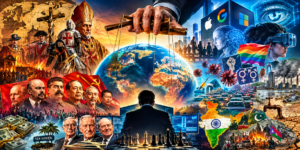
The utilization of conversions for geopolitics and strategic purposes has become extreme. There is an American plan to carve out a new Christian country from the territories of India, Myanmar, and Bangladesh. Because a wrench was thrown into that plan, developments occurred to topple Sheikh Hasina’s government in Bangladesh (Sheikh Hasina herself has revealed this publicly). What does this mean? If a new Christian country emerges, it will be a Christian nation nurtured by the grace of America; American churches will control it, meaning the CIA will have control! Clear proof is found here for Swami Vivekananda’s words: “Conversion is, in reality, expatriation (nationality conversion).”
In America’s view, who are the ‘minorities’? Whichever communities in foreign countries America plans to utilize to create anarchy, it first terms all those communities as ‘minorities.’ The work of systematically sowing the poisonous seed that ‘theirs is a distinct culture’ begins. An argument is constructed stating that ‘injustice is happening to them, and they are not getting equality and human rights,’ and immense publicity is given to that argument. NGOs and media organizations are utilized to manufacture such arguments. To officially enter the field, there are countless government-backed organizations like ‘USCIRF.’
Swami Vivekananda had warned even back then that ‘conversion is expatriation, and it is a danger to the nation.’ Yet, our political and constitutional systems also became indirectly responsible for the rise of conversions in India. How? The first mess was introducing the concept of ‘Minority Rights’ in India in a manner that is not in practice anywhere else in the world. In independent India, the concept of equality stating “religious minorities also have absolute equal rights” never arrived. A system dictating “let all citizens and all communities have the same rights” did not come into being. Instead, the concept of “special rights for minorities” was introduced. In other words, these are “special privileges and rights possessed only by religious minorities, which must never be given to the majority”!
There are two bizarre concepts here. One is the idea of divisiveness called ‘religious minorities.’ The other is the concept that ‘special rights must exist’ only for religious minorities. Even more bizarre than that bizarre concept is the notion that “those rights must not belong to the majority. Only then can it be deemed that special rights have been granted to minorities.” Does such a concept exist in America? Does it exist in European countries?
In India, under the concept of ‘Minority Rights,’ specific religious communities can run autonomous educational institutions without government control. They can teach their religious tenets. They can manage their places of worship themselves without handing them over to the government. Is this opportunity available to the ‘majority’? While there is government control over temples, there is no such control over mosques, churches, etc.! This is official, legal discrimination. As mentioned earlier, if one converts (individually or collectively) from a ‘majority’ religion to a ‘minority’ faith, it is considered ‘Religious Freedom’ in the eyes of Westerners and their followers in India. However, if a minority converts to the majority religion, a political battle begins! Ruckuses are raised claiming that the minorities are being annihilated or swallowed up. All these are unofficial discriminations motivated by politics and propaganda.
If one converts from the majority religion to a minority faith, according to the laws of our country, special rights and special privileges are granted under the ‘Minority Rights’ concept! This means there is profit in conversion! Thus, can it not be interpreted that “incentive and encouragement for this kind of conversion have been provided within the framework of our law itself”? One reason behind certain Hindu organizations or communities starting to think “we are not Hindus, ours is a separate group; we are minorities” is the flaw in our legal system. Such a bizarrely tangled legal system does not exist in any other premier democratic country in the world.
Religion/faith is your personal belief. You must have the freedom to preserve it. But what is the harm if all the freedoms you have are also available to others? In India, non-Hindu communities possess many legal rights (special privileges) that Hindus do not have. This is strange. It is noteworthy that in no other country in the world is such official legal discrimination taking place against the primary religion of that land.
If Hindus, Muslims, or Buddhists in America or Australia say, “We are religious minorities. We want special rights and privileges that Christians do not have,” they will not get them. First of all, the constitutions there do not recognize the concept of a ‘religious minority.’ Secondly, the idea that ‘religious minorities must have certain special privileges that others do not’ does not exist in their system. The governments there view everyone through the lens of ‘citizens.’ They have civil and criminal codes that apply equally to all.
Many ‘minorities’ of Indian origin living in Australia or America live by adhering to the common civil code there. As long as they are in that country, they are considered ‘citizens’ of that country. They confine their religious practices to their private lives. However, if they renounce that citizenship and return to India, the situation changes instantly. Here, they are not considered mere ‘citizens’ but get to wear a special label called ‘religious minorities’ once again! Many special constitutional privileges that the “majority” does not have stand waiting for them!
The true concept of ‘Minority Rights’ is to protect any minority by ensuring they face no discrimination and by providing them with all kinds of equal opportunities. It is not about giving special privileges exclusively to them and discriminating against the remaining majority.
Author