Dr. S.L. Bhyrappa had a very close relationship with the senior statesman, Mr. Harnahalli Ramaswamy, who was the President of the Lok Education Trust, and with the current president, Mr. Ashok Harnahalli. Before publishing his novel Avarana, Bhyrappa had shown it to both of them and asked, “Are there any legal flaws?”
In the past, Mr. Garudanagiri Nagaraj, who was an editor of Karmaveera, was a dear friend of Bhyrappa. Bhyrappa had discussed the scientific aspects of his novel Yana with Mr. Satish, an ISRO scientist (now retired), who is the son-in-law of Garudanagiri. Bhyrappa had learned a lot about scientific topics from him.
From the time of Garudanagiri Nagaraj, Bhyrappa had been an avid reader of Karmaveera. Later, he also read my articles and frequently interacted with me. I had spoken to him many times over the phone for hours. On several occasions, after reading my articles, he would call me and discuss them, showing immense kindness. When he wrote Uttara Kanda, some of his fans had criticized him. In that context, he called me and spent almost two hours explaining why he had written it that way.
Bhyrappa had attended many events organized by our office. During the “Kindari Jogi Festival” organized by us in Mysuru, he personally drove his car to attend it.
There are two instances in my personal interactions with him that I will always be grateful for.
One was when, some of us (from our publication group) were invited to Bhyrappa’s house in Mysuru for a grand meal that included holige, bisibele bath, chapati, vegetable curry, and gasgase payasa, which he himself served us! When we informed him we were coming to Mysuru to interview him, the only condition he set was, “The meal must be at my house.”
The second instance was when Bhyrappa invited me to inaugurate the “S.L. Bhyrappa Kadambari Loka” seminar, organized by the Ramakrishna Hegde Rashtreeya Vedike’s Mysuru chapter. How can one express gratitude for such generosity?
This is a time when philosophical and scientific discussions on “consciousness” are on the rise. Recently, Dan Brown’s new novel Secrets of Secrets was published. The main subject of the novel explores whether self-awareness exists outside the brain, what happens after death, and whether consciousness survives beyond the body. This topic has garnered global attention. But Dr. S.L. Bhyrappa had already discussed these subjects in his novels long ago!
As a great writer with a philosophical and scientific background, Bhyrappa has constantly explored the meaning of creation, life, death, and awareness through his works. Novels like Naayi Neralu, Nele, and Saakshi have deeply analyzed the soul and self-awareness in an unparalleled manner. Like the dimensions of the ultimate truth seen by Bendre through poetry, Bhyrappa saw them through his novels. The philosophical explorations of life by writers like Karant, Sharatchandra, and Tolstoy are all reflected in Bhyrappa’s works. In fact, he was one of the greatest writers in the world, a treasure of India and a pride of Karnataka.
Through his multifaceted achievements, Shivaram Karant followed the path of Rabindranath Tagore, and like Leo Tolstoy, Bhyrappa walked a similar path, uncovering unique insights through his novels. Both achieved greatness and popularity, but another parallel can be drawn—like Tolstoy, Bhyrappa too led a life of unexplained solitude, particularly in his 80s and 90s without much proximity to his family, which was also a distinctive feature of their lives.
While Bhyrappa was creating literature, many political movements were leading people astray. It is a well-known fact that political influences ruined the creative potential of many writers. In contrast, some poets, driven by money, turned to writing film lyrics. The focus shifted from “literature first” to “money first,” and the thrill of mass entertainment became more important than strong literature. Writers who used terms like “post-modern,” “Marxist,” “rebellious,” and “Dalit” to categorize their literary work gave a political label to their creative work. In doing so, they oversaw two generations of literary production under a political influence.
Against this background, some spread the rumor that Bhyrappa joined another political group when writing Avarana. When he wrote Kavalu, he faced harsh criticism from leftist feminist thinkers. However, in writing Uttara Kanda, Bhyrappa made it clear that his political opinions were personal and that his literary path remained independent. In his later years, his two novels, Yana and Uttara Kanda, revived his insights into life.
Does the moral law of truth change from one solar system to another? Does a promise given in one solar system lose its meaning and break in another? As the physical worlds have limits, do values too have boundaries? Does the law that prohibits certain marriages apply beyond the solar system? If stars and gravitational forces differ in other parts of the universe, do truths also differ? Is it possible that life forms with no need for the concept of God exist in a universe where knowledge and science have advanced significantly? These are the deep, foundational questions that Bhyrappa explores in Yana.
The story of Lord Rama, who after enduring a long exile and suffering for Sita, had to abandon her in the city, is a topic that has been discussed for centuries. The emotional question “Was Lord Rama right?” is answered traditionally by saying, “It was the kingly duty of Rama”. However, Bhyrappa’s opinion, as expressed in Uttara Kanda, is, “Rajadharma is merely a form of the establishment.” This view shocked traditional thinkers.
His magnum opus Parva, based on the Mahabharata, has similarly sparked discussions that continue even today. Writers have consistently re-told the stories of the Ramayana and the Mahabharata in their own way, and this represents their literary independence. Bhyrappa famously stated, “The Ramayana belongs to Valmiki, not to me. I am only expressing my thoughts here.” This shows the greatness of his thought process. This is why no two of his novels are alike, and it is difficult to categorize his literary creations within a rigid framework.
The tradition of pure literature continued, and writers like D.V.G., Bendre, Kuvempu, Anankru, Karant, Masti, M S Puttanna, Bhyrappa, and Adiga, in their thirties, instilled confidence and expanded the literary world. They began writing in ways that appeared more “original” than the other writers of their time. In doing so, they made people regard pure literature as something to be admired. People often invited writers into their homes to offer meals, even asking them to name their children. During the era of the leftist political movements, many leftist writers gained “fame” not for their literary works but through extra-literary activities. With the arrival of such “writers” who smoked cigarettes in the open and roamed with anger in their eyes, people began to fear literature. This shift marked the end of an era in which literature was seen as an idealistic endeavor.
Now, there are official definitions, directions, and frameworks for our literature. The notion that “if literature does not serve any political ideology or struggle, then it is not literature, it is a fairy tale” has become widespread among political writers. As a result, it is difficult for students today to find “pure” and “high-quality” works to read. Political agendas have taken over the works of many writers, and it is rare to find true literary talent that is not driven by politics.
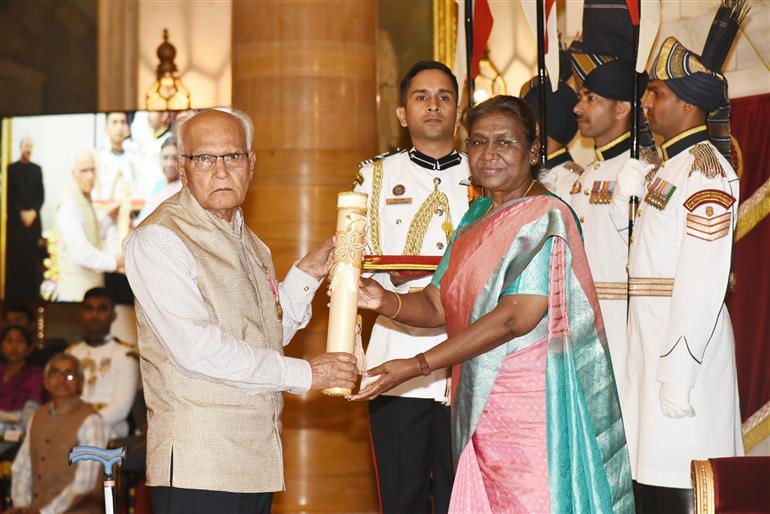
In contrast, the complaint that Bhyrappa did not receive the Jnanpith Award despite his exceptional literary contributions is often voiced. People also knew that Bhyrappa would never receive the Jnanpith Award, because of his strong non-leftist ideology. Even if he had received the Nobel Prize for Literature, it would have been insufficient to acknowledge his greatness. After Rabindranath Tagore’s era, the global literary awards, including the Nobel, have lost much of their former prestige. The Peace Prize, which was denied to Mahatma Gandhi, now goes to individuals like microfinance promoters, and the Literary Prize has come to represent a specific “ideology.”
Measuring Bhyrappa’s greatness by the awards he received or did not receive would be wrong. His greatness lies in being a link in the chain of pure Kannada literature. However, with his passing, if this legacy of pure literature breaks, Kannada literature will suffer a great loss.
Author