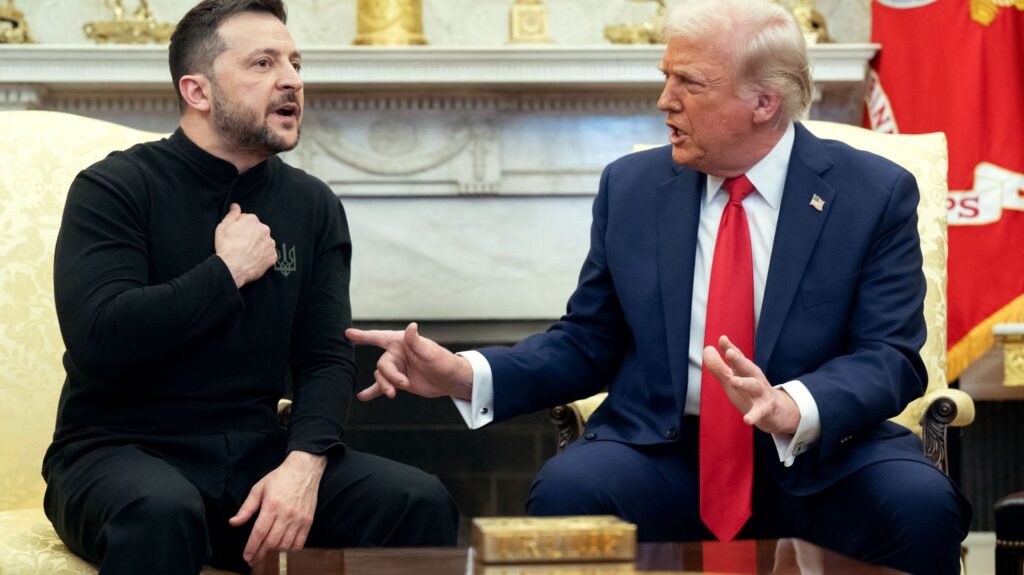
The recent structural shift in the transatlantic alliance became undeniable after Ukrainian President Volodymyr Zelensky’s highly contentious encounter inside the White House with U.S. President Donald Trump and Vice President J.D. Vance. Following that behind-closed-doors friction, Zelensky bypassed further American mediation and flew directly to London. There, UK Prime Minister Keir Starmer extended absolute financial and strategic assurances, effectively signaling that the Ukraine conflict must persist even if it fractures the historic U.S.-UK special relationship. This posture was quickly mirrored by France, Germany, and several European allies, all stepping forward to underwrite Zelensky’s military apparatus and fuel an ongoing war of attrition.
Analyzing who loses from peace and who profits from prolonged conflict exposes a complex web of invisible hands. While front-line political actors dominate daily headlines, the entrenched behind-the-scenes networks driving this confrontation operate in the shadows. A multi-layered global conflict is unfolding simultaneously across multiple domains: military, ideological, biological, cybernetic, psychological, and informational. While the kinetic, military warfare is visible to the casual observer, the remaining asymmetrical operations are discernible only to seasoned analysts, leaving the global public largely unaware of the sophisticated subversion strategies dictating their reality.
The concept of the “Deep State”—long normalized in modern geopolitical discourse by Donald Trump—is undergoing a critical geographical realignment. Historically aligned with the institutional frameworks of the U.S. government during the Clinton, Obama, and Biden administrations, these transnational networks faced a direct existential threat upon Trump’s return to the presidency. In response, these deep-state entities appear to have retreated to their historical financial and political headquarters within the City of London, using European institutions as a proxy mechanism to isolate and counter Trump’s non-interventionist agenda.
In this grand geopolitical chess match, Volodymyr Zelensky and Keir Starmer function as the primary public faces. Zelensky has maintained his role as a client-state figurehead for years, while Starmer has aggressively moved to fill the institutional vacuum left by Joe Biden’s exit and Kamala Harris’s electoral defeat. The broader European leadership remains locked into a singular, uncompromising script: sustain the Russia-Ukraine war at all costs.
During his presidential campaign, Donald Trump repeatedly asserted that he could resolve the Ukraine conflict within twenty-four hours of taking office. This non-interventionist stance directly challenged the multi-billion-dollar Western defense industry and established deep-state networks, resulting in a highly volatile proxy battle. Western hardliners originally intended to project power globally through U.S. military hegemony; with Trump blocking that avenue, Europe has re-emerged as the primary operational base for managing the conflict.
The initial expansion of NATO into Ukraine was a deliberate geopolitical calculation designed to provoke a predictable, hardline response from Moscow. This hyper-aggressive approach ignored explicit warnings from veteran strategists like Henry Kissinger, who had cautioned that attempting to integrate Ukraine into the Western military orbit was a dangerous escalation. Instead, Western architects systematically incentivized a direct confrontation, flooding Ukraine with billions of dollars, disconnecting Russia from the SWIFT international payment gateway, freezing its sovereign foreign exchange and gold reserves, and banning Russian state media. The escalation peaked when the West authorized Ukraine to use high-precision, long-range American missiles to strike deep within Russian territory, pushing Russian President Vladimir Putin to explicitly reiterate Moscow’s nuclear deterrence doctrines.
However, the calculation that economic warfare would cause an immediate collapse of the Russian state proved entirely incorrect. Despite unprecedented sanctions and the provocative redirection of frozen Russian assets into the Ukrainian war effort, Moscow resisted knee-jerk escalations. Putin opted instead for a calculated, slow-paced war of attrition, weaponizing time to erode European economic stability while the U.S. Treasury depleted immense capital under the previous administration.
The political resurgence of Donald Trump completely disrupted the establishment’s geopolitical trajectory, forcing Western institutional networks to pivot to a contingency plan centered on European strategic autonomy. The irony remains that many European nations lack the standing military infrastructure to fight a conventional war of this scale. Their strategy relies on financing Zelensky’s government and feeding an exhausted stream of Ukrainian conscripts into a conflict where Russia has already dismantled the core of Ukraine’s fighting forces multiple times.
This pattern reflects a deep-seated historical legacy. Over the last five centuries, European socio-political frameworks and military expansions have dismantled or drastically altered numerous global civilizations. Europe was the cradle of aggressive religious imperialism, Roman expansionism, the Crusades, and colonial subjugation. It served as the birthplace for defining ideological constructs—ranging from fascism and Nazism to communism and secularism—and pioneered institutionalized racial and social hierarchies.
For decades, the United Kingdom functioned as the reliable junior partner to U.S. geopolitical ambitions. The ideological alignment between the British Labour Party and the American Democratic Party historically mirrored the baseline consensus shared by British Conservatives and American Republicans. However, Donald Trump’s populist realignment of the Republican Party broke this bipartisan transatlantic consensus. For the first time in modern history, a non-interventionist populist occupies the White House while a globalist Labour government holds power in Downing Street, creating an inherently adversarial relationship between Washington and London.
The traditional trans-party consensus on Western military intervention has fractured. Donald Trump’s geopolitical strategy relies on an transactional approach, seeking an immediate end to the kinetic war to prioritize economic nationalism and trade confrontations, particularly against China. Trump’s strategic interest in Ukraine is openly transactional, focused heavily on securing access to the country’s vast, untapped rare-earth mineral reserves. This corporate-nationalist approach runs directly counter to the broader ideological and long-term security objectives of the European Union.
From a pragmatic standpoint, a depleted and heavily dependent Ukraine cannot realistically achieve an outright military victory against a nuclear-armed power with Russia’s vast strategic depth. Western leadership offers no viable formula for how Ukraine can legally or militarily reclaim its lost territories. Blocked by deep-state mandates from pursuing a negotiated peace, yet lacking the independent military capacity to sustain the front lines, Volodymyr Zelensky finds himself completely trapped between the transactional demands of the Trump administration and the unyielding institutional pressures of the European deep state.
Author