The successful return of Indian-origin American astronaut Sunita Williams and her crewmates by Elon Musk’s SpaceX, after they were stranded aboard the International Space Station for nearly nine to ten months, has brought immense relief globally. However, this high-stakes rescue has simultaneously cast a harsh spotlight on the profound challenges, volatile uncertainties, and brutal physical toll of prolonged space travel. When an intended eight-day mission spirals into a grueling nine-month survival ordeal due to technical failures, it is only natural to question the grandiose timelines pitched for colonizing Mars.
While space travel remains a romanticized dream for many, the reality of living beyond Earth is a logistical and biological nightmare. Even if we set aside the glaring dimensions of administrative, political, and engineering inefficiencies, the human body is simply not built to survive outside Earth’s biosphere. Stripped of the protective embrace of Mother Earth, the human anatomy begins to unravel, proving that artificial environments are a poor substitute for the complex ecosystem that evolved to sustain us.
For an astronaut, every second spent in microgravity is an engineered battle against bodily decay. Spacefarers routinely combat spatial disorientation, acute nausea, and splitting headaches. Proprioception—the body’s inherent ability to perceive its own position and movement—is severely compromised. Furthermore, inhabitants of the space station witness 16 sunrises and sunsets every single day. This catastrophic disruption of the natural circadian rhythm triggers deep psychological fatigue and chronic insomnia. Even the basic act of eating is stripped of pleasure; because fluids float, food is heavily processed, rehydrated, or pasteurized, and lacks vibrant flavor.
The most basic human functions become complex technical operations. To use the waste collection system, astronauts must literally strap themselves down to the commode with specialized belts to prevent floating away. Despite rigorous pre-flight training, elimination remains incredibly difficult. When astronauts finally return to Earth, the transition is brutal. Many report an inability to coordinate their limbs, with some collapsing entirely when attempting to walk under the sudden weight of Earth’s gravity. For most, re-entering Earth’s atmosphere feels like being born all over again, requiring months of intense physical therapy and medical monitoring. Given this grueling reality, the long-term health consequences for Sunita Williams remain a subject of profound concern.
In light of these physiological barriers, the dream of establishing a permanent, self-sustaining human colony on Mars feels incredibly distant. The driving force behind contemporary space colonization is existential dread. Thinkers and tech tycoons argue that human extinction is an impending certainty due to climate collapse, nuclear annihilation, rogue artificial intelligence, or catastrophic asteroid impacts. Believing that one or more of these existential threats will materialize in the coming decades, they argue that while we may not save every individual, we must save the human species. The proposed solution involves transforming human civilization into a multi-planetary species. Because Mars is a terrestrial, rocky planet in relatively close proximity, it has become the focal point of governmental space agencies and private billionaires. Yet, it forces us to confront a poignant question: humans have systemically degraded the environment of Earth; if we colonize Mars, is there any guarantee we won’t turn its pristine landscape into another ecological wasteland?
The truth is that outside of Earth, our solar system is actively hostile to terrestrial life. While billions of exoplanets exist across the cosmos, our current technology is nowhere near advanced enough to reach them. For now, Mars is our only realistic testing ground—but a look at its atmospheric profile reveals how inhospitable it truly is. Mars has less than 1% of Earth’s atmospheric pressure, its atmosphere consists of 95% carbon dioxide, and temperatures average a freezing -62°C, dropping as low as -140°C. Furthermore, its soil is laced with toxic perchlorate salts and sulfur dioxide.
To survive here, NASA and SpaceX are designing pressurized, artificial biospheres. Humans will be entirely confined to these specialized pods. The moment an astronaut steps outside without a heavily pressurized spacesuit, the vacuum-like atmosphere and extreme radiation would prove instantly fatal. Even within the safety of these artificial habitats, how the human body will cope with living under 38% gravity for years remains completely unknown.
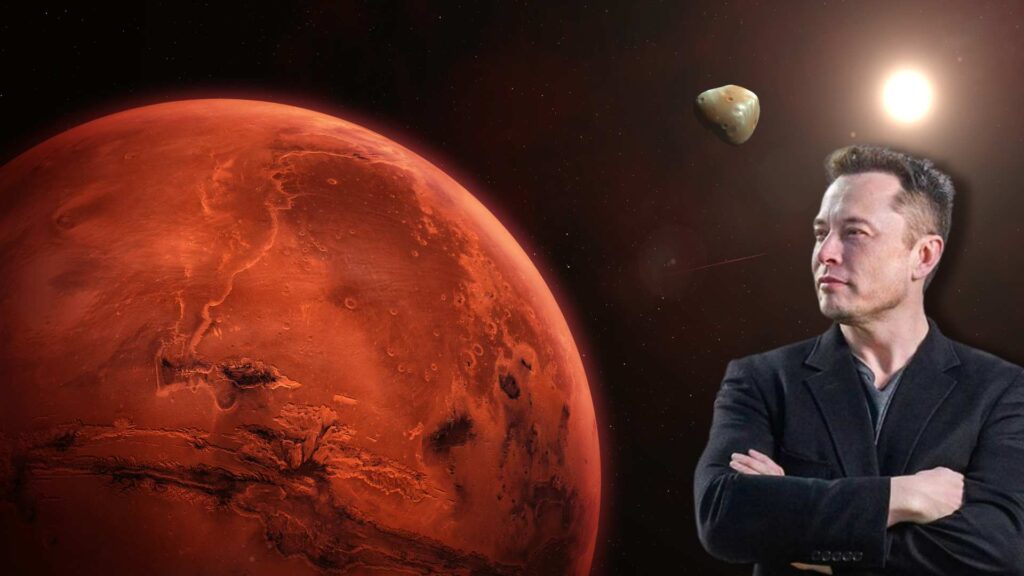
For decades, the vision of Martian colonization has been aggressively pushed by Elon Musk. SpaceX has undoubtedly revolutionized spaceflight by mastering reusable rocket technology, proving its mettle by ferrying astronauts and cargo to and from the International Space Station. Musk’s ultimate objective is to build a massive fleet of reusable Starships capable of transporting hundreds of humans and tons of cargo to Mars simultaneously. His stated goal was to establish a fully functional Martian base within 7 to 8 years. However, it has been nearly 15 years since those initial, overconfident timelines were broadcasted, and progress is nowhere near that pace. Forget a permanent settlement; humanity has yet to leave a single footprint on Mars. In fact, more than five decades have slipped by since a human last stood on the Moon. Space exploration is deceptively easy on a whiteboard, but brutally unforgiving in practice.
In the long term, space enthusiasts dream of “terraforming” Mars—a hypothetical process of deliberately modifying its atmosphere, temperature, and ecology to mimic Earth. However, terraforming is a monumental task that cannot be achieved in a generation; it would require advanced technology, unthinkable amounts of capital, and centuries of uninterrupted execution. Furthermore, Mars sits outside the primary habitable zone of our sun. Its weak gravitational pull—a mere 38% of Earth’s—is a fixed planetary characteristic. We cannot artificially inflate a planet’s gravity. Without sufficient mass, any atmosphere we attempt to pump into Mars will slowly leak back out into outer space.
To alter an entire planet, human civilization must evolve past its current primitive state. In 1964, Russian astrophysicist Nikolai Kardashev formulated a method to measure a civilization’s level of technological advancement based on the amount of energy they can utilize. This is known as the Kardashev Scale. A Type I civilization can harness and control all the energy available on its host planet, including total control over weather, earthquakes, and volcanic activity. A Type II civilization can directly harness the entire energy output of its parent star. Currently, humanity has not even achieved Type I status; we are technically a Type 0 civilization. We remain utterly incapable of controlling our own planet’s climate, predicting earthquakes with absolute certainty, or subverting tsunamis. Only when we advance well past a Type I civilization can we realistically talk about re-engineering the atmosphere of another planet like Mars. To seamlessly manipulate and utilize the energy resources of the entire solar system, we would need to reach the milestone of a Type II civilization.
Optimistic scientists estimate that humanity might transition into a Type I civilization within the next 100 to 500 years. However, such exponential technological evolution demands a highly stable, deeply collaborative global society. Scientific breakthroughs can only bear fruit in a world free from geopolitical friction, religious fanaticism, and ideological warfare. When our current reality is marred by constant anxieties of imminent world wars, economic collapses, and manufactured pandemics, can we genuinely pull off pan-solar achievements? If we spend our collective energy fighting over borders in our own backyard, we risk destroying ourselves long before we ever reach the stars. Even under ideal conditions of absolute global peace, climbing the rungs of the Kardashev Scale will take time. According to Kardashev’s original calculations, it could take humanity up to 3,200 years to fully attain a Type II status. Until then, settling on Mars remains a beautiful, distant illusion.
Author