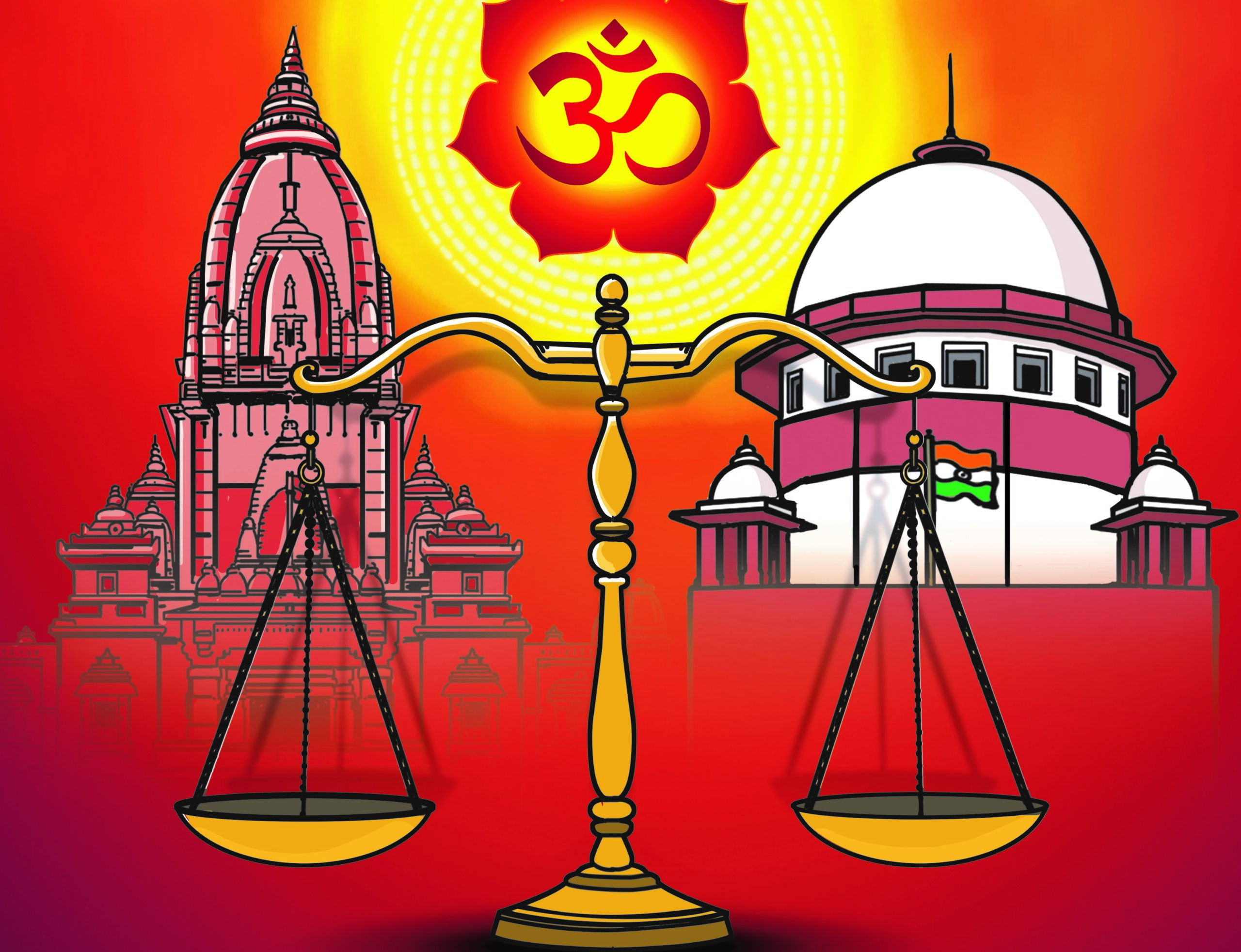
The Mystery of Judicial Nuance
To what extent can the judiciary provide directives regarding God, Dharma, and rituals? After which point should it show restraint and determine its own limits? These are “delicate” questions that have been under discussion for many decades. Justice Indu Malhotra, who wrote the dissenting opinion on the issue of allowing women aged 10-50 to enter the Sabarimala Ayyappa temple, raised these questions and recorded her views in the verdict. According to her, “It is not the job of the court to decide which religious practices should be retained and which should be prohibited. Generally, courts should not intervene in matters of religious feelings. The Sabarimala temple and its deity are protected under Article 25 of the Constitution. It is not correct to apply Article 14 to interpret religious practices… It is not correct to apply rationalism to religious matters. It is for the respective communities, not the court, to decide what constitutes their religious practices and what does not. India is a diverse country. Constitutional morality permits everyone to practice according to their religious beliefs.”
An interesting phenomenon in the Sabarimala case is noteworthy. Unlike the protests that erupted when court verdicts regarding Jallikattu and Kambala were delivered, or the violence that occurred many times when interim Cauvery verdicts were issued, or the criticism the media showed when the verdict came to close liquor shops on highways, or the intensity with which various governments openly showed their emotions against the verdict on SC/ST promotions—none of this was seen during the Sabarimala verdict. However, all ordinary devotees, including countless female devotees, were bewildered. Sanatani devotees peacefully placed their pain and dissatisfaction before the Supreme Court itself and asked, “Please review your verdict!” This is the difference between political activists, social fighters, and virtuous Sanatan Hindu devotees of God.
Retired Justice Markandey Katju, who analyzed Justice Indu Malhotra’s dissenting opinion in the media, had alleged, “The court is showing over-activism only in the case of Hindus.” In one of his articles, he directly questioned, “In most of the country’s mosques, Muslim women are not allowed to enter. They have to pray at home. Even in places where there is access, e.g., the Jama Masjid in Delhi, they cannot stand and pray equally with men. They have to stand under a separate roof to pray. Will the court show the courage to intervene similarly in the case of Muslim women, ordering not only to allow them entry into all mosques but also to allow them to stand on par with men and pray? Or is the court’s courage selective, meant only for Hindus?”
Today, the term “gender discrimination” has become a powerful “feminist” weapon across the world. The mere application of it is enough to make the anxious male population react with excessive caution. It is noteworthy that Justice Indu Malhotra, a woman judge, did not pay heed to this and did not accept the “gender” argument in the Sabarimala case.
According to Justice Indu Malhotra, “It is not the job of the court to decide which religious practices should be retained and which should be prohibited. Generally, courts should not intervene in matters of religious feelings. The Sabarimala temple and its deity are protected under Article 25 of the Constitution. It is not correct to apply Article 14 to interpret religious practices… It is not correct to apply rationalism to religious matters. It is for the respective communities, not the court, to decide what constitutes their religious practices and what does not. India is a diverse country. Constitutional morality permits everyone to practice according to their religious beliefs.”
Another important question relates to the freedom of communities and the freedom of expression. It is the opinion of some judges that the rights of a community should be protected in the same way that individual rights are protected under the concept of “human rights” (e.g., during the hearing against the ‘UPSC-Jihad’ program on ‘Sudarshan TV’, Justice D.Y. Chandrachud’s bench was reported to have stated that the community cannot be targeted in a way that creates an atmosphere of hatred, referring to the Muslim community). The concept that “a community has rights just like individuals” is one that allows for curious discussions. What is the answer to the question of whether “it is not right to portray an entire community in a negative light while advocating something” can be applied to all situations? If the answer is “yes, it can be applied,” then many questions and sub-questions arise. Many “liberal” media outlets have previously analyzed that “Brahmins are in the majority in the bureaucracy.” The act of Twitter founder Jack Dorsey displaying a placard saying “Smash Brahminical Patriarchy” received widespread publicity. How can all of this be interpreted? Is it criticism within the periphery of “freedom of speech,” or is it unnecessary slander “against an entire community”?
If the opinion that “it is the responsibility of the judiciary to maintain a balance between freedom of speech and communal dignity” becomes strong, then the court bears the grave responsibility of holding an equal scale in the case of all communities. The root of the discussion is whether all judges will adopt the opinion of “balancing” both “freedom of speech and community dignity” in all such instances where disputes like “ban that program,” “ban this book,” and “save the dignity of our community” increase.
A few years ago, a dispute was filed in the Supreme Court stating that “an author named Kancha Ilaiah Shepherd has written a book portraying the entire Vysya community in a negative light.” In 2017, a bench led by Justice Dipak Misra rejected the plea, refusing to accept the community’s argument and upholding the freedom of expression. That bench, which opined that the court should be cautious while judging the contents of a book and should not impose restrictions on the freedom of expression, also included Justice D.Y. Chandrachud!
Does this mean that there is no “universal standard” regarding communities; it has to be decided by “examining the respective contexts”? Can “balancing” be defined as taking a stance in favor of freedom of expression sometimes and in favor of the community in other cases, after “examining the nature of the respective cases”? Should we assume that “a single framework cannot be applied to all situations; because the nature of each case can be different”?
‘Freedom’ in Indian Civilization
Perhaps because such confusion is undesirable, or because it is difficult to determine “who is right,” or perhaps out of a pragmatic realization that the mindset of those making such judgments might come to the fore, in short, “freedom of expression” was limitless in ancient India. The very concept of “communal dignity” did not exist. Criticisms, arguments, and refutations were boundless. Critical books were written freely, and philosophical debates were held. If possible, opponents would argue, “Not so, it is like this.” If not, they would remain silent, thinking, “Believe what you will; does heaven crumble if a dog barks?”
Recently, the argument that “the Constitution is the basis for everything” has begun to flourish. Putting this same argument forward, some had argued, “There is no obstacle in the Constitution for same-sex marriage, give permission for it.” It is in such situations that a greater sense of social responsibility and greater self-restraint are required for judges who hold the highest authority. It is necessary for our honorable judges to show greater care regarding religious beliefs that have taken root over thousands of years. Otherwise, people’s faith in the system may weaken.
As time passed, that very true, liberal mindset became a hurdle for Indian philosophies. Voices against them intensified, and new problems of proselytization and cross-border issues began. Swami Vivekananda clearly identified this. During the era of foreign rulers, an unwritten system emerged: “Indian thinkers cannot criticize foreign religions; if they want, they can criticize and fight among themselves within their community, but others can criticize Indian philosophies, and it cannot be stopped—that is freedom of expression.” One can still see here and there that the same unwritten belief persists: “It does not matter who insults Hindus, and especially Brahmins, in whatever way.”
If you go to some “prestigious” (“infamous”) universities in the West to study “humanities,” it is natural to get deeply confused amidst the roar of bizarre arguments. Even now, there is little remorse in Western scholarly circles about the 18th-19th century British racism or its dark and oppressive history. The “imperialist” delusion that “we are the ones who gave civilization to the world” still appears dense. Even today, negative concepts from the British era regarding India’s history and civilization are being sown in American schools. Although American textbooks have set aside many old British arguments, they have continued them extensively only in the case of India. One can still see many Indian postgraduate and PhD students, steeped in this “academic” slush, writing articles claiming, “Where is India? India never had an independent existence. It was the Mughals and the British who made it ‘one’.”
The story is no different in India. Here too, we do not yet see an “education of the Indian people” that views and analyzes from our own perspective of life. There is no teaching about “people’s history.” Our schools do not teach the achievements of our own people. Proper explanations regarding the atrocities of the Mughals and the British are not found in our textbooks. When writing about Thomas Babington Macaulay, our books say (in the “positive” sense that he “removed old superstitions and brought about great reforms”) that “he introduced a new type of English education system in India,” but they do not pay the necessary attention to his infamous notes: “I will create a class who may be interpreters between us and the millions whom we govern—a class of persons, Indian in blood and colour, but English in taste, in opinions, in morals, and in intellect.” Many do not even know what discussions took place in the British Parliament, scholarly circles, and media at that time regarding this matter, and what kind of opinions and conspiracies were exchanged about India.
Mahamahopadhyaya, Bharat Ratna P. V. Kane, has written wonderful books in all fields of study concerning the Indian tradition—such as Indian Dharmashastra, Sanskrit language, literature, philosophy, and culture. Possessing immense information about the lifestyle, legal codes, and religious and social matters of ancient India, he was known as a “living encyclopedia.” He became a great author by writing scholarly books of about 15,000 pages in English, Sanskrit, and Marathi. His most famous work, which can be called his masterpiece, is the five-volume, approximately 6,500-page “History of Dharmashastra.” It is essential reading to understand what religious codes and civil laws were like in ancient and medieval India.
Freedom Versus Community
What is the nature of the balance between individual rights, familial and social responsibility, and national duty? If someone says, “I will not brush my teeth,” it can be called individual freedom. But what if they say, “I will not pay taxes”? Under a national system, can one say, “That is their individual freedom; we must respect it”? How should society and governments respond in such situations? Similarly, how should one critique the strategic moves, stances, and the maneuvering of religions and faiths? Is the solution, “From now on, no one should criticize any religion so that no one’s feelings are hurt”? That is not correct either. In this world, there is no critique, review, analysis, or intellectual inquiry possible without someone’s feelings being “hurt” or someone’s “sensibilities” being affected. This is a significant challenge common to all communities.
In the friction between freedom and dignity, it is wrong for anyone to follow different standards. It is not right to respect the sensibilities of only one community while ignoring the sensibilities of another. Freedom and sensibility are equal for all, are they not?
This raises another question: “Does the freedom to critique include the freedom to insult?” This is a very complex question. First, there needs to be clarity on what constitutes an insult and what does not, and how, and by whom, one should respond to such things. This is the information age. Additionally, a revolution of rationalism took place in the 19th and 20th centuries. Hinduism, Christianity, Islam—all have been subjected to intellectual inquiry and continue to be. As a result of such inquiries, many reforms are taking place.
As the influence of “wokeness” grew stronger in America, the argument of “Islamophobia” came to the forefront—a concept aimed at controlling and suppressing opinions regarding the Islamic faith that are disliked by those of that religion. The process of attempting to implement this legally in many American states became a subject of intense debate and criticism.
The Organization of Islamic Cooperation (OIC) began an effort at the global level in 1999 to somehow put an end to intellectual inquiries concerning religious dimensions. 56 OIC countries raised their voices together, proposing resolutions stating, “The defamation and insult of religions in the world are intensifying. It must be stopped. A ban should be imposed at the international level. Member states of the United Nations should be pressured to create laws in this regard.” Along with the 56 OIC countries, nations including Communist China, Cuba, Russia, Singapore, Thailand, Nicaragua, Venezuela, and South Africa voted in favor of the resolution. However, it was not implemented. Later, the OIC took a new path. As a result of its persistent efforts, the United Nations Human Rights Council adopted a new resolution against “intolerance” in 2011, stating that “religious communities should not be portrayed negatively” (Resolution 16/18). Now, its echoes have started being heard in all liberal circles (however, the resolution remains silent about the fact that many new religions were founded by insulting and mocking older ones!).
Subsequently, as the influence of “wokeness” grew stronger in America, the argument of “Islamophobia” came to the forefront—a concept aimed at controlling and suppressing opinions regarding the Islamic faith that are disliked by those of that religion. The process of attempting to implement this legally in many American states became a subject of intense debate and criticism.
Religious matters are very delicate. Everything in the world has a specific relationship and connection with everything else. Everything is a part of something else. In creation, everything has a mutual cause-and-effect relationship. There are duties. There are responsibilities. Thousands of types of subsystems are born and live within these natural laws across different eras. Here, a human is both an individual and a part of a larger system. Just as everyone has individual freedom, familial duty, social responsibility, national commitment, global dimension, and a universal concept—all exist simultaneously. We must learn to view things from the perspective of this reality. We must identify natural linkages and organize our systems and frameworks accordingly.
At the level of serious philosophical thought, two questions become important: First, when it comes to communities, can all critiques be labeled as “slander”? Second, can all slander be dismissed by calling it “critique”? Finding the correct answer to these two questions is essential.
It is a very difficult task to distinguish between reasoned critique and baseless slander here. It is not a trivial task to recognize the subtle differences between critiquing an individual based on available evidence, questioning the behavior of a group, or intentionally portraying an entire community negatively. Whether the liberal stance of the West is currently prevailing in most courts globally is a subject of discussion.
Can the concept of “consumer rights” available to individuals going to movie theaters be applied to devotees going to Hindu temples? If it can be applied, then the temple will have to be called a “service provider”!
Court and Dharma
There is confusion among the people as to why some “intelligent” judges are not understanding the diversity of rituals and why they are not respecting it. When the Sabarimala case was hot, the question was at the forefront: “How right is it to apply the vision of monotheism—based on a single scripture—to Indian traditions that worship and revere crores of different forms of deities?”
Can the concept of “consumer rights” available to individuals going to movie theaters be applied to devotees going to Hindu temples? If it can be applied, then the temple will have to be called a “service provider”! Devotees will have to be called “consumers.” And God will have to be called a “product” (commodity)! Just as no one can dictate the clothing, customs, food, or purity/pollution of those going to movie theaters, it would have to be said that no instructions can be given to devotees going to temples either!
Whose decision is it from which perspective God and dharma should be viewed? Is it possible for anyone to prove the existence of God in court “constitutionally”? How would it be if the court delivers a verdict saying “there is no God” after stating that “it has not been proven in court”? If the court can poke its nose into everything, it is hard to say where this will end and which dimensions its consequences might touch.
Among the Navagrahas (nine planets), each planet has a specific way of worship and offering. There is a difference between the worship of the Sun and the worship of Shani. There are many tantric temples. Access there is not open to all. In some temples, there is animal sacrifice, while in others, there is only worship with fruits, coconuts, milk, and water.
It is necessary for courts to form an appropriate reflection on the extent of their expertise regarding religious practices.
Among the Navagrahas (nine planets), each planet has a specific way of worship and offering. There is a difference between the worship of the Sun and the worship of Shani. There are many tantric temples. Access there is not open to all. In some temples, there is animal sacrifice, while in others, there is only worship with fruits, coconuts, milk, and water. Moreover, although they may appear as a single Shiva Linga at first glance, there are five distinct major forms of Shiva Linga across different fields: Ishana, Tatpurusha, Aghora, Vamadeva, and Sadyojata. The worship rituals and beejamantras vary for each form. In the tantric path, there is a distinction between the Dakshina and Vamachara paths. Women and men have different roles. Disregarding all that, and considering only a specific argument, can one bring a uniform form of God, a uniform form of devotee, and a uniform form of worship everywhere in the name of the Constitution? As Justice Indu Malhotra questioned, is all this the job of the court? Or is it the work of sages and seers like Vyasa, Shankara, Madhva, and Ramanuja, as devotees and the religious believe?
An interesting phenomenon in the Sabarimala case is noteworthy. Unlike the protests that erupted when court verdicts regarding Jallikattu and Kambala were delivered, or the violence that occurred many times when interim Cauvery verdicts were issued, or the criticism the media showed when the verdict came to close liquor shops on highways, or the intensity with which various governments openly showed their emotions against the verdict on SC/ST promotions—none of this was seen during the Sabarimala verdict. However, all ordinary devotees, including countless female devotees, were bewildered. Sanatani devotees peacefully placed their pain and dissatisfaction before the Supreme Court itself and asked, “Please review your verdict!” This is the difference between political activists, social fighters, and virtuous Sanatan Hindu devotees of God. The stance of the virtuous devotee is, “Everyone must bow to the Supreme Court, and disagreements with verdicts must be questioned right there.” Their expectation is that the courts should respond to that as well.
Recently, the argument that “the Constitution is the basis for everything” has begun to flourish. Putting this same argument forward, some had argued, “There is no obstacle in the Constitution for same-sex marriage, give permission for it.” It is in such situations that a greater sense of social responsibility and greater self-restraint are required for judges who hold the highest authority. It is necessary for our honorable judges to show greater care regarding religious beliefs that have taken root over thousands of years. Otherwise, people’s faith in the system may weaken.
The Constitution of India has given people the freedom of religion and the right to practice it. Everyone has the right to practice it without harming others. However, the Constitution is not a self-manifested deity. It is an administrative code that people have created for themselves and accepted. As long as it is in force, the Supreme Court has the supreme authority to interpret it. The responsibility to protect it without compromising its fundamental ideals also lies with it. This is the procedure generally present in all democratic countries, including India. But the question of how appropriate it is to view and interpret everything in life, including matters of God which cannot be proven in court, merely from the perspective of the Constitution, is a question that needs reflection.
The Supreme Court showed self-restraint by entrusting the question of what kind of balance should exist between religious belief and constitutional process to a large constitutional bench of 7 members.
Reform Through the Court
It is not as if the court has no role in religious matters. When injustice is done to people in the name of communities or religious texts, when their rights, freedom, and dignity of life are harmed, or when discrimination occurs, protection through the judiciary is essential. In many instances, welcome “reforms” have come about through courts.
Sometimes, there are examples where judges have resolved “sensitive” issues with “cautious wisdom.” A famous example is that of the Shri Ram Mandir in Ayodhya.
Between “religious fundamentalism” and “gender justice,” which is your choice? If you are a reformer of this era, it is natural to choose the latter, and if you are a medieval religious zealot, the former. However, in India, this does not always appear as clearly as “black and white”; it often appears as a strange shade. The practice of supporting the arguments of religious leaders in the case of the Muslim community, while supporting reform in the case of other communities, is frequently seen here. So far, many reforms related to the customs and traditions of Hindus and Christians have taken place in our civil code. But even when oppressed women of the Muslim community cry out that “Muslim society also needs reforms,” we still calculate whether “the leaders of that religion will agree or not!”
In our country, for many decades, there existed a practice oppressive to wives called “Triple Talaq.” From the Shah Bano case of 1986 to the Shayara Bano case of 2017, the story remains the same tale of lament. In 1986, Shah Bano was a courageous woman who, after being thrown out by her husband, knocked on the doors of the court. But as the saying goes, “Even if God grants a boon, the priest may not,” the central government of that time did not provide the alimony ordered by the court. Instead, it brought in a legal amendment that bowed to the fundamentalists and prolonged the agony of abandoned women. Subsequent governments did not show the courage to change that either. In 2017, the legal battle fought by Shayara Bano, another abandoned woman suffering from violence, bore fruit. A Supreme Court verdict was delivered against the “instant Triple Talaq,” which threw wives away like trash. The central government stood by the side of the oppressed Muslim women.
It is well-known that some politicians have consistently argued that “the community itself must decide on Islamic religious matters; the court and government should not interfere.” Who are “those community members”? Are they the oppressed common people of that community, or a few leaders with vested interests? Are the women who knocked on the court’s doors not from that same community? Are they from a different community? Should Dalits have to ask for “the removal of untouchability,” or should we sit and wait until everyone practicing untouchability comes together to ask for it?
A definitive decision on which matters the court can intervene in and which it cannot is not so simple. The kind of justice the oppressed receive is a key factor in determining the nature of the administrative system of that era. Is there any example in the world, in any religion or era, where religious reform happened with the cooperation of fundamentalists? It is a historical reality that all reforms have taken place amidst opposition from fundamentalists. Religion should become a walking stick, not a lash.
When the 3:2 majority verdict against instant Talaq was delivered, it is noteworthy that two judges, including the Chief Justice, stated that “the Talaq system is an integral part of Islam and falls within the ambit of religious rights.” The question of which is more important—the right to religion or human rights—arose again. Some provisions of the Constitution and certain laws formulated by Parliament in the past have tied the hands of the court, preventing it from delivering a verdict of complete reform in the case of some communities.
Sometimes, there are examples where judges have resolved “sensitive” issues with “cautious wisdom.” A famous example is that of the Shri Ram Mandir in Ayodhya. There is a difference between the Ayodhya dispute and the dispute against Sabarimala. In Ayodhya, the dispute arose because Babar, a foreign invading king, built a mosque on a site that devotees have believed for thousands of years to be the birthplace of Shri Ram. The fact that a mosque was built by destroying a pre-existing temple there added even more heat to the dispute. Who that land belonged to was a major dispute. Along with that, the ancient faith of Hindus was intertwined. That is, it is a noteworthy point that it was both an “ownership” dispute and a matter of religious belief. The Supreme Court resolved it. It is noteworthy that it resolved it in a way that “did not hurt the feelings of the devotees.” With the Supreme Court’s verdict, justice was served for both “ownership” and “religious belief.”
The Uniqueness of Ritual Diversity
Is the Sabarimala issue an “ownership” dispute like Ayodhya, or a historical conflict between two religions? Neither. It was merely a dispute submitted by some regarding religious ritual practices. For example, it is a religious belief and ritual method of Hindus that one should not enter a temple without bathing, and that one must enter barefoot. Hindus have been following this practice for thousands of years. There is no such rule in Christian churches. There, those who wish to pray can do so even if they have not bathed or are wearing footwear; it is noteworthy that the ritual there is “collective prayer,” not the shodashopachara puja (worship with sixteen rituals). How would it be if someone who has not bathed or does not want to leave their slippers outside raises a dispute claiming, “I have been treated unfairly”? A similar kind of absurd argument was seen in the Sabarimala case.
In Kerala itself, there is the “Chakkulathukavu Amma” temple. Bhagavati is the deity there. That temple is near Thiruvananthapuram. Every year on the first Friday of the month of Dhanu, a unique ritual called “Nari Puja” (worship of women) takes place. Male priests wash and worship the feet of thousands of women who are fasting. It is said that both this temple and this ritual are 3,000 years old. In societies that do not respect women, rituals like Nari Puja do not take place. Therefore, it is difficult to conclude that there is a biased attitude behind the denial of entry to women of reproductive age at the Sabarimala Ayyappa temple for the last 1,500 years.
This is ritual diversity. In some temples, all devotees are allowed inside the sanctum sanctorum. There was such a tradition for centuries at the Panduranga temple in Pandharpur. In most places, only priests can enter the sanctum sanctorum; no one else is allowed. For example, the Guruvayur Shri Krishna temple. In some places, there is a satvik (pure) method of worship, while there are also temples of vamachara (tantric/left-hand path). There, the supreme worship is performed by women who are menstruating! In some places, offering meat is forbidden, for example, the Tirupati Shri Venkateswara temple. In some places, animal sacrifice is primary, for example, the Kamakhya temple in Assam. In some places, there are customs that only specific delicacies must be offered. This is ritual diversity. This diversity is due to the sthalapuranas (local legends) and myths of the respective fields. There are mythological and historical reasons for it.
Another reason for this diversity is that Sanatana Hindu Dharma is not an organized religion like Islam or Christianity. In India, no one has formulated religious rules by force like Emperor Constantine, nor has anyone imposed rules by showing the fear of the sword like the Caliphs. Among Hindus, there is nothing like Canon Law. There has been no establishment of administrative regulations like the Council of Nicaea or the Vatican Council. No king in India has decided, “In such and such a village, there must be such and such a village deity.” Village deities have not been established through public voting after putting different deities to the test and creating a canvas! A village deity is not like a village panchayat. It is not possible to provide written evidence or permission letters for all religious processes. Different rituals and customs arise based on some belief, event, or mutual consent.
There is also the concept of “convention” in the constitutional field. There is no single model there either. If India has a written Constitution, Britain, which does not have one, determines its constitutional processes based on “convention” (customary practice). Given this, deep reflection and discussion must take place regarding to what extent and up to what level “constitutional” elements can be applied to religious practices. The Supreme Court should also show clarity on which religious reforms are the job of religious leaders and gurus, and which are the work of secular courts. Let those who believe in purity, pollution, menstruation, mangalsutra, toe rings, arati, lamps, incense, namam, kumkum, and ornamentation believe, and let those who don’t, leave it. But does deciding all this fall under the jurisdiction of the courts? Should it? This clarity is necessary.
India has a spiritual mindset—a lifestyle that can complement spiritual pursuit. Personal freedom is prioritized here. Likewise, communal freedom is also prioritized. When two people from different towns meet, it is common here to talk about it: “Our town’s custom is like this; how is your town’s custom?” It is the nature of this land that equal respect is given to the custom of every town.
Our temple fairs (melas, jatras) are proof of this. In some fairs, a particular community has special recognition. In some places, the temple chariot moves only after the local forest dwellers have touched it. Kerala priests in the Badrinath field, Karnataka priests in Nepal’s Pashupatinath, special recognition for the King of Nepal in Udupi’s Krishna Math—it would be wise for those in power to think deeply before erasing such complex systems with “a single stroke” of their pen.
If ritual diversity is not recognized, the questioning of all such diversity may increase. One could argue, “Entering the sanctum sanctorum is everyone’s right. As it is allowed in some temples, it should be allowed in all. Permission should be given to touch the main deity idol in all temples. There shouldn’t be different rules in different places.” Or, “Do you have a constitutional right to say that only such and such must be offered? Why can’t it be cake or ice cream? Why not pizza? Aren’t they all food? You eat them too. Why can’t they be offered to God? Based on ‘place of birth,’ there cannot be discrimination in food either. Why must only Ladoo prasadam be distributed in Tirupati? Why not cake? Why can’t the priest worship while wearing jeans? The temple is public property. So who are you to decide this? The democratic way is to place new proposals before the administrative committee and bring about new changes through a majority vote.” The probability of such muddled arguments growing is high.
How many female archbishops and cardinals are there among Catholics? Is the concept of a female Pope possible? In Islam, except for a few sects, women still do not have access to mosques. Muslim women cannot go to thousands of mosques in India. Due to the Talaq practice and the imposition of the Burqa, crores of women are suffering. Given this, why have those concerned maintained a wise silence on these issues?
Some religious feelings regarding menstruation have been questioned. There are such beliefs regarding men as well. The religious view is that while sexual and pre-pregnancy processes are not base, they are not appropriate for satvik (non-tantric) rituals. Thus, the scriptures say that even a man who has had a seminal discharge does not become eligible for worship until he has bathed.
India is a unique country that is not easily understood. It is a Sanatana custom that both husband and wife perform puja, vows, and sacrifices together while sitting on the wedding bench. Our country holds the strong “equality” belief that rituals are complete only if both are present. Many Vedic hymns are famous in the names of female sages. This is a country where Matru Puja (worship of the mother) and Kanya Puja (worship of the girl child) have been going on for thousands of years. There are also temples where only women worship and men are not allowed! There are temples that do not give access to children (boys!) along with women. Except for Sabarimala, women have access to all other Ayyappa temples in the country.
Some religious feelings regarding menstruation have been questioned. There are such beliefs regarding men as well. The religious view is that while sexual and pre-pregnancy processes are not base, they are not appropriate for satvik (non-tantric) rituals. Thus, the scriptures say that even a man who has had a seminal discharge does not become eligible for worship until he has bathed. The belief is that if a man becomes pure with one bath, a woman becomes pure after a bath following the complete cessation of the bleeding process. This applies only to religious activities. Scripture writers have not imposed this rule on “secular” transactions. This is a religious life that crores of householders have been following for thousands of years. There is no need to view all this from a “scientific” perspective. If looked at that way, “science” does not even accept the existence called “God.” Can worship be banned because of that?
So, should one believe in all this? No. Everyone must have the right not to believe in anything. Such people should not believe what they do not want to. It is true that reforms according to the times are necessary in everything. If there is no reform, it becomes like jihadi terrorism. The matter of “non-violent” religious practices that do not cause trouble to others’ wealth, honor, or lives is different. The Supreme Court has given the verdict that “Agamas are the basis for temple matters” in the case of Tamil Nadu temples.
Are Hindu Temples Government Property?
No one has been able to provide a satisfactory answer to the question of why the mental attitude that “Hindu temples are government property” persists in our country. Why cannot Hindu temples become autonomous (devotee- or community-run) institutions like churches and mosques? If our governments and courts do not intervene in the affairs of mosques “up to a certain level,” what is the harm in not intervening in the affairs of Hindu temples “up to the same level”? Why not grant Hindus the permission: “Your temples are autonomous; manage them according to your traditional, local, non-violent practices and the *Agama Shastras”? Who would be harmed by that, and how?
If not, will you implement a “Uniform Religious Code”—a “secular” model where the government itself decides and manages the rituals of all religions? Is it even possible? A “Uniform Civil Code” can be brought, but a “Uniform Religious Code” is impossible.
A clarification from a religious perspective is needed here. It is noteworthy that Hindu temples, Muslim mosques, and Christian churches are not of the same nature. There is a fundamental difference in their very essence, and naturally, their rituals differ significantly. Therefore, they should not be viewed from the same lens. Integrating everything and formulating a single method or code of conduct for all would change their very character.
Mosques and churches are not recognized by those respective religions as “God’s own residence where He personally resides.” They do not say, “God/Goddess is inside this building; we have invoked them here through mantras; therefore, this is their house.” But that is what Hindu Shastras say.
Mosques and churches are not recognized by those respective religions as “God’s own residence where He personally resides.” They do not say, “God/Goddess is inside this building; we have invoked them here through mantras; therefore, this is their house.” But that is what Hindu Shastras say. In Islam and Christianity, there is no scope for idol worship. Even if “Allah” and “God” are thought of in masculine terms, there is no practice of imagining them in the form of an idol. Churches contain statues and paintings of some “Saints,” and statues and pictures of Jesus, but a statue of “God” is not found anywhere. In mosques (and everywhere else), one cannot place idols or pictures of Prophets; there is even a prohibition on imagining them in physical form. Mosques and churches are religious places for collective prayer to an abstract God. There, priority is given to bringing all people who believe in the faith together. Their methods include calling for Azan, performing Mass, and organizing Congregations. If there are no people there, there is no ritual.
Hindu temples follow a different method. Even if no devotees come, the puja takes place. A temple is not a place for constant collective prayer; it is a place for ritually worshipping God, who is manifest in a concrete form. There, God is imagined as a person. The temple is considered the private home of God. Just as subjects used to go to the palace to see the King, devotees go to the temple for darshana (to see) God. Even if there is an opportunity for collective darshana, there is no rule that collective prayer must exist. Devotees can offer personal prayers according to their personal desires. They cannot offer puja directly. Just as a King has official attendants in the palace, there is staff (priests) who are knowledgeable about religious rituals and are officially and ritually appointed to conduct rituals like puja. In matters of ritual, their understanding and that of Agama scholars are recognized. Even they do not act as they please; they follow what is laid down in the Agama Shastras, considering the nature of the deity, the sankalpa (intent) made during the original prana-pratishtha (consecration), appropriate rituals and tantras, sthalapuranas (local legends), and daily/occasional requirements to establish a suitable method of worship.
After the government takeover of temples, divine and spiritual feelings have declined. The story of millions of temples in the country is pathetic. In addition to the problem of corrupt officials siphoning off money from the donation boxes (hundi), the real root of the problem is that politicians and “secular” governments consider the property of Hindu temples as “their own.” Because of “Muzrai” laws—which state that “Hindu temples belong to the government”—the assets of these temples and crores of rupees in income are being officially snatched away from the devotee community.
A Hindu temple is not the private property of any human. Even if someone pays to build the structure, once the deity is invoked and consecrated, they are not the “owner” of the temple. Devotees are not the owners either; they are merely visitors. Hindu Agama Shastras say that God Himself is the owner of the temple. “Devalaya” means “abode (home) of God.” Everyone working there on behalf of God is merely a servant of God.
After the government takeover of temples, divine and spiritual feelings have declined. The story of millions of temples in the country is pathetic. In addition to the problem of corrupt officials siphoning off money from the donation boxes (hundi), the real root of the problem is that politicians and “secular” governments consider the property of Hindu temples as “their own.” Because of “Muzrai” laws—which state that “Hindu temples belong to the government”—the assets of these temples and crores of rupees in income are being officially snatched away from the devotee community.
Devotees who put money in the hundi and offer vows hold the innocent belief that the money they give is dedicated to that very temple and that very God. Devotees who offer money to Anjaneya believe it will be used for Anjaneya’s worship. But the reality is different. In many temples, puja is not even being performed properly. It has been years since the walls were whitewashed. According to the Hindu American Foundation, in the 1980s, an order was issued to immediately transfer 10 crore rupees from the Shri Guruvayurappan temple to the government treasury to meet the government’s shortfall. Under the Land Reforms Act, the Guruvayur temple’s 13,000 acres of land were snatched and reduced to 230 acres. 1,90,000 dollars were transferred from Mumbai’s famous Siddhivinayak temple to politician Vilasrao Deshmukh’s charitable trust! The Maharashtra government itself admitted this in the Mumbai High Court in 2004. In 2010, the Odisha government took 500 acres of land from the world-famous Puri Jagannath temple and set out to sell it to the controversial Vedanta Resources mining company for a mere 1 lakh rupees per acre! The Supreme Court stayed this deal. Under the “Hindu Religious Endowments Act,” the Tamil Nadu state government has kept millions of square feet of building area, lakhs of acres of land, and crores of square feet of temple precinct land belonging to Hindu temples under its control. Not even one square foot of mosque or church land is under its control. Not only that, but temple properties have been rented out; people with political influence have easily grabbed temple assets at cheap rents!
In no other country in the world do “secular” governments run religious institutions. Courts in no other country decide what a religious cap should look like or what kind of cross one should wear. India is the only exception. Here, governments and courts interfere in religious matters—specifically only in the case of the Hindu religion—with the feeling that their decision is final.
In the past, people have approached courts when there were mismanagement issues in some mathas and temples. That does not provide support for the argument that “the government must handle everything.” What is the harm in establishing appropriate administrative formulas and granting autonomy? In the days of the old Kings, temples had autonomy. Every town’s temple was an independent cultural institution. The town’s weddings and other programs, Harikathas, Vedic schools, religious guidance, justice panchayats, space for children to study and for visiting devotees to stay, learning of classical music and dance, agricultural guidance, and water for the people through temple ponds and wells—the local temple provided everything. After coming under government control, this collective life was destroyed.
People are asking why the “valuable thinking-time” of some rationalists is being devoted only to the affairs of Indian-origin religions. “Why are they not saying: ‘Do not slaughter sheep on Bakrid; do not cut trees in the name of Christmas Tree’?” Such questions have been raised from time to time. What is the answer to this? People are expressing frustration on social media, saying, “Dissent against every Hindu festival is increasing one by one.” AC-room liberals have already floated arguments like “Do not apply colors during Holi, do not immerse idols during Ganesh Chaturthi, do not jump over fire during Sankranti, vows are not needed, no big processions for God during any festival.” Researcher Rajiv Malhotra says, “Every time the Kumbh Mela takes place, experts from various universities come and do ‘studies’ on how this is causing harm to the environment; the same fate may befall village fairs in the future.” Matters of religious belief and ritual should be decided with caution and social responsibility. Even while implementing the law, extreme caution and social consciousness are necessary. Laws and orders exist for human life, not for life’s purpose to be merely carrying the burden of regulations. Maintaining a harmonious balance between freedom and regulations is important. Would it be right to arrest Digambara monks by saying “public nudity is prohibited”? What should shine here is wisdom and a sense of propriety, not passion.
The Philosophy of Constitutional Principles
When a conflict arises between the individual Fundamental Rights in Part III of our Constitution and the Directive Principles of State Policy in Part IV, which one should be upheld? This is a difficult question to answer—akin to asking, “Which of your two eyes do you need more?” However, this question has arisen many times in the course of our constitutional governance. Great legal scholars have struggled to answer it, resulting in various interpretations, often colored by their respective ideological and political stances. The Supreme Court, too, has frequently interpreted this and offered “abstract” answers.
During the Emergency, the Indira Gandhi government, through the 42nd Amendment of 1976, amended the Preamble, Fundamental Rights, and Directive Principles. Attempts were made to curtail the Supreme Court’s power to interpret the Constitution and to subordinate Fundamental Rights to Directive Principles. The subsequent Morarji Desai government attempted many counter-amendments to restore the Constitution to its pre-1976 state, but it was not entirely successful.
The Preamble, Fundamental Rights, and Directive Principles are the three crucial pillars that determine the character of our Constitution. They were designed to be complementary, not contradictory. This was clarified by B.R. Ambedkar and endorsed by Jawaharlal Nehru. The Preamble is the proclaimer and descriptor of the constitutional form; Fundamental Rights are the life-rights granted to citizens according to the concepts of human rights prevailing at any given time; and Directive Principles are the clear roadmap for the path the Constitution must traverse.
Nothing here is insignificant. The right to life of the people is supreme, and so are the Directive Principles. It is important to ensure that no part of the Constitution overshadows another. The Supreme Court has clearly stated that Parliament does not have the power to alter the “Basic Structure” of the Constitution (Kesavananda Bharati v. State of Kerala; Minerva Mills v. Union of India). It has also held that if certain limited individual rights obstruct the implementation of Directive Principles, the principles themselves cannot be questioned.
Fundamental Rights have limitations. Primarily, national security, public order, and public morality determine the extent to which one can exercise their individual rights. What is considered a Fundamental Right today may be completely abolished tomorrow. For example, the “Right to Property,” which existed previously, is no longer a Fundamental Right.
Directive Principles indicate the basic character of the Constitution and the path it must follow. They are a core component that gives the Constitution its “basic character.” Our Constitution is not a stagnant pool; it is dynamic. The Directive Principles dictate how it should adapt its policy stances according to the times. It is necessary for the country to formulate its policies in the light of these principles, and it is inevitable under constitutional rule.
B.R. Ambedkar himself stated that the Directive Principles are not merely for decoration. They were formulated because, at the time of the Constitution’s drafting, the nascent administration could not bear the burden of implementing everything at once. He clearly stated, beyond any doubt, that it is the duty of the administration to implement them gradually, phase by phase.
The intent of the framers was not just to hand over a book of the Constitution to the rulers, but to provide a roadmap for how to carry forward constitutional governance. Although partly inspired by the Irish Constitution, the concept of Directive Principles displays the specialty and uniqueness of the Indian Constitution. One thing is clear: the original intent of the framers and the Constitution is that administrative policies must move forward in the light of Directive Principles.
It is true that no one can compel governments to “implement the Directive Principles in full right now,” nor can the court issue such an order, as they are guiding principles and not mandatory injunctions. However, the court has often directed the government to “implement a Uniform Civil Code.” It is noteworthy that the “Constitution Review Commission” recommended the establishment of an appropriate authority to monitor the progress made in implementing these principles.
The core idea is that Directive Principles must be implemented, and if someone takes steps to implement them, no one else should oppose them. For example, Article 44 mandates that the country should formulate a Uniform Civil Code that views all communities equally and applies to all without discrimination. Similarly, Article 48 suggests that agriculture should be improved by prohibiting the slaughter of cows, calves, and other milch and draught cattle nationwide. The Supreme Court has upheld such measures. Implementing them nationwide is simply following the original intent of the Constitution, isn’t it? Denying the basic principles of the Constitution is a disservice to it.
Pandit Nehru had clearly stated that if there is a competition between the concept of individual rights and the ideals of Directive Principles, the weight of the Directive Principles increases. It was also Baba Saheb Ambedkar’s hope that even if the country could not implement what was stated in the Directive Principles immediately, it should do so within a decade or two. The stance of many political parties today is: “Centuries have passed since the Constitution came into effect; let us not even mention the name of Directive Principles; let them just remain in the book.”
Author