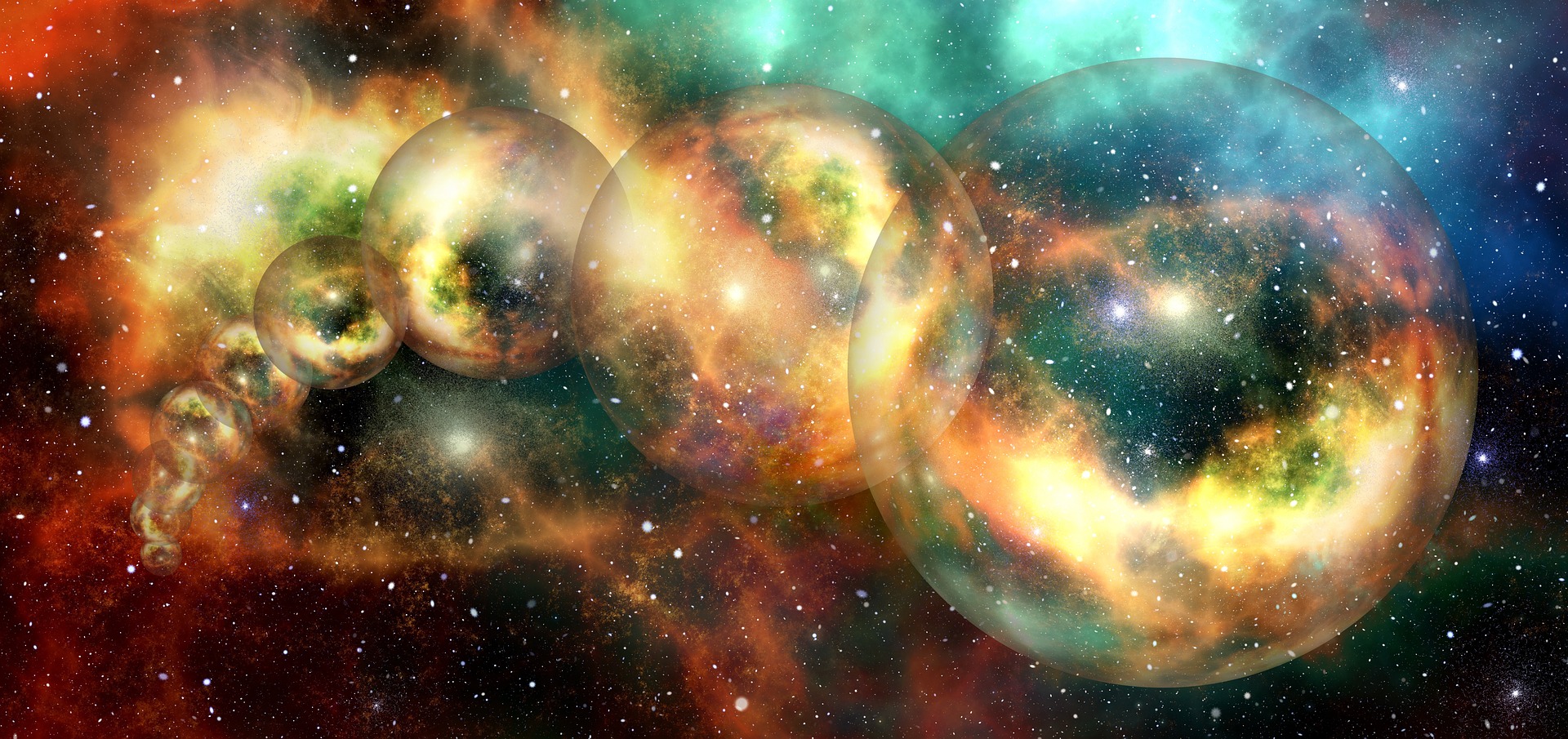
When we seek an answer to the question of how vast the universe (Brahmand) truly is, we turn to scientists. However, despite extensive studies, scientists still do not have a definitive understanding of the origin of the universe or its extent! Is the universe infinite, or does it have boundaries? Are there multiple universes? These discussions continue to this day.
According to the physics we are taught, the speed of light is the ultimate limit. Nothing can travel faster than light. But how fast is the speed of light? It is 299,792.46 kilometers per second, or about 108 million kilometers per hour. Vehicles cannot travel at such speeds. However, if a vehicle could travel at that speed, it could reach the Moon from Earth in just 1.26 seconds! To reach the Sun, it would take 8 minutes and 17 seconds (by Earth’s clock). To reach Pluto, it would take 5 hours and 20 minutes. To reach our nearest star, Proxima Centauri, it would take 4 years of continuous travel. To travel to a point so distant that the Sun would no longer be visible to the naked eye, you would need to travel at the speed of light for about 60 years continuously. To reach the farthest edge of our Milky Way galaxy, it would take 62,700 years of continuous travel. To go beyond our galaxy, even more years would be needed. To reach the nearest known galaxy, light-speed travel would take 174,000 years. And to reach the farthest star visible from Earth would require 2,309,000 years. By the time we reach that star, countless new stars would have appeared! The question “Will they ever come close to us?” might arise in response. If we were to continue our journey without stopping, aiming to reach the most distant object in the universe known to man (a quasar), we would need 14 billion years!
The speed of light becomes insignificant in comparison to the vastness of the universe. It is impossible to personally “see” the entire universe and understand it fully.
So, how did this vast universe come into existence? How did it expand to such an extent? According to scientists, the universe is about 13.8 billion years old (as measured by Earth’s calendar). What existed at the time of the universe’s creation? Were there stars then? If stars existed, did they all come into existence at the same time? According to current knowledge, when the universe came into being, there were no stars. In other words, there was no light in the universe at the time of its birth! So what was the “universe” at that time? What “matter” existed before stars? And what was truly created at that time?
As mentioned earlier, there was no light as we know it. In fact, everything was pure darkness! So, the first thing that was created in the universe was not light but a kind of dark energy (which could have been a form of light beyond our perception). This is what scientists refer to as “dark matter” or “dark energy.”
The physical existence of the universe, as we know it, came into being through a sudden process called the “Big Bang.” You may ask, “What existed before the Big Bang?” The answer given by physicists is astonishing. They say, “The idea of ‘before the Big Bang’ is incorrect, because the concept of ‘time’ itself was created by the Big Bang. Without time, there was no ‘before’ or ‘after.'” In other words, “The Big Bang happened, but the moment it happened, time itself began, and any thought about what happened before it becomes meaningless.”
This is a curious answer! “Physicists have applied such reasoning to avoid fully answering the question about the Big Bang. We must accept that they have not yet been able to explain the causes of the Big Bang!”
When did the first stars come into existence? According to scientists, many millions of years (according to Earth’s calendar) after the Big Bang, the first stars formed. Since then, an innumerable number of stars have been born and died. This is what science says.
Modern scientists say that it has been about 13.8 billion years since the universe was born through the Big Bang. They believe the universe is expanding at a rate of 66-74 kilometers per second. However, as we’ve already seen, even if something were to travel at the speed of light for 14 billion years, the universe would still be there. Does this mean the universe was expanding even before its birth? Is it impossible for light itself to measure or comprehend the vastness of the universe? Countless light rays from stars and celestial bodies are still on their way to reach Earth. And if the universe eventually “ends,” light from many stars will never reach Earth. So, has the universe expanded beyond the speed of light? Or should the universe be considered as eternal (without a beginning) and infinite (without an end)? This remains a tough question for modern “evidence-based” science. If we are unable to fully explain the causes of the Big Bang, how can we describe the eternal nature of the universe with evidence?
The vast majority of the universe is made up of dark voids, regions with no stars—just black, empty space. What exists within that darkness? Only the supreme consciousness knows. But there must be some form of mysterious divine energy or consciousness in that darkness, because without consciousness, nothing can exist. If something is without consciousness, it can be said that “it does not exist.” So, what kinds of dark masses or energies fill most of the universe? Or, what kind of matter and consciousness must have been involved in the creation of the entire universe?
Imagine stretching out a large sheet and sprinkling sugar grains on it. The sheet represents the sky, and the sugar grains represent stars and galaxies. We are currently studying the celestial bodies, much like studying the grains of sugar. However, we know very little about how the entire sheet (the universe) was woven, or how the sugar grains (stars and galaxies) were arranged.
As a result, we know very little about the unseen energies and masses in the universe, which are called “dark matter” and “dark energy.”
In modern physics, we do not have certain answers to the biggest questions. We cannot assume that every question in the world can be answered within the current framework of physics. Humans also have biological limits. It is not possible to know everything through our minds and senses. Our sensory perception has its limits, and there may be things in the universe beyond our understanding. Just as there is knowledge we have yet to discover, there may be things we will never comprehend.
If we assume that the universe exists in the way we currently understand it, there may come a time when scientists will discover more about its origin and its future.
Our experience of the universe is three-dimensional: length, breadth, and depth (or size). “Time” is also considered a dimension. Together, these four dimensions form our understanding and perception of the universe. However, some scientists argue that the structure of the universe is not the same everywhere. They hypothesize that there may be places in the universe where the laws of physics do not apply.
There is a model in physics called “quantum physics,” which deals with subatomic particles. The rules governing large objects differ from those that apply to subatomic particles. According to quantum theory, “pure energy” does not require a massive physical body to exist. Experiments with quantum entanglement have shown the limitations of Einstein’s physics. Even though Einstein’s theories of physics are fundamental, quantum physics still cannot be fully integrated with them. Some scientists suggest that there may be higher dimensions beyond our physical understanding. Without these “higher dimensions,” it may be impossible to fully describe our universe.
Physicists are currently using various mathematical theories to propose the possibility of ten dimensions. The realm of dimensions above our own is referred to as “hyperspace.” Ancient Vedic sages also contemplated the universe, presenting a theory of various higher realms: Bhū, Bhuva, Suva, Maha, Jana, Tapa, and Satya. These realms of existence were referred to by Vedic sages as “Urdhva Lokas,” which Western scientists have now labeled “hyperspace” as if they discovered it themselves. In fact, many quantum ideas have been borrowed from ancient Indian Upanishads, which quantum scientists have acknowledged.
The “Nasadiya Sukta” of the Rigveda raises fundamental questions about the universe that surpass even the questions of modern scientists. It humbly acknowledges that it is impossible to provide definitive answers to the most fundamental questions.
Author